
The Overwhelm Recovery ProtocolWellness & Routines · ~5 min
About this template · Updated November 2026
Every move here comes from the method Joseph Pilates developed in the early twentieth century and called Contrology; Penelope Latey's history of the Pilates method follows how it spread after him. The squeezebox is an independent worksheet. No Pilates studio, teacher-training school or keeper of his name made it, checked it or stands behind it.
A Pilates ring is a bendable hoop with a padded handle on each side. You hold it between your palms, knees or ankles, or against your hip, and press until it gives a little. It pushes back, so a move you already know gets something to work against, and it shows you at once when one side presses harder than the other. Good Pilates ring exercises are about pressing and letting go slowly, which is why this page times every squeeze.
There are twelve moves in the order a session runs them: five in a sturdy chair, five on a mat, and two standing at a kitchen counter. Each one names where the ring sits, what it adds, and an easier version.
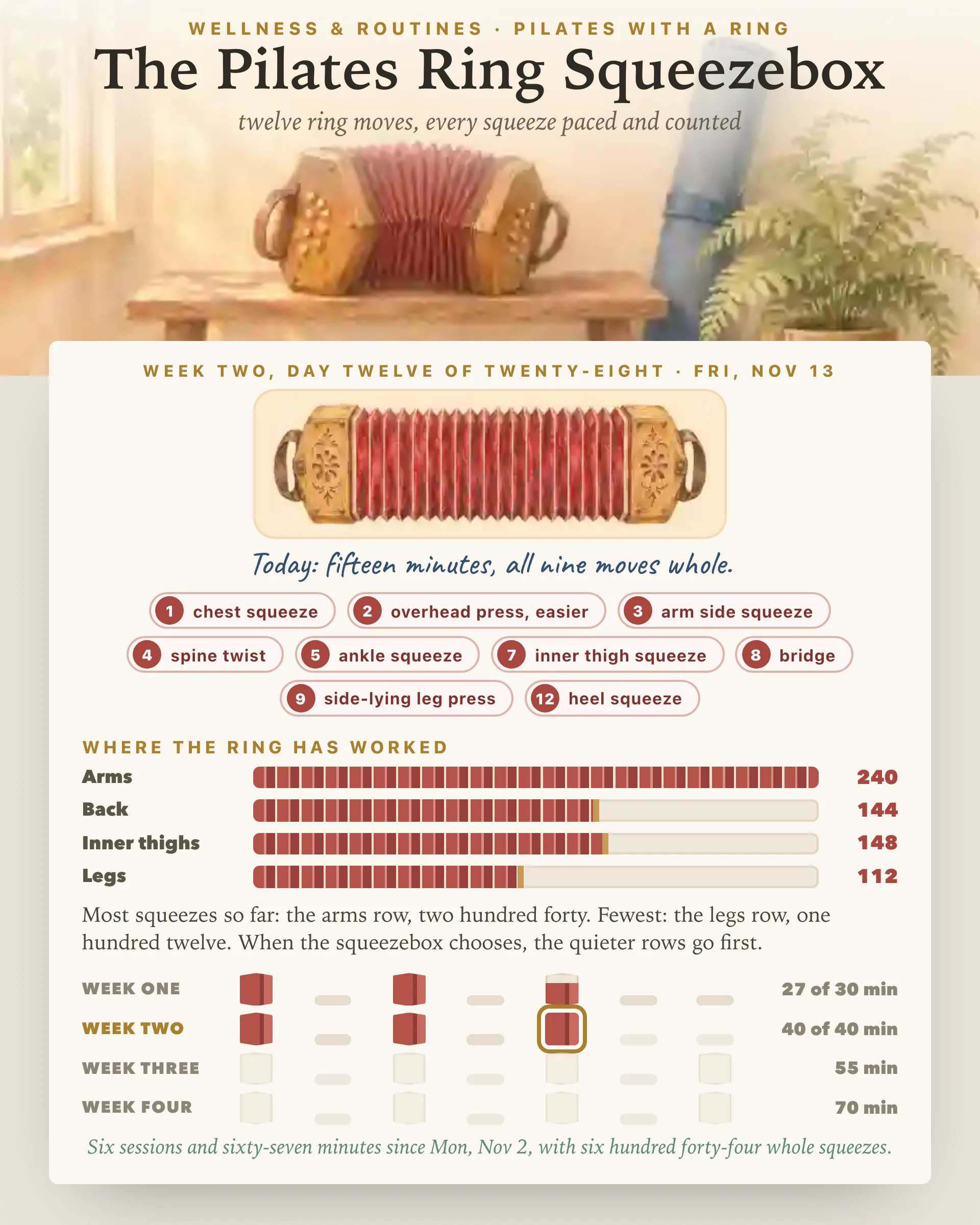
Every move lasts one minute and forty seconds: ten seconds to get set, eight squeezes of five seconds, ten seconds to rest or switch sides, and eight more squeezes. A squeeze is two seconds in, one to hold and two to let go. Six moves make a ten-minute session, nine make fifteen, and all twelve make twenty.
When you press begin, the painted concertina near the top closes as you squeeze, holds, and opens as you let go, so you can follow the rhythm without counting. A squeeze counts only once all five of its seconds have run. Stop early and the log keeps whole minutes and whole squeezes only; skip a move and its time never comes back. The clock reads real time from your start, minus pauses, so a phone that locks partway through still knows where you are.
Below the session, four rows for arms, back, inner thighs and legs stretch with every whole squeeze. When you let the squeezebox choose, it takes one move from each row in turn, quietest rows first, so a month does not drift into chair work only.
Week one is three ten-minute sessions. Week two brings in fifteen minutes. Week three adds a fourth day, and week four asks for twenty minutes twice, which is all twelve moves. Rest days belong to the plan; if you miss a day, pick up with the next one.
Very little research looks at the ring itself. In a lab study of twenty-eight men in their twenties, holding a Pilates ring during a modified version of the hundred raised the activity of the core muscles more than a small soft ball or no prop did. That was one session measuring muscle activity, not strength built over weeks, and it included no women and no older adults.
For Pilates in general, a 2024 review of twenty-four trials with 1,190 people over sixty found low-quality evidence that it did not clearly improve muscle strength compared with no exercise, and no difference from other exercise. Very low-quality evidence pointed to better muscle endurance. Pressing against springy resistance has a closer cousin in elastic bands: a review of eleven trials with 834 people aged sixty to seventy-nine found band training made people stronger, but those programs moved to stiffer bands over time, while a ring stays the same.
None of this shows that a ring tones, slims or reshapes any part of you.
The 2022 UK consensus on exercise for osteoporosis advises against postures with a high degree of spinal flexion and suggests alternatives to curling Pilates moves like the roll-down. It also says twisting should be safe when it is smooth and comfortable, and it recommends exercise that extends the spine. So the bone check on this page swaps the roll-back, the one curling move here, for a lean with a long back that keeps its slot and its time. The twist stays small, the bridge rises in one piece, and the belly-down press is a gentle extension.
Breathe out as you squeeze and never hold your breath. Both standing moves face a counter, with your hands on it the whole time. Talk with your doctor or a physical therapist before you start if you have had a fall, dizzy spells, a joint replacement, a heart or blood pressure condition, or pain that keeps returning, and stop any squeeze that hurts.
Despite its name, The Pilates Ring for older adults uses no ring at all. Its ring is a picture that fills in as the session runs, and its moves climb from the chair to standing. The Beginner's Pilates Mat brings in classic mat moves one week at a time without props. The Twelve-Blossom Pilates Branch is a longer mat practice that swaps in stand-ins for pelvic floor, back and bone concerns. Here the ring is in play for every move, and the clock counts each squeeze.
Keep the ring beside the chair you sit in most and open the squeezebox three or four days a week, at a time of day you can repeat.
Start with moves where the ring sits somewhere steady and you stay well supported: the chest squeeze in a chair, the inner thigh squeeze lying on your back with the ring between your knees, a low bridge with the same squeeze, and the heel squeeze with both hands on a counter. Press at half effort for the first week.
It gives you a light, springy resistance to press against, and it tells you when one side pushes harder than the other. In a small lab study of young men, holding a ring during a Pilates move drew more activity from the core muscles than no prop or a soft ball did, though that was one session, not weeks of training.
No exercise reshapes one part of the body, and nothing here promises to. Squeezing against light resistance can build muscle endurance over weeks, and a review of trials in people over sixty found Pilates helped endurance more clearly than strength, though the evidence was weak.
Most of them, with one change. A 2022 UK consensus on exercise for osteoporosis advises against deep forward curling of the spine and suggests other options for Pilates moves like the roll-down, so this page swaps the roll-back for a lean with a long back. It also says smooth, comfortable twisting should be safe.
No. The squeezebox is an independent worksheet put together from moves taught in Pilates classes, and no Pilates studio, school or certifying body wrote it or reviewed it.
By the team behind Fabulous, the science-based self-care app used by over 30 million people.


