Leaves on a StreamEmotional Fitness · ~3 min
About this template · Updated September 2026
This page is built on cognitive behavioral therapy for perfectionism, the approach Roz Shafran, Sarah Egan and Tracey Wade set out for readers in their self-help guide Overcoming Perfectionism. The Centre for Clinical Interventions (CCI) in Western Australia covers the same ground in a free nine-module workbook, Perfectionism in Perspective. The weighing of costs, the loosened standard and the small experiment all come from that tradition. The lab itself is independent: the authors, their publisher and the Centre had no part in making it, and none of them has endorsed it.
Wanting to do good work is not the problem. The trouble starts when a standard stops being something you aim for and becomes the thing your worth hangs on. Shafran and two colleagues described this clinical form of perfectionism as judging yourself largely by how hard you pursue demanding standards, and keeping at it even as the costs pile up. They also spotted a trap in the scoring. Miss the standard and you criticize yourself. Meet it and you decide it must have been too easy, so the bar goes up. Either way, the finish line never arrives.
The CCI workbook is careful about what it asks you to give up: not high standards as such, only the unrelenting ones that damage your life. So the lab weighs a standard instead of attacking it: some of what it gives you is real, and the question is what you pay for it.
You can tell yourself a dozen times that the email is fine and still reread it a sixth time. Arguments rarely move a standard, because underneath it sits a prediction: if this goes out less than perfect, something bad will happen. Someone will spot the typo, think less of you, send it back. A prediction is something you can check.
That is the logic of a behavioral experiment. You pick a real task, decide ahead of time what good enough looks like, write down what you fear will happen and how sure you are, then hand the task in at that line and record what actually happened. Deciding the line in advance matters, because perfectionism moves the goalposts while you work. Three marks of done and a stop time are harder to renegotiate at eleven at night.
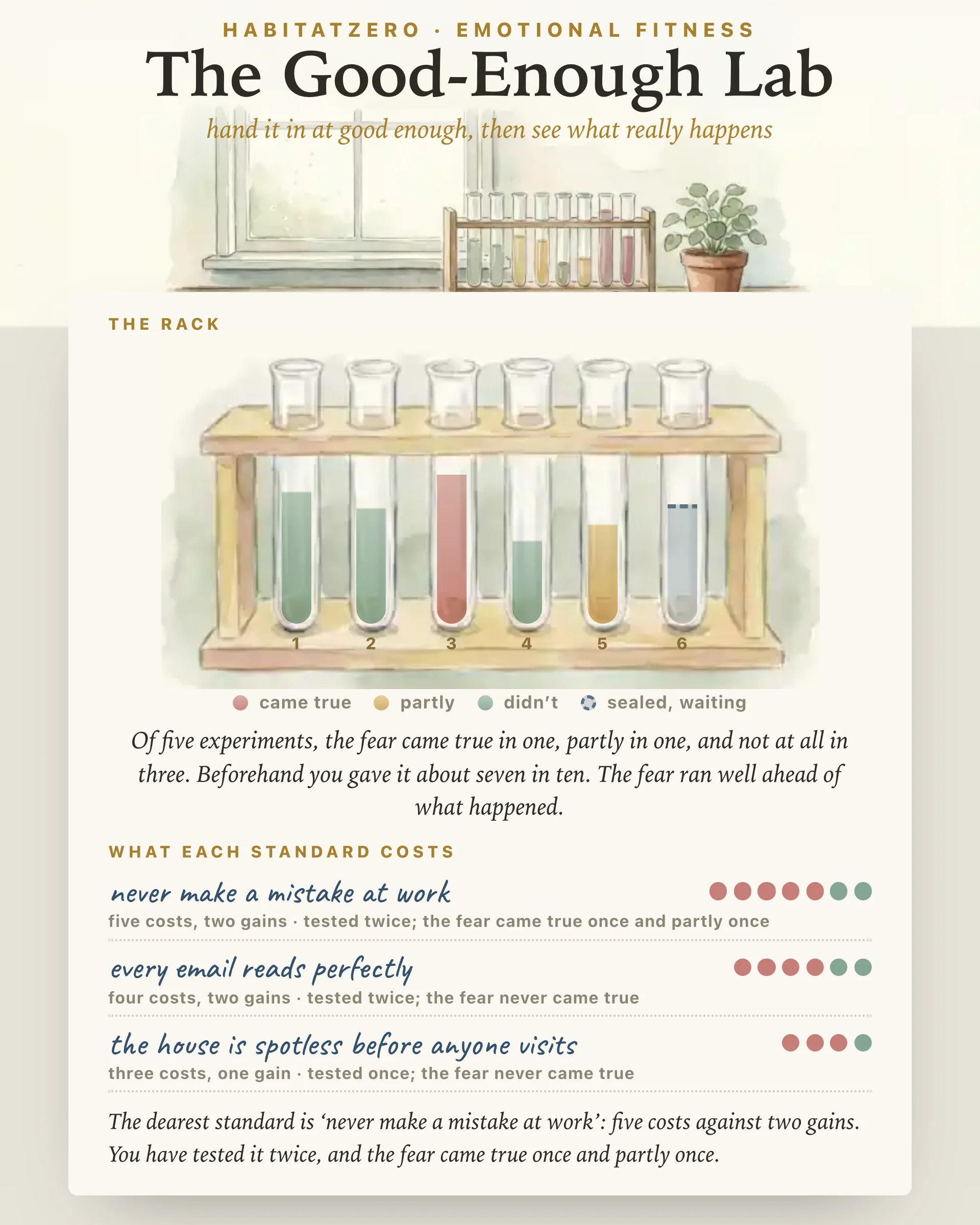
At the top you name up to four standards you hold, then tap what each one costs you, such as lost sleep or hours of rework, and what it gives you, such as fewer mistakes. The sheet ranks your standards by their costs, so the one taking the most from you is plain to see.
The experiment bench tests one standard at a time. You name the task, draw the good-enough line, choose when to stop, write the fear and rate it out of ten, then seal the prediction. Sealed words can't be edited, which keeps the result honest, and taking a prediction back also clears any result noted against it.
After the task has gone in, you mark whether the fear came true, partly came true or didn't, and add a line in your own words. The experiment then goes onto a painted rack of six test tubes. Each tube fills to how sure you were and takes the color of what happened, so a row of tall green tubes is a fear that kept overshooting. The reading under the rack sets how often the fear came true against how likely it felt.
CBT for perfectionism has been tested in randomized trials, with encouraging results. A 2022 meta-analysis by Galloway and colleagues pooled fifteen trials of self-help and face-to-face versions, with 912 participants whose average age was twenty-three. It found medium to large reductions on measures of perfectionism, medium drops in symptoms of depression and eating disorders, and a smaller effect on anxiety. The authors are frank about the limits: the trials were few, and comparisons with other active treatments were lacking.
This lab has not been tested in a trial; it takes one technique from a full program, and it is practice, not therapy. If perfectionism has been costing you sleep, meals or your mood for weeks, a therapist trained in CBT can take you through the whole approach, and your rack is worth bringing along. Perfectionism that has turned into thoughts of suicide or self-harm needs a person rather than a worksheet: in the US, call or text 988 at any hour, and elsewhere your local emergency number will connect you with help.
Open the lab when a task starts growing past what it needs: the reply you have drafted four times, the slides you keep nudging, the kitchen that has to be spotless before a friend drops by. Run one experiment per task and record the result the same day. Six experiments make a fair first round.
If the fear feels catastrophic before you even begin, The Worry Barometer is built to take that forecast apart. If the real trouble is starting at all because it has to be perfect, The Diving Board helps you off the edge. And when a result stings and the inner voice turns harsh, Inner Critic Translator gives you a kinder way to answer it.
Not by dropping every high standard. The CBT approach works on the costly ones: list what a standard takes from you and what it gives you, decide in advance what good enough means for one task, then test the fear behind the standard by handing that task in at the line. Over a few weeks the results give you evidence the standard never offered.
A small real-world test of a perfectionist prediction. Before you hand something in at good enough, you write down what you expect to happen and how sure you are. Afterward you record what did happen. The gap between the two is the finding, and it tends to persuade more than any argument you could have with yourself.
The trials so far are encouraging. A 2022 meta-analysis of fifteen randomized trials found medium to large reductions in perfectionism and medium reductions in depression and eating-disorder symptoms, with a smaller effect on anxiety. The trials were few, comparisons with other active treatments are still missing, and this page, which borrows one technique, has not been tested at all.
No. The Good-Enough Lab is an independent page. It draws on Perfectionism in Perspective, the free workbook from CCI in Western Australia, and on Overcoming Perfectionism by Shafran, Egan and Wade, but none of them made, reviewed or endorsed it. Their original materials are linked in the article below.
You can explore the filled-in example on this page without it. To keep your own standards and a rack that fills over the weeks, personalize the lab in HabitatZero, which costs nothing.
By the team behind Fabulous, the science-based self-care app used by over 30 million people.