
Leaves on a StreamEmotional Fitness · ~3 min
About this template · Updated September 2026
Credit where it belongs. Decatastrophizing is a working tool of the cognitive therapy Aaron Beck built, in which people learn to notice a distressing thought and check how realistic it is. The habit it answers was named earlier: Albert Ellis wrote about catastrophizing in 1962, and his own approach, rational emotive behavior therapy, goes after a close cousin he called awfulizing: judging that a bad outcome would be not merely bad but awful, as if nothing could be worse. A 2019 review maps where the two ideas overlap and where they part. This barometer is an independent practice page. Neither the Beck Institute nor the Albert Ellis Institute had a hand in it, and neither endorses it.
A fear that has run to the worst case usually makes two mistakes at once. It treats the worst outcome as the likely one, and it quietly assumes you would have nothing to meet it with. Both feel like common sense from the inside, so arguing with them in your head tends to go in circles.
The pattern is common, and it is not tied to one kind of problem. A review co-written by Beck traced catastrophic thinking through panic, health anxiety, obsessive-compulsive disorder, post-traumatic stress and chronic pain. What the fear is about changes from one problem to the next; the way it runs ahead to disaster stays the same.
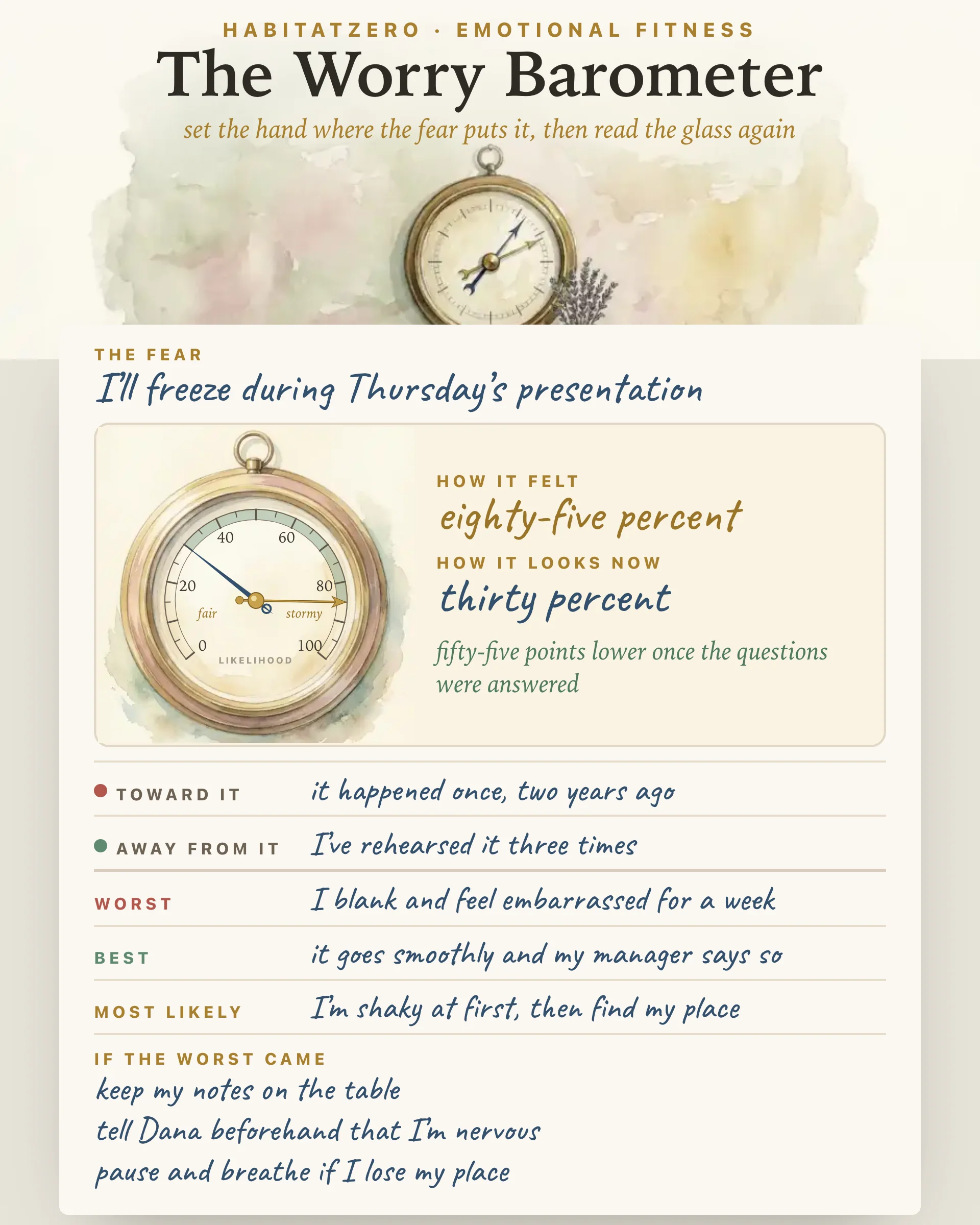
You slow the forecast down and put questions to it, one at a time. What exactly are you afraid will happen? How likely does it feel, as a number out of a hundred? What does the evidence say, on both sides? What is the worst that could happen, what is the best, and what is most likely? If the worst came anyway, what would you do first, and who would you call?
Then you rate the likelihood again. The second number is not a verdict and nobody grades it. It is what the fear looks like after it has been asked to show its work.
The page is built like the instrument in its name. Many old wall barometers have two hands: a needle that moves with the air, and a brass hand you turn yourself to mark where the needle stood, so you can see later how far the weather shifted. Here you write the fear in a few words and slide the brass hand to how likely it feels. Go with your gut; the sensible number comes later.
Next come the questions. Evidence goes on two short lists, toward the outcome and away from it, with tap-in suggestions and room for your own lines; each stops at five so the strongest points stay in view. The worst, the best and the most likely outcome get one line each, and the plan for the worst takes a few first steps.
Then you read the glass again. The re-rating moves only the needle, so the brass hand stays where the fear put it, and the space between them is shaded on the dial. The card says in words how far the needle fell. If it did not move, or climbed, the card says that plainly and sends you back to your plan, because some fears have a real basis, and there the useful work is preparing rather than arguing. List "it feels certain" as evidence and the card will point out that the feeling describes you, not what will happen.
The idea that anxious forecasts run high has been checked against reality. In a study of people with generalized anxiety disorder, twenty-nine participants logged their worries for ten days and followed what happened over the next month. More than nine in ten of the feared outcomes never came about, and the odds people had expected ran well above what actually occurred. Participants who watched more of their worries fail to come true improved more over treatment.
Keep the limits in view. That was a small clinical group inside a treatment study, and this worksheet has not been tested in any trial. Decatastrophizing is one technique inside cognitive behavioral therapy, so the barometer is a way to practice a habit of mind, not a treatment.
Reach for it when one outcome has crowded out every other: the night before a hard conversation, while you wait on news, when a small slip starts growing into a disaster in your head. Once the day has come and gone, the Anxiety Journal is the place to write down what actually happened, which becomes evidence for the next forecast. To learn to catch catastrophizing among its neighbors, practice with the Thinking-Trap Spotter, and if the fear turns out to be something you can act on, The Worry Tree will sort it into a next step.
This card is practice, not therapy. If worry runs through most of your days, or keeps you from sleep, work or the people you love, a therapist trained in CBT is the next step. And if the worst case in your head is about hurting yourself or not wanting to be alive, set the card aside and call or text 988 in the US, or your local emergency number, right away.
A cognitive therapy technique for a fear that has jumped straight to the worst case. You name the feared outcome, rate how likely it feels, test that number against the evidence and the full range of outcomes, plan how you would cope if the worst came, and then rate it again.
Take them in order and write each answer down. What exactly am I afraid of, and how likely does it feel? What points toward it, and what points away? What are the worst, best and most likely outcomes? What would I do first if the worst came? Now that I have answered, how likely does it look?
It is a core technique of cognitive behavioral therapy, and the idea behind it has held up when tested. In one study of people with generalized anxiety disorder, more than nine in ten of their feared outcomes never happened, and people with more untrue worries improved more. This worksheet itself has not been tested in a trial, so treat it as practice rather than treatment.
No. The Worry Barometer is an independent practice page that draws on published accounts of Aaron Beck's cognitive therapy and Albert Ellis's writing on catastrophizing. Neither the Beck Institute nor the Albert Ellis Institute reviewed or endorsed it.
There is no PDF, because the card does its work on screen: the hands move as you answer and the reading is worked out from your two ratings. The filled-in example on this page shows a finished card. To fill in your own and keep it, personalize the barometer in HabitatZero, which is free.
By the team behind Fabulous, the science-based self-care app used by over 30 million people.


