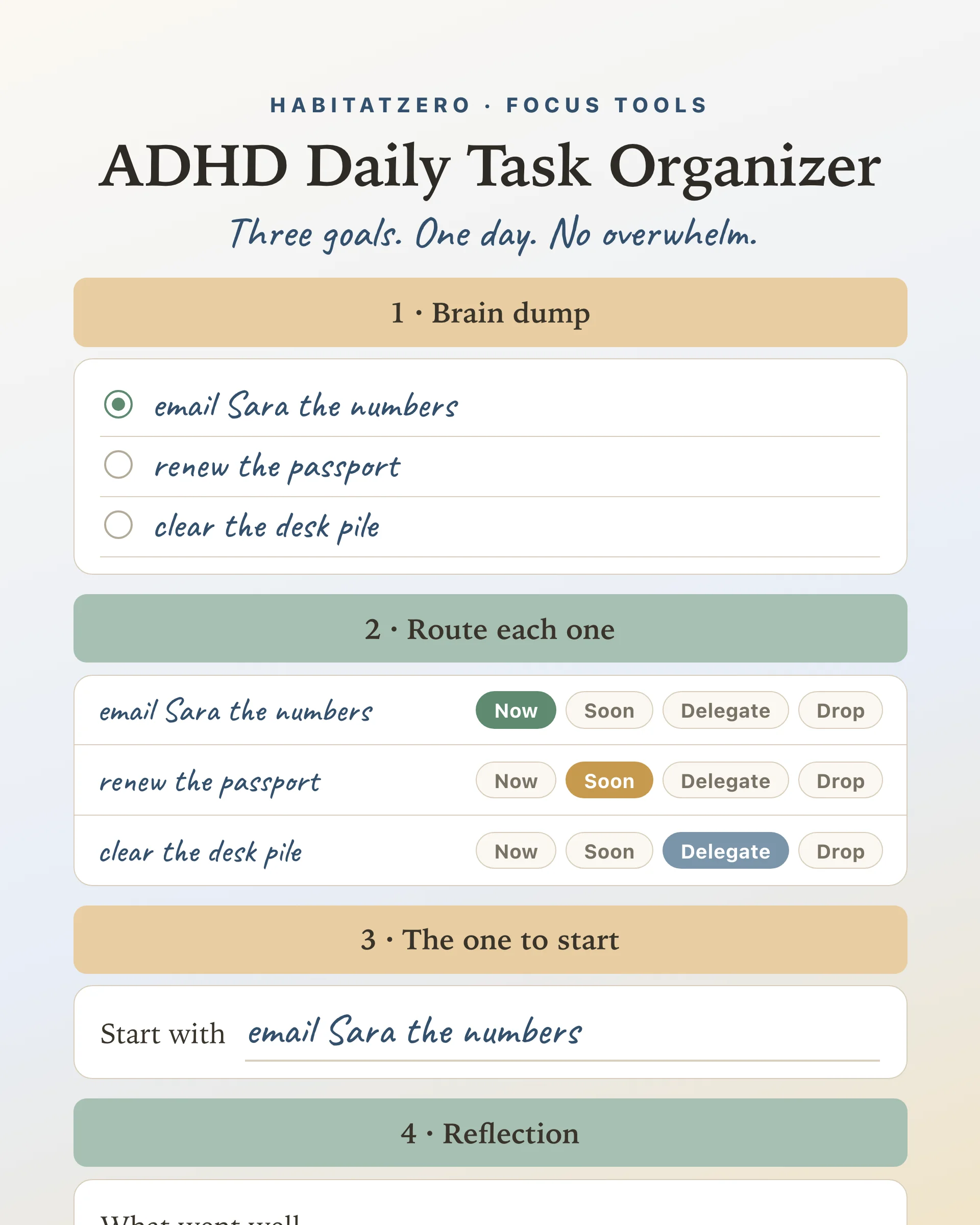
ADHD Daily Task OrganizerFocus & ADHD · ~10 min
About this template · Updated September 2026
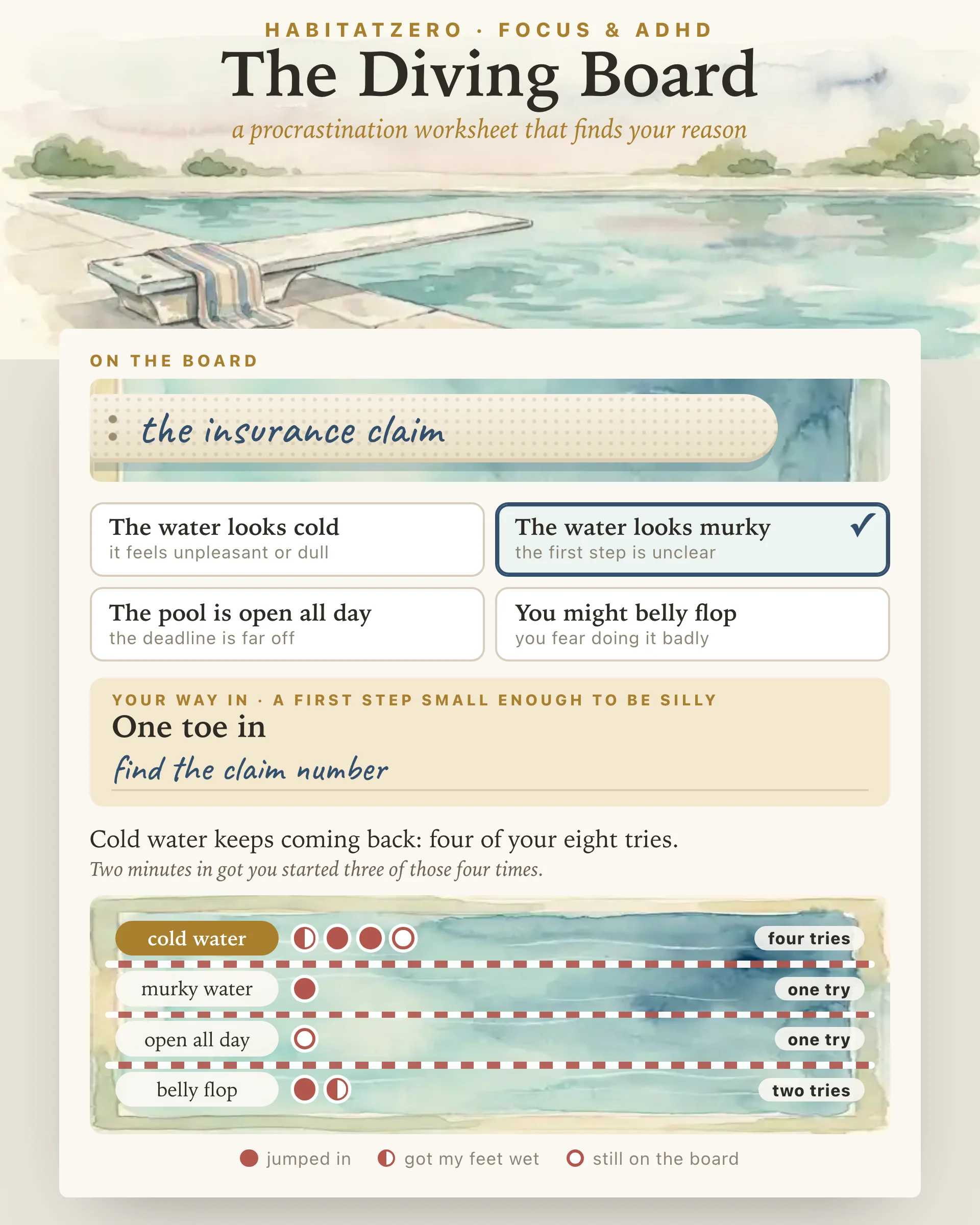
You know this moment from any public pool. You climb the ladder, walk to the end of the board, look down at the water, and walk back. The water just looks colder from up there. Procrastination works the same way: the task is rarely impossible, but something about it makes the next ten minutes feel worse than walking away. This procrastination worksheet asks you to name that something, then answer it with a move built for it.
Each reason is a view from the edge, and each comes with its own way into the water.
Write the task on the board, or tap a suggestion. Pick the reason that feels truest today, and its way in opens underneath with first moves to borrow, or room to write your own.
Then try it, and log what happened: you jumped in, you got your feet wet, or you are still on the board. The stuck days count. If you jumped in, the board clears for the next task. If not, the task stays up there and asks again what is holding you, because the answer can change between Monday and Thursday.
Every try drops a swim cap into the lane of its reason. From the third try on, the lanes read the pattern back to you: which reason keeps coming back, and how often its way in actually got you started. The logbook keeps twelve dated tries, few enough to take in at a glance.
In a meta-analysis built on 691 correlations, Piers Steel found that the strongest and most consistent predictors of procrastination included task aversiveness, task delay, low self-efficacy and impulsiveness. Three lanes sit right on top of those findings: cold water is aversiveness, the open pool is delay, and the belly flop is doubt that you can do it well. Murky water is not one of Steel's named predictors. It is on the sheet because an unclear first step is such an ordinary place for a task to stall.
Fuschia Sirois and Timothy Pychyl argue that procrastination is largely mood repair: stepping away from a task you dread makes you feel better now, and the cost lands on the person you will be next week. A two-minute start is built for that trade. It caps how much of the bad feeling you sign up for, so ducking out buys you very little.
The jump-on-three card borrows from research on implementation intentions, plans that name when and where you will act. In one study, 152 university students were due to report for an experiment, and the half who formed a when-and-where plan for attending had nearly eight times the odds of keeping the appointment (Owens, Bowman and Dill, 2008). That is one study about showing up once, not about finishing a long project, so treat it as a nudge.
Procrastination does respond to help. A meta-analysis of twenty-four intervention studies found large reductions that held at follow-up, with cognitive behavioral therapy doing the most, though its authors call for stronger evidence. No study has tested this page's four pairings as a set. They are sensible matches to try on yourself, and the lanes are where you find out which ones hold for you.
Use it for the task that has sat on your list for days while everything else suddenly looked urgent: the essay intro, the insurance claim, the dentist you still haven’t called. Students can run it on the assignment they keep opening and closing. Open the sheet at the edge, in the moment you catch yourself walking back, rather than at the end of a lost afternoon.
If the lanes keep filling with murky water, the task may need breaking down further than one toe allows, and The Shrinker walks it down in four passes. If cold water wins week after week, pair the dull job with something you enjoy in The Temptation Lockers. Once you are in the water on a long task, Sand Timer Sprints times the rest in short rounds, pomodoro style.
If putting things off is costing you a job, a grade or your health, or it arrives with low mood most days, bring it to a doctor or therapist. It can be part of something treatable, such as depression, anxiety or ADHD, and that is not something to push through alone.
Mostly because of how the task feels right now, rather than any flaw in your character. A large review of the research found that the strongest and most consistent predictors included a task that feels unpleasant, a deadline or payoff that sits far away, low confidence that you can do it well, and impulsiveness. This sheet works with the first three and adds a very ordinary fourth: not knowing what the first step is.
Name the task, pick the reason it stalls, and answer that reason with a move built for it. An unpleasant task gets a two-minute start. A murky one gets a first step small enough to feel silly. A distant deadline gets your own, sooner one with a day and an hour. Fear of doing it badly gets permission to make a rough first version.
It can. Francesco Cirillo's method of working in twenty-five-minute rounds with short breaks turns an open-ended chore into a small, finite promise, which is the two-minute start on this sheet stretched longer. A timer does less for a murky first step or a fear of doing it badly, so name the reason first and time the work once you are in the water.
No. Laziness is not wanting to act at all, while procrastination means you intend to do the task and put it off anyway, usually feeling worse for it. The psychologists Fuschia Sirois and Timothy Pychyl describe it as mood repair: ducking the task buys relief now and hands the bill to your future self.
No sign-up is needed to look through the sample on this page, with its board, its lanes and eight logged tries. Putting your own tasks on the board and keeping the logbook from week to week happens once you personalize it in HabitatZero, which is free.
By the team behind Fabulous, the science-based self-care app used by over 30 million people.