
The Overwhelm Recovery ProtocolWellness & Routines · ~5 min
About this template · Updated September 2026
Temptation bundling is the work of Katy Milkman, a behavioral scientist at the Wharton School and author of How to Change. She named the idea and put it to the test with Julia Minson and Kevin Volpp in a field experiment published in 2014. The lockers on this page are Fabulous's own way of practicing that idea. We built them independently, and Milkman, her coauthors and her university have not reviewed, endorsed or partnered on them.
The idea fits on a sticky note. Take something you want and tend to overdo, like a gripping audiobook, and something you should do and tend to skip, like the treadmill. Then make one rule: the want only happens during the should. The story you cannot put down stops being a guilty indulgence and turns into the reason you lace up.
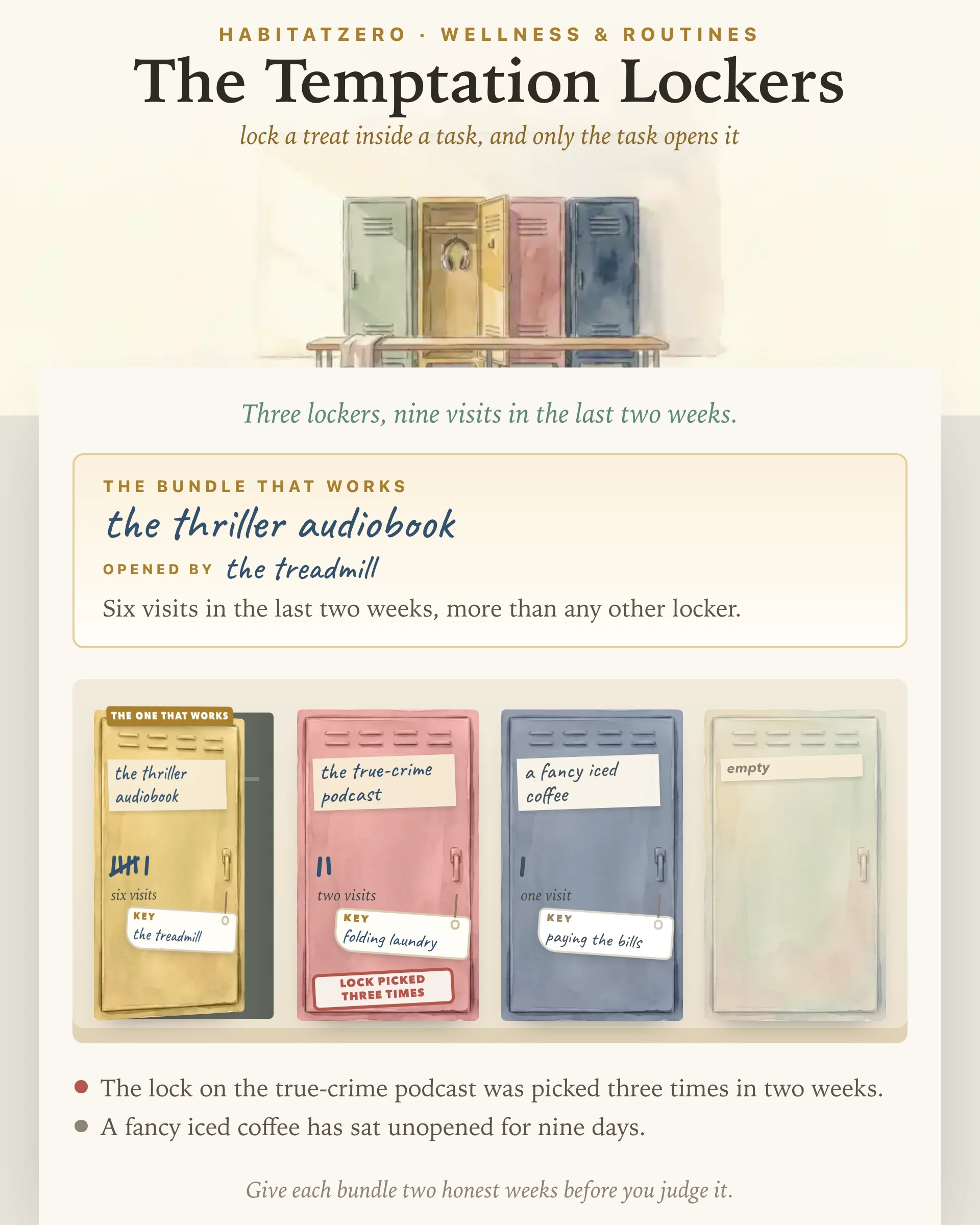
Each locker holds one want, written on the tape across its door. Its key, the tag hanging from the latch, is the should that opens it. You can fill four, and every want gets exactly one locker, since a treat you can enjoy in three places soon feels special in none of them.
On any day you do the task with its treat, tap the door. It swings open and a tally mark goes up. If you had the treat without the task, tap picked the lock instead. Logging the slip is how the row spots a lock that leaks.
After a couple of weeks, the card above the lockers names the bundle with the most visits, the one that keeps you showing up. It also flags a lock picked as often as it is opened, visits dropping week over week, and a locker untouched for a week, each with a suggestion for what to change.
Milkman's team recruited 226 students, faculty and staff at a large university in the Northeast and tracked their gym visits for about nine weeks. One group received an iPod holding four audio novels of their choosing that they could only use at the gym. A second group got their novels on their own iPods, on the honor system, with encouragement to save them for workouts. A third group got a $25 bookstore gift card.
At the start, the gym-only group visited 51 percent more often than the comparison group, and the honor-system group 29 percent more often. That first figure gets quoted most, but the rest matters as much. The boost faded week by week and fell away most sharply after the Thanksgiving break, when the gym closed. The honor-system bump was too small to rule out chance. Most participants were undergraduates, and the study's main measure was gym visits, not fitness. When it ended, though, 61 percent chose to pay for gym-only access to tempting audiobooks, a sign that people value the lock itself.
A much larger follow-up led by Erika Kirgios, with Milkman among the authors, tested the idea with 6,792 people in a four-week exercise program. Giving people an audiobook and suggesting they bundle raised their chances of working out in a given week by 10 to 14 percent, and the gain lasted up to seventeen weeks after the program ended. The suggestion added little beyond the free audiobook, perhaps because an audiobook handed out by an exercise program already hints at its use.
Temptation bundling is a modest, real nudge, not a cure for procrastination, so let your own tally marks, rather than the headline number, tell you whether a bundle works.
James Clear wrote about temptation bundling in Atomic Habits and combined it with habit stacking, placing the habit you want right after the habit you need. That order works like a reward that comes afterward, a close cousin of Milkman's rule. Her version puts the treat inside the task, so the task itself becomes the thing you look forward to. To map a habit's cue and reward first, try the Habit Loop Worksheet; if a treat after the hard part suits you better, Deal With Your Brain handles that bargain.
Reach for the lockers when a task you value keeps losing to a pleasure you have no wish to give up. If you are short on wants, the sides course of The Dopamine Menu is a ready list of small pleasures that ride along with a dull job. Then give each bundle two honest weeks before you decide whether it works.
It means pairing something you enjoy but tend to overdo with something worthwhile that you tend to avoid, and letting yourself have the enjoyable part only while doing the dull part. Behavioral scientist Katy Milkman named the idea and tested it with two colleagues in a study published in 2014.
Saving a gripping audiobook for the treadmill, a favorite podcast for folding laundry, a guilty-pleasure show for ironing, or a fancy coffee for the afternoon you sort the bills. Pick a treat you would genuinely miss, and a pairing that lets you do both at once.
The idea comes from Milkman's research. James Clear later wrote about it in Atomic Habits and combined it with habit stacking, placing the habit you want right after the habit you need. Milkman's original rule is stricter: the treat happens during the task, never before or after it.
In the first field study, people who could only reach their audiobooks at the gym went about half again as often as a comparison group at the start, but that gap shrank over the following weeks. A later study of nearly seven thousand people in an exercise program found a smaller boost, about a tenth more workouts, lasting up to seventeen weeks after it ended.
Yes, as long as the treat leaves your mind free. Podcasts and audiobooks compete with reading for attention, so save a different reward for study sessions, such as a favorite cafe, a special drink or a cozy corner, and keep it off limits the rest of the week.
By the team behind Fabulous, the science-based self-care app used by over 30 million people.


