ADHD Daily Task OrganizerFocus & ADHD · ~10 min
About this template · Updated September 2026
Credit comes first. The Pomodoro® Technique was created by Francesco Cirillo in the late 1980s, as a struggling university student with a tomato-shaped kitchen timer, and Pomodoro® is his registered trademark. His own site carries the whole method, including the planning half that timer apps drop. This page borrows only the shape of a short timed sprint and rebuilds it for ADHD. It was made with no involvement from Cirillo or his company, and neither has reviewed, approved or endorsed it.
Twenty-five minutes is a promise about attention: sit down, and for that long the task will hold you. If it usually does not, that is not a character flaw. The technique assumes a sense of elapsed time that many people with ADHD do not have on tap. A meta-analysis of twenty-seven studies found that children and adolescents with ADHD judged time less accurately and less precisely, and tended to overestimate how long a stretch had lasted. In adults the evidence is thinner; a review of the last decade found some studies showing a clear deficit in estimating time and others showing none. Either way, a glass you can see beats a number you are supposed to feel.
The other assumption is that starting is the easy part. For many ADHD brains it is the whole fight. A small study of fifty-four students found that it was the inattention side of ADHD, not the restless side, that tracked with general procrastination. A vague intention gives that inattention nothing to grab, so this page will not let the sand run until you have written one line saying exactly what the next few minutes are for.
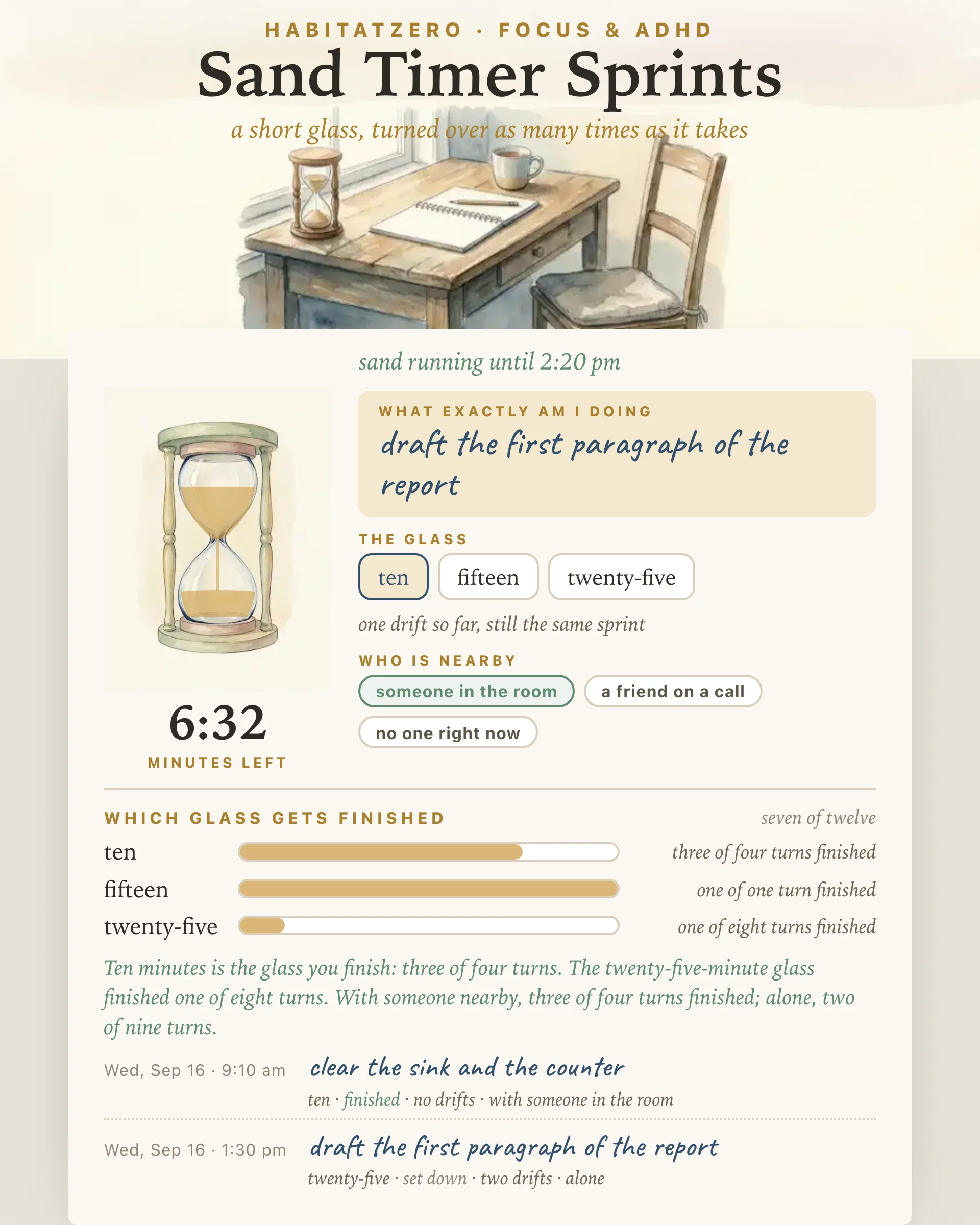
Write the line first: one verb, one object. Not "work on the report" but "draft the first paragraph of the report". If it is hard to write, borrow one of the six on the sheet. The button stays locked until the line is filled.
Then choose the glass. Ten, fifteen or twenty-five minutes, and shorter is not lesser: a ten-minute glass you finish teaches you more about your attention than a twenty-five you abandon at minute eight. Under the lengths is a row for who is nearby, because many people with ADHD find that a person in the room, a friend on an open call or a study-along video makes starting easier. This body doubling has not been through controlled trials; the best evidence is a survey of two hundred and twenty mostly neurodivergent people, who described it as using the presence of others to start, stay on, or finish a task. The cue under the row says what to do: say the line out loud to whoever is there, then turn the glass.
While the sand runs, the page shows one green button: I drifted, turn it over. Tap it the moment you notice. The glass refills, the same sprint carries on, and the drift is counted rather than punished. Cirillo's rule that an interrupted sprint is void makes sense for a planner; for a brain that drifts several times an hour it turns every session into a failure. Here a drift is a data point. When the sand is through, log the sprint and take five, or go again on the same line. If you had wandered off before the end and only noticed now, say so; that counts as a drift, and the glass turns again.
Every sprint lands on the log with its length, how it ended, how many times the glass was turned and who was nearby. Above the list, three bars answer the only question that matters: which glass actually gets finished. Each turn counts as an attempt, so a twenty-five-minute sprint you restarted three times and finished shows as one finished out of four turns. After a handful of sprints the sheet writes the pattern out in a sentence, company included.
Expect the short glass to win at first. That is not a verdict; it is the length you can currently keep, and you move up when the ten-minute bar fills.
Fixed short sprints with fixed breaks have some support outside ADHD. In a study of eighty-seven university students, those who took pre-set breaks reported more concentration and motivation and less fatigue than students who chose their own break times, and finished the same amount of work in less time. That study did not involve people with ADHD, and nothing on this page treats or diagnoses anything. It is a timer with a memory.
One honest limit: the sand keeps true time, but this page cannot ring, buzz or light up a locked phone. If you want a sound at the end, set a phone timer for the same minute; when you come back, the glass will show where the sand is.
Use it on the task that has sat untouched for days. If the day needs planning in sprints first, the Pomodoro Planning Worksheet does the estimating and capacity check. If even the one line feels too big to write, shrink the job with The Shrinker. And if the drifts come mostly from the room rather than from you, the Distraction Log will show which hour and which pull.
Often, but rarely in its textbook form. Pre-set short sprints with fixed breaks have some support in students without ADHD, where they improved concentration and mood compared with self-chosen breaks. The parts that fail people with ADHD are the twenty-five minute length, the rule that an interrupted sprint is void, and the assumption that starting is easy. This timer changes all three: shorter glasses, drifts that restart without penalty, and a written line before the sand will run.
As long as you can currently finish, which for many people is ten or fifteen minutes rather than twenty-five. The sheet offers all three and keeps a tally of how many turns of each glass ended with the task still in hand, so the right length for you comes out of your own log rather than a rule. Move up a size when the short bars fill.
Tap the I drifted button and the glass turns over: the sand refills, the same sprint carries on and the drift is added to the count. Nothing is voided. At the end of the session the log shows how many turns each sprint took, which is more useful than a row of abandoned timers.
Because many people with ADHD find it easier to start and stay with a task when someone else is present, in the room, on an open call or in a study-along video. This is called body doubling. It has not been tested in controlled trials, so the sheet records it alongside each sprint and lets your own log say whether company changes how often you finish.
No. The Pomodoro Technique was created by Francesco Cirillo and Pomodoro is his registered trademark; his own site teaches the full method. This sand timer is an independent practice sheet tuned for ADHD, with no connection to Cirillo or his company, and it has not been reviewed or endorsed by them.
The page above shows a filled-in sprint you can look at but not run. Turning the glass, counting drifts and keeping the log of which length you finish happens once you personalize it in HabitatZero, which costs nothing.
By the team behind Fabulous, the science-based self-care app used by over 30 million people.