The Overwhelm Recovery ProtocolWellness & Routines · ~5 min
About this template · Updated July 2026
Task paralysis has a shape everyone recognizes and almost no one names: the report matters, the afternoon is free, the document is open — and you are suddenly reorganizing a drawer. Not because you are lazy. Because every time you reach for the task, you pick up all of it at once, and all of it is too heavy to lift in one motion.
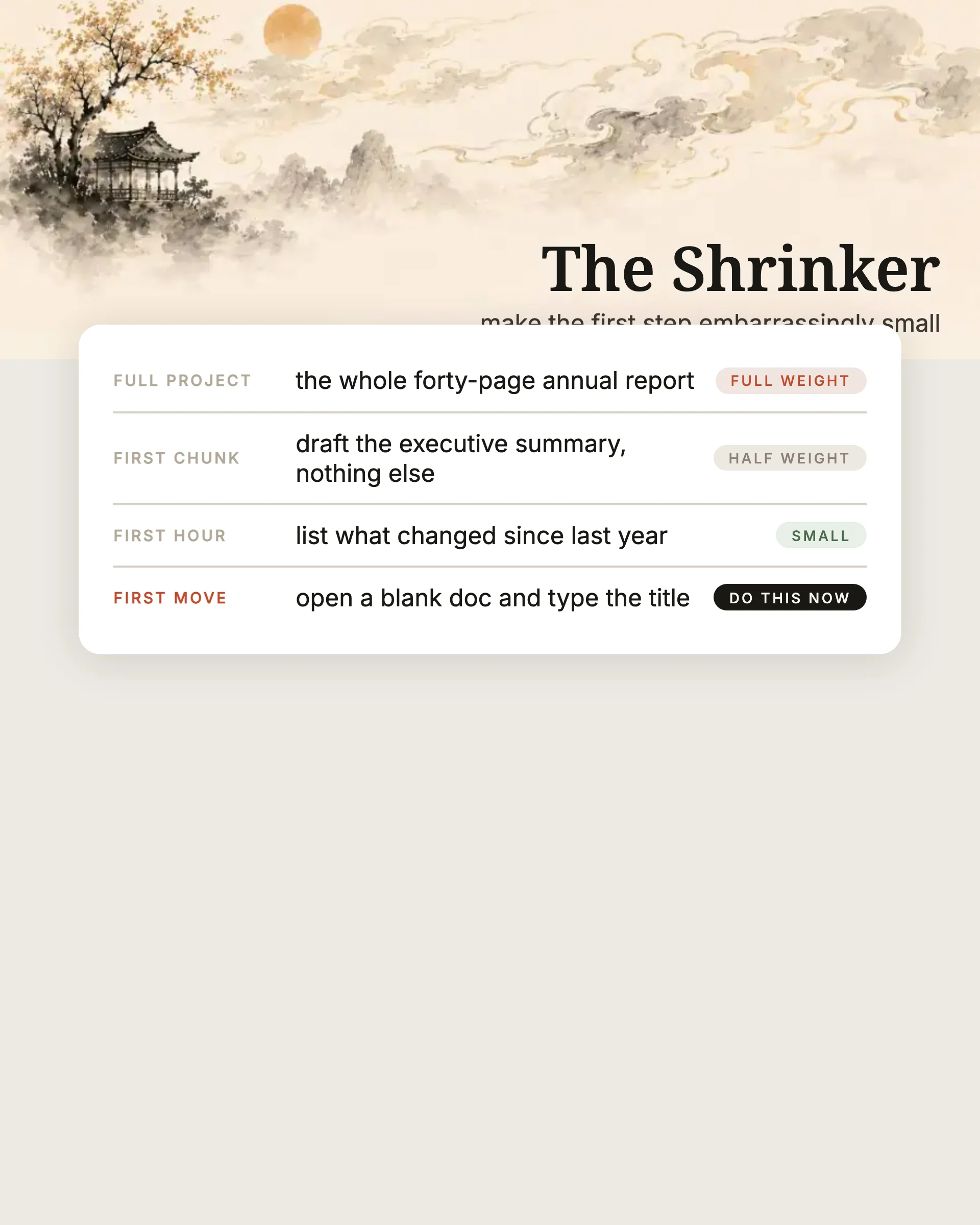
The Shrinker is a five-minute exercise built on a single move: put the impossible thing down on paper at full size, then walk it down four passes until the first step is smaller than the resistance.
The paralysis is rational, in its way. Psychologist Piers Steel's sweeping meta-analysis of procrastination research found that task aversiveness is among its most reliable drivers — we delay what feels unpleasant to engage, and nothing is more unpleasant to engage than everything at once. An ambiguous, high-stakes project presents itself to the mind as one undifferentiated mass: write the annual report arrives priced at forty hours, and the mind — reasonably — declines to spend forty hours right now. Since right now is the only place starting can happen, nothing starts.
Notice what the trap is made of: not the work, the sizing. You were never actually facing forty hours this afternoon. You were facing one small act — but the label on it said the whole project's name, so it weighed the whole project's weight.
The sheet has you write the task five times, and the repetition is the mechanism. First, name what feels impossible, exactly as it looms. Then four passes:
Full weight — the whole scary thing as you see it now. Yes, write it again. Seeing it at full size, outside your head, already changes it: a written monster has edges.
First chunk — the first meaningful piece. Not a plan for all the pieces; just the leading one. Draft the executive summary, nothing else.
First hour — what you could do in the next sixty minutes. The horizon collapses from someday to today. Pull last year's report and list what changed.
First move — and this is where the exercise earns its name — something so small it feels almost silly to write down. Open the doc. Type the title. Send one message. The tag under this line is black and says do this now, because the line is an instruction, not a note.
Each pass should feel noticeably lighter than the one above. If the bottom line still feels heavy, it isn't the bottom yet — shrink again.
People resist making the first move genuinely small because it feels like cheating — surely type the title cannot count as working on the report. But the research on getting from intention to action points the other way: Peter Gollwitzer's work showed that a specific, concrete, pre-decided act gets performed at far higher rates than a general intention, precisely because it removes the deciding from the moment. Work on the report requires a negotiation every time you approach it. Open the doc and type the title requires four seconds and no negotiation at all.
And momentum is not a metaphor. Once the doc is open and the title exists, you are no longer a person trying to start the report; you are a person already in it, deciding what the second sentence should be. The forty hours never had to be lifted. Only the four seconds did.
One honest caveat: this is a thinking tool for a stuck afternoon, not a treatment. If starting things is a wall you hit constantly and broadly — at work, at home, with things you actively want to do — that pattern is worth a conversation with a clinician, particularly since task initiation is a well-known executive-function sticking point.
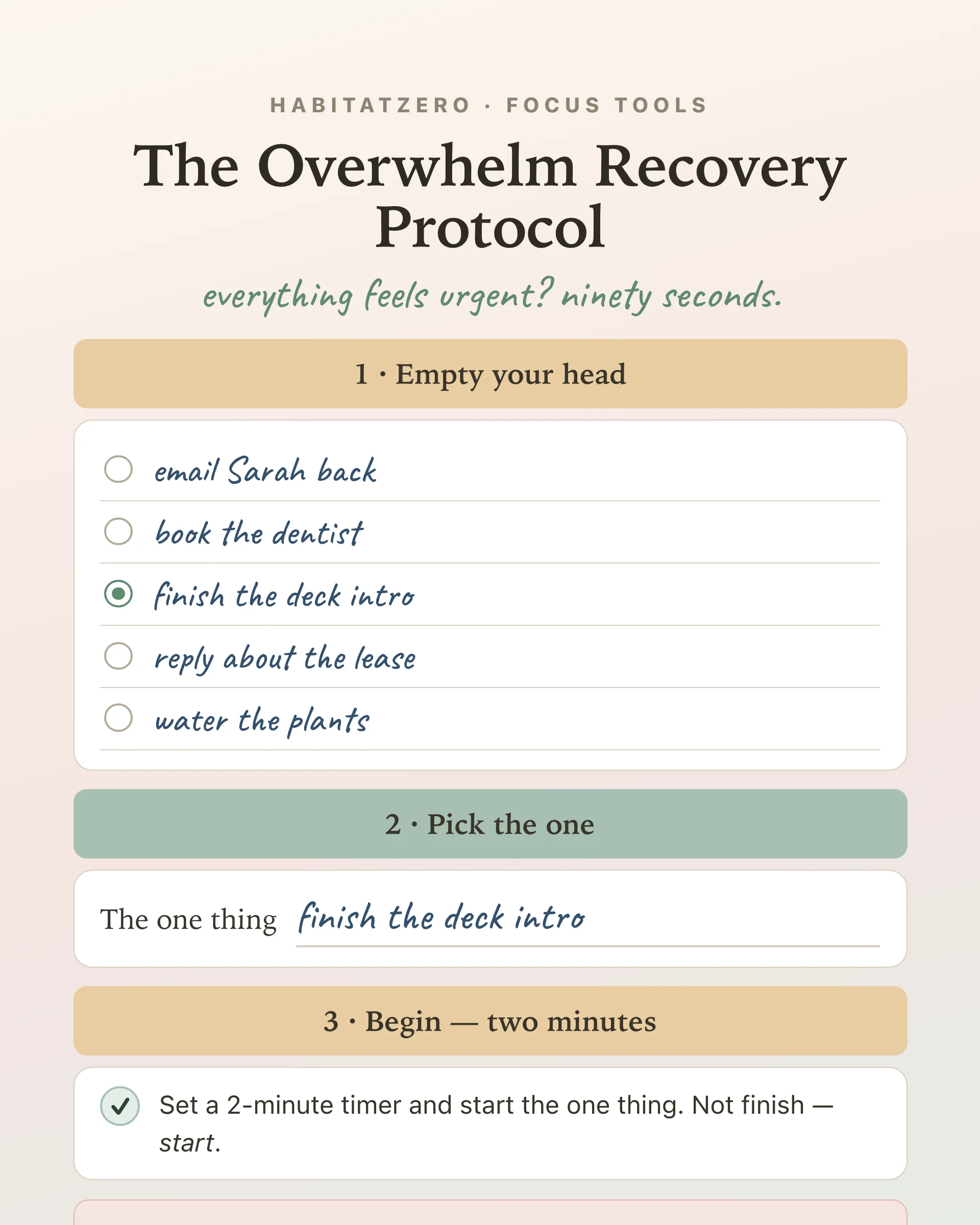
The Shrinker works on one project at a time, which is its strength and its limit. If the problem is twelve tasks swarming at once, run a brain dump first to get the swarm onto paper, then pick one item and shrink it. If the swarm needs ranking before anything else, the priority matrix sorts it, and on the days when the paralysis is really overwhelm wearing a work costume, the overwhelm recovery protocol comes before any productivity tool does.
Name the impossible thing. Walk it down four sizes. Then do the bottom line — it was never really the report you couldn't start, just a first move that hadn't been built yet.
The stuck state where a task matters, you have the time, and you still cannot start — often precisely because the task matters. The mind takes in the whole project at once, prices the whole thing as the cost of starting, and refuses. It is extremely common, especially with ambiguous, high-stakes, or long-horizon work, and it is a sizing problem more often than a discipline problem.
Because paralysis is usually aversion to the size of the load, not the work itself. Research on procrastination consistently finds task aversiveness and ambiguity among its strongest drivers — and a four-word first move is neither ambiguous nor heavy. Once a concrete, trivially small action exists, starting stops being a decision about the whole project and becomes a decision about one minute.
Embarrassingly small — smaller than feels reasonable. Open the doc. Type the title. Put the shoes by the door. If writing it makes you think this is almost cheating, it is the right size. Momentum is cheap once anything at all is in motion; the expensive part was only ever the first move.
It is a task initiation exercise for anyone, and the shrinking mechanic is one many people with ADHD find genuinely useful, since task initiation is a common executive-function sticking point. It is a thinking tool, not a treatment — if initiation struggles are disrupting your life broadly, that is worth raising with a clinician.
Yes. Fill it in on the page and your passes save as you go, or print it blank and run the four passes in pen whenever a project freezes on you.
By the team behind Fabulous, the science-based self-care app used by over 30 million people.