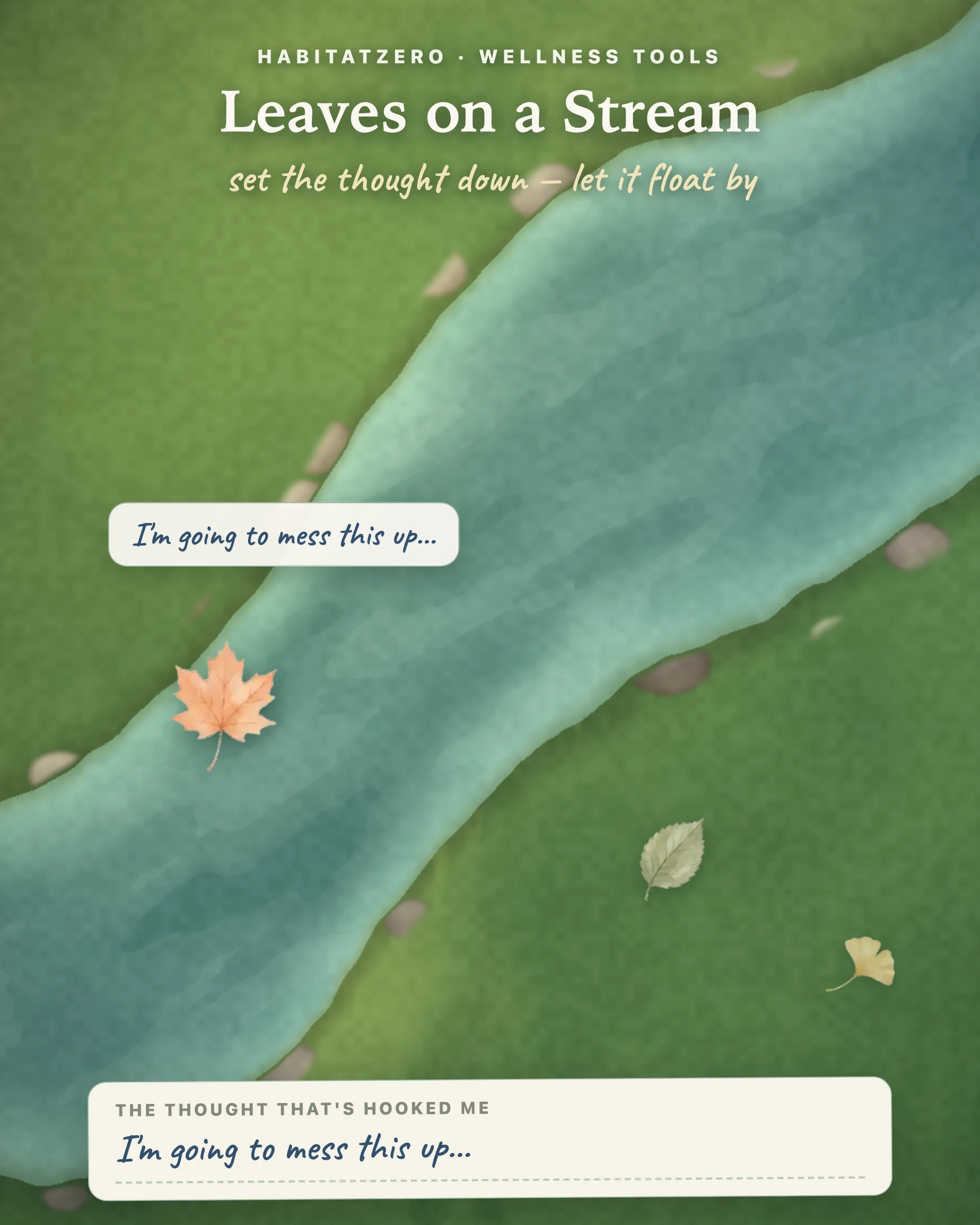
Leaves on a StreamEmotional Fitness · ~3 min
About this template · Updated September 2026
Opposite action is one of the emotion regulation skills that psychologist Marsha M. Linehan built into dialectical behavior therapy, or DBT, and her skills training handouts walk through it one step at a time. The Flip Side is a practice sheet HabitatZero made on its own. It has no connection to Linehan, to Behavioral Tech or to any other DBT organization, and none of them has reviewed or endorsed it.
Fear says get out. Anger says hit back. Sadness says stay in bed, and shame says hide. Psychologists call this pull action readiness, and in Nico Frijda's studies people agreed closely on which kind of readiness belongs to which emotion.
The urge is often useful. Trouble starts when a feeling fires at the wrong size or the wrong target, and obeying it keeps the feeling going: skip the party because you are nervous, and the next invitation feels riskier. Opposite action breaks that loop. You notice what the feeling is telling you to do, and you do the other thing, fully, until the feeling changes. The handout's examples are short: approach what you fear, gently step away from the person you are angry with and be a little kind, get active when you are sad, and tell what shames you to people who will accept it.
Opposite action is not a rule to fight every feeling. Linehan's handouts ask two questions first. Does the emotion fit the facts, including how intense it is and how long it has lasted? And would acting on it be effective here?
If the feeling fits and acting on it would help, you do not flip anything. Fear of a car running a red light should send you back onto the curb, and anger at being cheated can fuel a clear complaint. The job then is problem solving: change the situation that set the feeling off. When another person is part of it, The DEAR MAN Script helps you ask for what you need. Opposite action is for the other cases: the feeling does not fit, it is far bigger than the facts, or it fits but following the urge would make things worse.
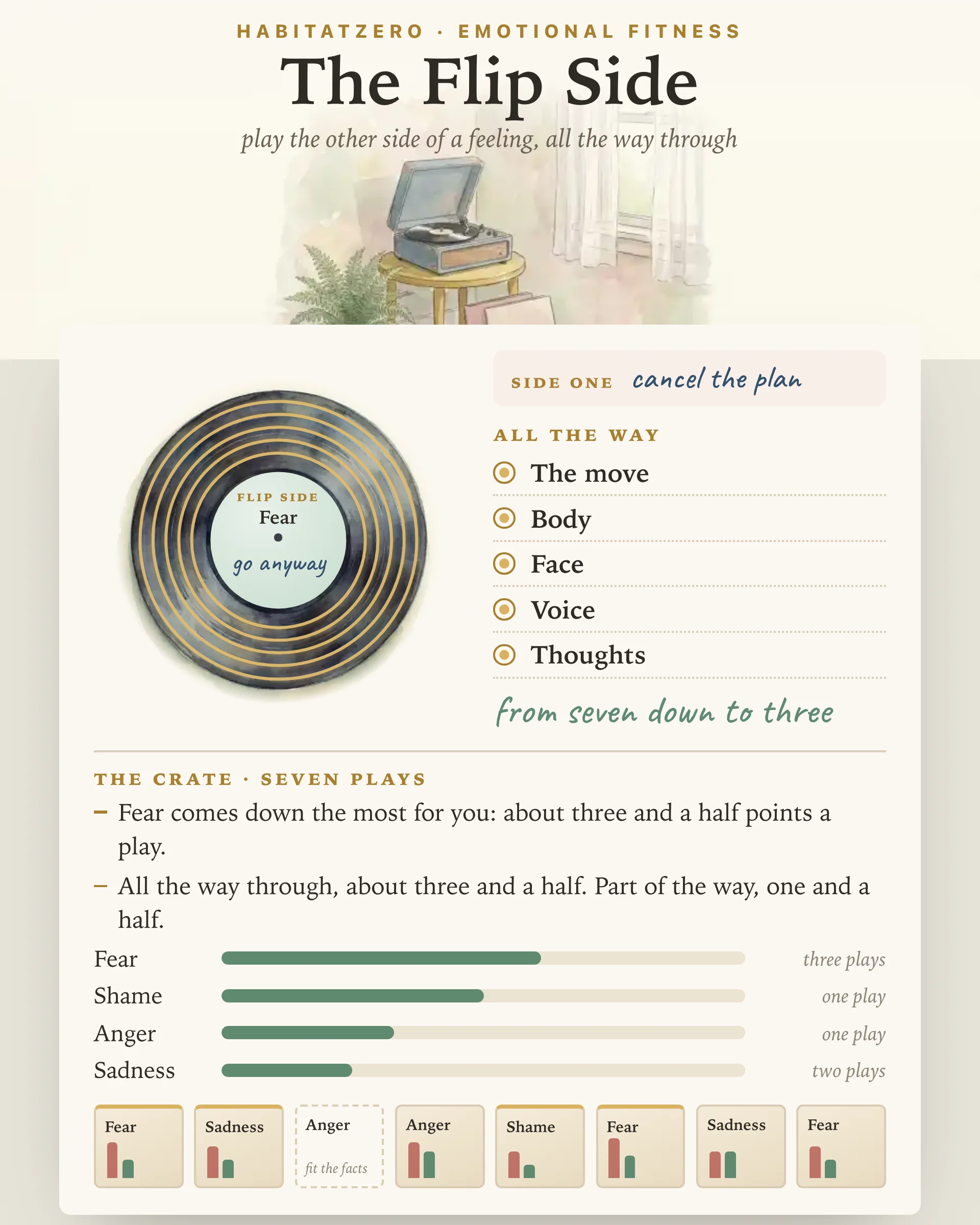
Side one holds what is playing now: the feeling, how loud it is from zero to ten, and the urge, tapped from suggestions or written in a few words. Then comes the facts check, with a plain line on when that feeling usually fits; if it does and acting would help, the record stays put and the page sends you to problem solving.
Otherwise, flip it. Choose the opposite move, then play it through five tracks: the move itself, your body, your face, your voice and your thoughts, each with a prompt matched to the feeling. Every track you play inks a groove. Set the volume again and keep the play in the crate, which reads your plays back: how far the feeling usually drops, which feeling responds best, and whether plays taken all the way through dropped further than halfway ones.
The phrase that matters most in Linehan's version is "all the way." Walking into the party with your head down, eyes on your phone, rehearsing why you should leave, is still avoidance in a party outfit. Opposite action asks your posture, face, voice and thoughts to go along with the move, which is why the flip side has five tracks instead of one.
A large review of facial feedback research found that changing your expression does shift how you feel, but the effect is small and varies a lot from study to study. A half-smile is one part of a move that works as a whole, not a rescue on its own.
Direct tests of opposite action on its own are few. The closest is a pilot study of the DBT Coach, a phone app that coached opposite action for twenty-two people in DBT programs for borderline personality disorder and substance use. Over ten to fourteen days they opened it about fifteen times each, and emotion intensity dropped within each coaching session. Everyone got the app and everyone was in treatment, so it shows the skill is usable in daily life more than it proves the effect. Your crate is the same kind of record: evidence about your practice, not a verdict about you.
Reach for the flip side when an urge points you away from something you care about or toward something you will regret: canceling again, snapping, hiding. Linehan's last step is to repeat the opposite action until the emotion changes, so a play kept while the feeling is still loud offers to go again. When the wave is too high to act on anything yet, ride it out first with Urge Surfing, and when you cannot tell whether a feeling fits the facts, the pause in Wise Mind is a good place to ask.
This is a skills practice, not treatment, and DBT is best learned with a trained therapist or in a skills group. If shame or sadness ever turns into thoughts of hurting yourself, stop here and reach a person now: call or text 988 (US), or the local emergency number where you are.
It is an emotion regulation skill from dialectical behavior therapy. Every emotion carries an urge to act, and when obeying that urge would feed a feeling that is unjustified or oversized, you deliberately do the opposite, fully, until the feeling eases. Fear turns into approach, anger into gentle distance and a little kindness, sadness into getting active.
When the feeling fits the facts and acting on it would help. Fear of a real danger should move you out of the way, and anger at a real injustice can power a fair complaint. For those moments the DBT handouts send you to problem solving instead: change the situation that set the feeling off.
Nervous about a party, go and stay until the end. Furious at a text, wait an hour and reply gently. Low and wanting bed all day, get dressed and walk outside. Ashamed of something that would not really get you rejected, tell a friend who will accept it. Jealous, leave the phone alone and say you trust them.
It means the whole of you joins the move, not only the action itself. Your posture, face, voice and thoughts go the opposite way too. Walking in with your eyes down while rehearsing reasons to leave is still avoidance, which is why this worksheet splits the move into five tracks.
The copy on this page is a locked example you can read through. Opening your own in HabitatZero costs nothing, and it keeps your record, your plays and the crate that reads them back.
By the team behind Fabulous, the science-based self-care app used by over 30 million people.