
The Overwhelm Recovery ProtocolWellness & Routines · ~5 min
About this template · Updated November 2026
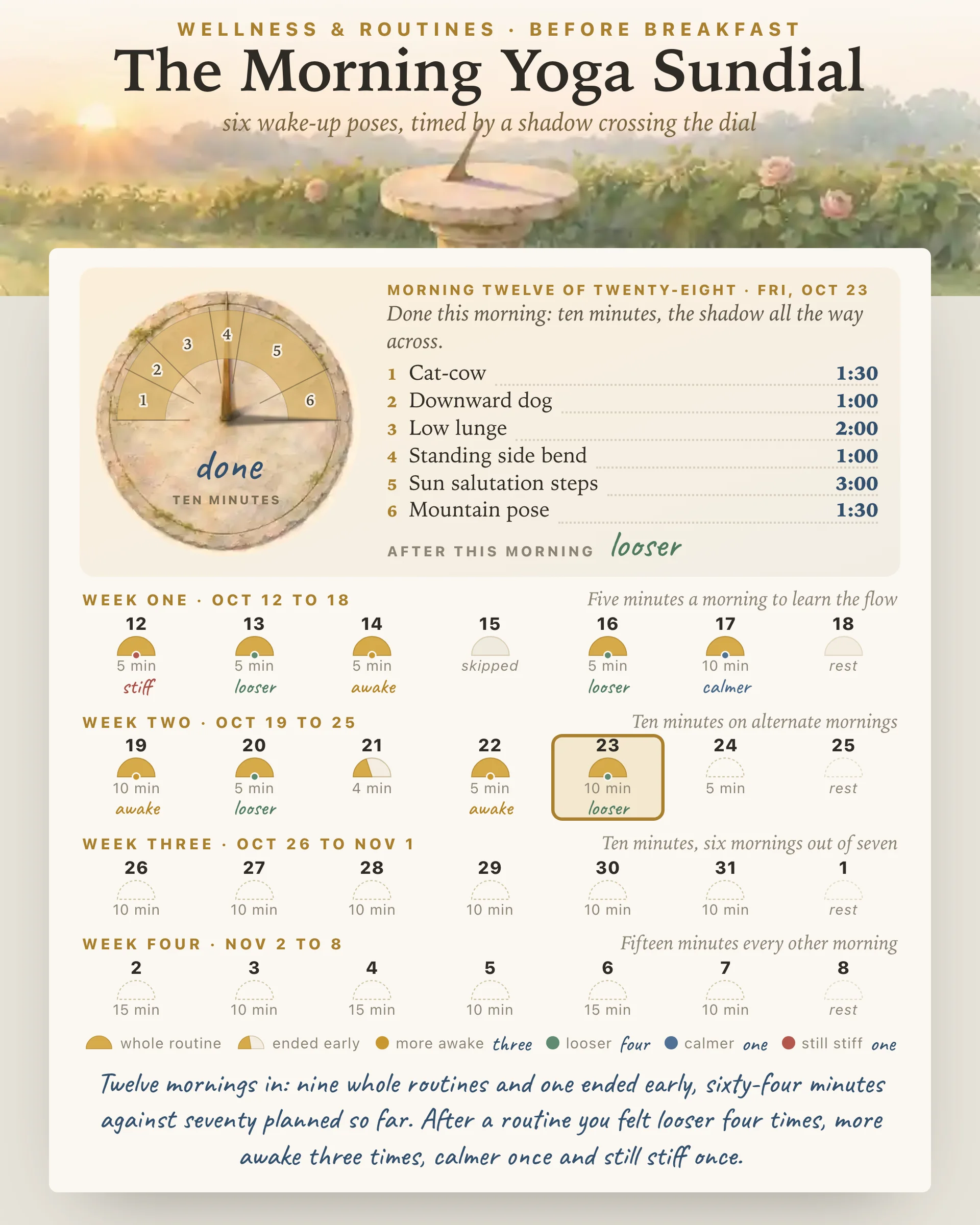
You get out of bed and your back feels like a folded deck chair, your hips are tight, and your hand is already reaching for the phone. A morning yoga routine puts a few minutes of slow movement in that gap, before the day takes over. It should be simple enough to do half awake.
This page gives you one: six poses that take you from hands and knees up to standing, five, ten or fifteen minutes long, timed by a shadow that moves across a stone sundial while you hold each one.
The flow starts close to the floor, where a stiff body feels safest, and ends on your feet.
If the floor is hard on your knees, switch the page to the chair and counter version. Cat-cow and the side bend happen sitting, downward dog becomes a long reach with your hands on a kitchen counter, and the lunge and mountain pose keep one hand on a chair back.
Choose this morning's length; a small gold dot marks the one the plan suggests. The dial divides its upper half into six bands, one per pose, each as wide as that pose's share of the time. Press begin and a shadow sweeps across the bands while the side panel shows the pose, a cue, the breath and a countdown. Cat-cow follows a four-count breath, and the sun salutation steps are named one breath at a time, with the round you are on.
The clock keeps real time, so a phone that locks mid-hold still counts correctly when you come back. Pause holds the shadow where it is. End early and only whole minutes count; less than a minute leaves nothing on the calendar. Run the flow to the end and today's small fan fills with gold.
Then the page asks how you feel now: more awake, looser, calmer or still stiff. That word goes under today on a four-week calendar, and the page adds up your notes, so after a couple of weeks you can see whether ten minutes leaves you looser than five, or whether the stiff mornings are the rushed ones.
Week one is five minutes on six mornings, enough to learn the order. Week two alternates ten and five. Week three settles at ten minutes six mornings out of seven, and week four reaches fifteen minutes every other morning. Each week keeps one rest day. That is thirty minutes in the first week and seventy-five in the last.
A review of twenty-two randomized trials in adults aged sixty and over found that yoga improved balance, lower body flexibility and leg strength compared with doing nothing different, and people also rated their mood and sleep better. Those were regular classes running for weeks, so they describe what a yoga habit can do over time, not what any single morning will do.
On the waking-up side, a small study of thirty college-aged women found their attention and working memory scores were better after a single yoga session than after aerobic exercise or no exercise. One study in young women is a hint, not proof that your workday will go better.
There is also a caution. Head-down poses raise the pressure inside the eye: downward dog and the standing forward fold pushed it up within a minute in people with and without glaucoma, and it settled within two minutes of sitting up. If you have glaucoma or high blood pressure, ask your doctor about the folds and downward dog first, and use the counter version, which keeps your head nearer the height of your heart. With back, hip, knee or wrist pain, or during pregnancy, check with a doctor or physical therapist which poses suit you, and stop any pose that hurts.
Soon after you get up, with a glass of water first; the folds are easier on a nearly empty stomach. If the whole household's morning needs structure, the Out-the-Door Morning Chart times every step against the minute you have to leave, and this flow can be one of the steps. If you want a month-long challenge where each hold grows by a breath, the thirty-day challenge page is built for that. And if the chair version suits you best, The Woven Mat is a slower practice with a chair, support or mat choice for every pose. And for the other end of the day, The Bedtime Yoga Moon has eight slow poses to do in bed or beside it.
Start with five minutes tomorrow. The shadow does the counting.
Something that moves the spine, something that opens the hips and something that gets you upright. Here that means cat-cow, downward dog, a low lunge on each side, a standing side bend, a few rounds of sun salutation steps and a minute in mountain pose.
Five minutes takes you through all six poses once, and ten or fifteen gives the holds and the sun salutations more time. The plan here begins with five minutes a morning and reaches fifteen on alternate days in the fourth week, with one rest day each week.
Tie it to something you already do every morning, such as the first glass of water, and keep the plan's one rest day a week. Poses this mild suit most people on most days, but skip a morning when something hurts, and ask a doctor or physical therapist first if you have a joint, back or blood pressure problem.
Yes. Switch the page to the chair and counter version: cat-cow and the side bend are done sitting, downward dog becomes a long reach with your hands on a kitchen counter, and the lunge and mountain pose keep one hand on a chair back.
Most people find the folds and downward dog easier on an empty stomach or after something light, such as a glass of water or a piece of fruit. If you wake up dizzy or with low blood sugar, eat a little first and keep the folds gentle.
By the team behind Fabulous, the science-based self-care app used by over 30 million people.


