
The Overwhelm Recovery ProtocolWellness & Routines · ~5 min
About this template · Updated November 2026
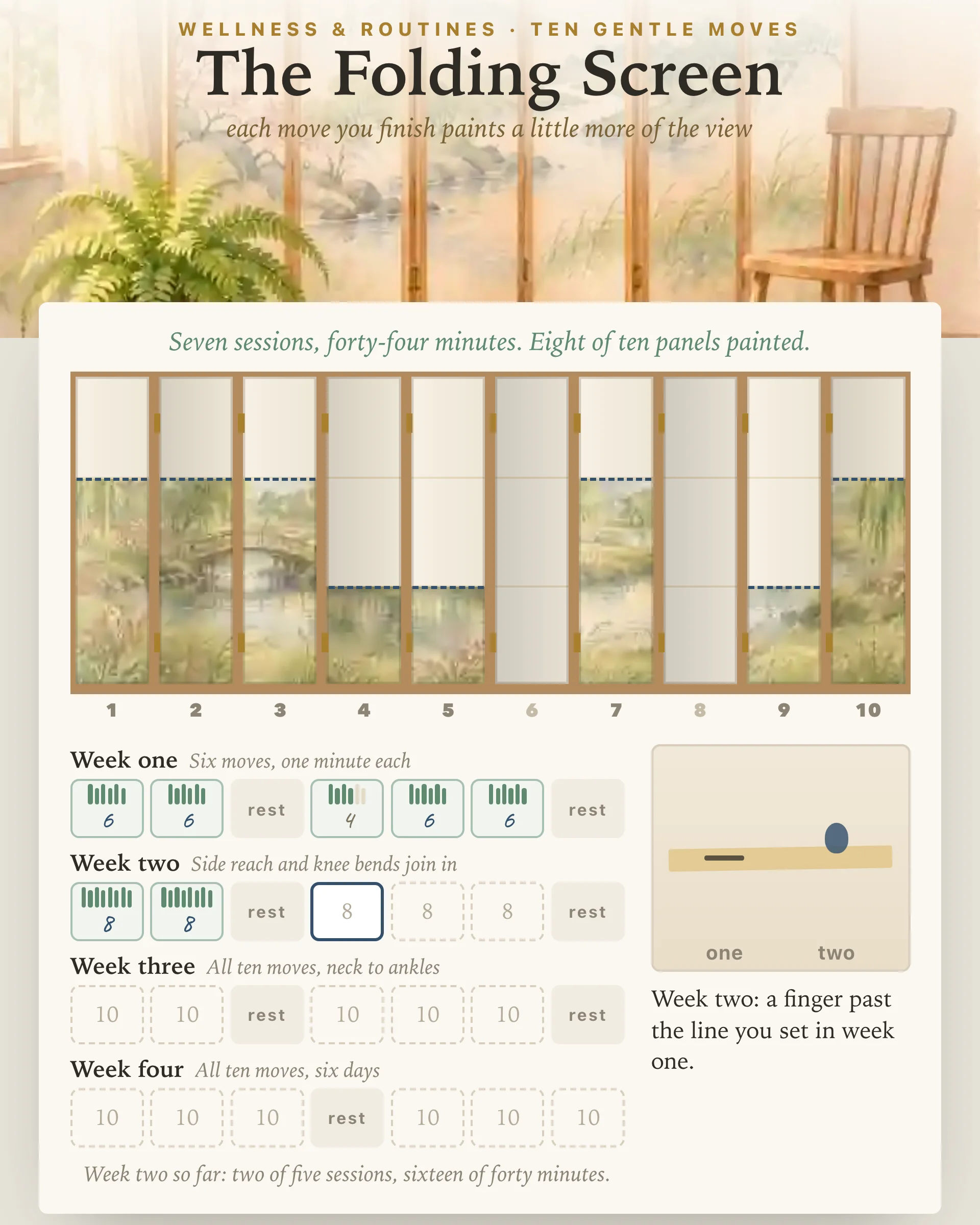
Mobility work is the quiet part of staying active: turning your head to check behind you, reaching a high shelf, swinging a leg into the car. These mobility exercises for seniors take ten of those motions and give each one a single slow minute, in a chair or standing behind it, so the whole routine lasts about as long as a cup of tea takes to cool.
The page is a folding screen with ten panels, one for each move, running from the neck at the left to the ankles at the right. Every panel starts as plain paper. When a move runs its full minute in a session, its panel fills with part of a river landscape, painted up to the range you worked at. A small move paints the bottom third, a fuller one two thirds, the fullest the whole panel. Over the weeks the view comes through, and the panels that stay pale show you which moves you have skipped or kept small.
Tap any panel to read its move and choose one of three ranges. Head turns, for example, go from a small turn led by your eyes, to halfway to your shoulder, to your chin in line with your shoulder. The dashed line on the panel marks the range you are working at, and the paint only rises when a minute at that range is actually finished. If you lower a range on a stiff week, the paint you already earned stays where it is.
Choose seated or standing before you press start. Seated, you sit near the front of a sturdy chair. Standing, you hold the chair back, or stand with the seat touching the backs of your legs for the arm moves, so you can sit down at any moment.
Week one uses six: head turns, shoulder rolls, arm raises, a gentle twist, knee lifts and ankle circles. Week two adds a side reach and knee bends. Week three adds a slow round and lift of the back and hip openers, so the last two weeks run all ten, neck to ankles, in ten minutes. The timer counts each minute from the clock itself, so a phone that dims or a tab left in the background does not lose time, and a pause stops the count until you go on.
Only what you did is kept. A session ended early is logged as the whole minutes you moved, a skipped move earns no paint, and anything under one minute leaves the calendar as it was.
Start every move at its smallest range, even if it feels too easy. After a move has been finished three times at one range, its card suggests the next range, but only if it felt easy. A move that pinches, catches or aches is a move to keep small or to skip for the day.
Once a week the page asks for a reach check. In week one, stand facing a wall or door with your toes a hand's width away, or sit side-on to it, walk your fingers up as high as is comfortable, and mark the spot with painter's tape. That tape is your line. In later weeks, reach the same way and tap where your fingertips landed: short of the line, on it, or a finger, two fingers or a hand past it. The page compares each check only with your own first one. Reach shifts from day to day, so trust a run of checks more than any single one.
A systematic review of flexibility training in adults over sixty-five found that it may improve range of motion, but that its effect on daily function was unclear, partly because studies used very different routines. So more ease turning and reaching is a fair hope, not a promise.
Falls are a different question. The Cochrane review of exercise for preventing falls in older people living in the community drew on 108 trials and found that programs built mainly on balance and functional exercise reduce how often people fall. It found no trials that compared flexibility exercise with no exercise, so mobility moves alone have not been shown to prevent falls. If falls are on your mind, add the balance exercises for seniors ladder to your week.
The World Health Organization 2020 guidelines ask adults of every age for 150 to 300 minutes of moderate activity a week and regular muscle strengthening. Ten minutes of mobility does not replace walking or strength work. Think of it as the warm, loosening part of an active week.
Use it on most mornings, or whenever sitting for a long stretch has left you stiff. If you want longer holds for tight spots, the stretching exercises for seniors map pairs well on rest days, and the hip mobility routine goes deeper on one joint. On mornings when getting out of bed is the stiff part, the bed exercises for seniors start lying down and at the edge of the bed.
Check with a doctor or physical therapist before you begin if you have had a fall, dizzy spells, a joint replacement, osteoporosis, a heart or blood pressure condition, or pain that does not settle. Stop any move that hurts, and keep a sturdy chair or a kitchen counter within reach whenever you stand.
They are slow, controlled movements that take each joint through the range it has, such as turning the head, rolling the shoulders, twisting the spine or circling the ankles. Unlike a held stretch, the joint keeps moving, so a short routine touches the neck, shoulders, back, hips, knees and ankles in about ten minutes.
Most days is a reasonable aim, since the moves are gentle and short. This plan asks for five days a week for three weeks and six days in the fourth, at six to ten minutes a session. Rest days are part of it, and a stiff or sore day is a good reason to keep every range small.
Yes. Every move here has a seated version done near the front of a sturdy chair, and a standing version done behind the chair with your hands on its back or with the seat touching the backs of your legs. You can switch between the two on any day.
They overlap. Stretching usually holds a position for twenty or thirty seconds, while mobility work moves in and out of a position again and again. A review of flexibility training in people over sixty-five found it may widen joint range, while its effect on everyday tasks stayed unclear.
That has not been shown for mobility moves on their own. A large Cochrane review found that programs built on balance and functional exercise reduce falls in older people living at home, but it found no trials comparing flexibility exercise with no exercise. Pair this routine with balance practice if falls worry you.
By the team behind Fabulous, the science-based self-care app used by over 30 million people.


