
The Overwhelm Recovery ProtocolWellness & Routines · ~5 min
About this template · Updated November 2026
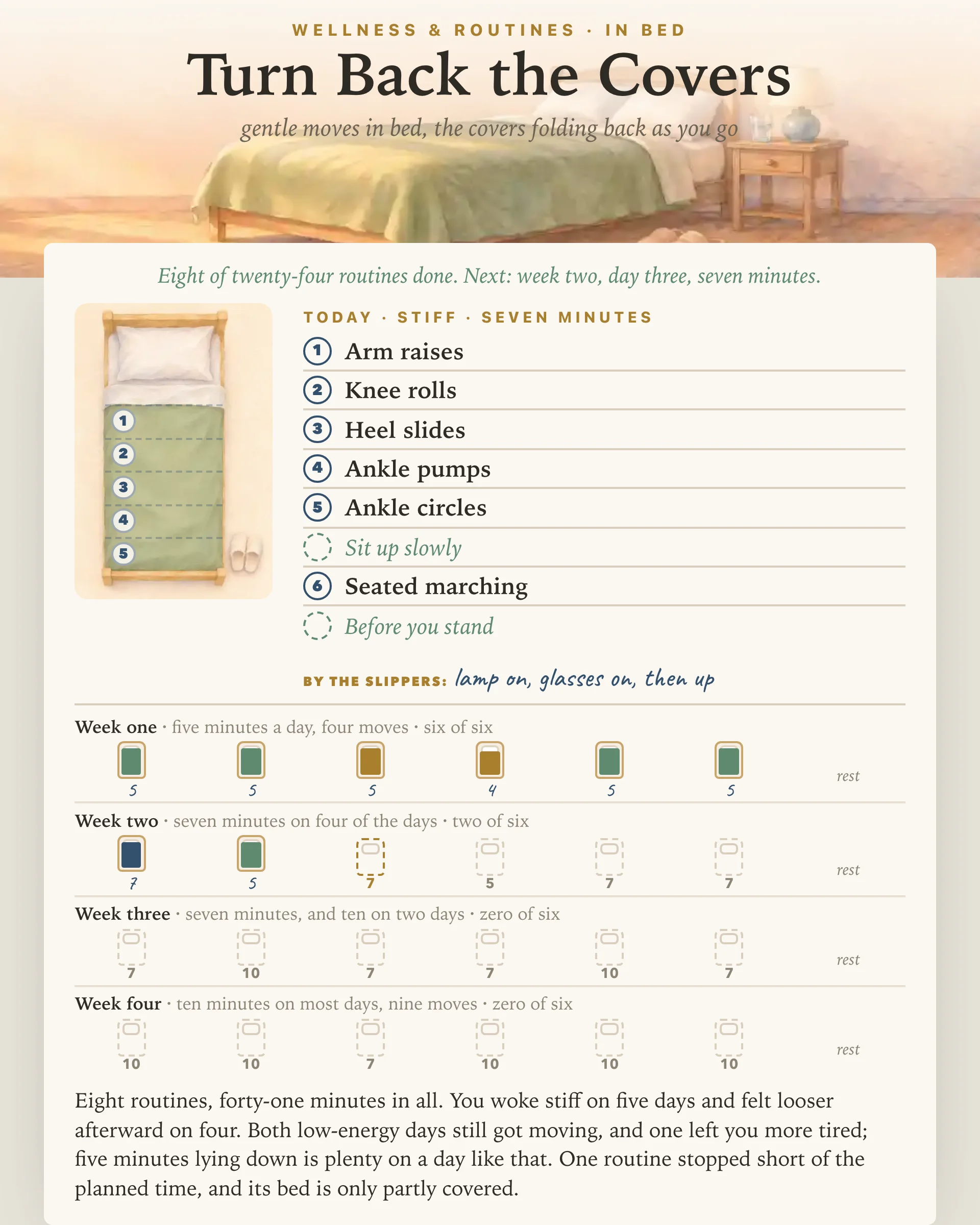
Some mornings the hardest part of the day is the first move. Joints feel rusty, and getting up in one go can leave you lightheaded. Bed exercises for seniors begin where you already are: on your back, head on the pillow. A few minutes of gentle movement there, a few more at the edge of the bed, and standing up becomes the last small step instead of the first big one.
Before you begin, talk with your doctor or a physical therapist if you have had a fall or dizzy spells, have a replaced joint, live with a heart or blood pressure condition, or have pain nobody has looked at yet. If you are recovering from an illness or an operation, the plan your care team gave you outranks anything on this page. Stop any move that hurts, and keep a sturdy chair or bedside table close for the moment you stand.
Eight are done lying down, in order from the pillow to your feet. Two are done sitting at the edge of the bed.
Tap how you feel today: stiff, low on energy or rested. Keep the length the plan sets for the day, or choose five, seven or ten minutes. A stiff morning leans on knee rolls, heel slides and the ankle moves. A low-energy day keeps you lying down. A rested one brings in bridges, leg raises and the seated moves. Leave out anything a clinician has ruled out for you, or swap another in; each move still gets about a minute.
Press start and the timer walks you through, keeping true time even if your screen locks. On the painted bed, the covers fold back as the lying moves go by. When they reach your feet, the page has you roll onto your side and sit up, then gives you half a minute at the edge, with your own note, such as switching the lamp on first.
Afterward, tap looser, about the same or more tired. Each finished routine becomes a small made bed on a four-week chart, colored by that answer, and the reading underneath counts what the colors say, such as how many stiff mornings eased. The plan runs six days a week with one day off, from five minutes a day in week one to ten on most days by week four.
Lying still costs older muscles quickly. When eleven healthy volunteers with an average age of sixty-seven spent ten days in bed, their knee strength fell by about thirteen percent and their aerobic fitness by about twelve (Kortebein and colleagues, 2008). They did no exercise at all, so the study shows what stillness takes away, not that a few minutes of bed exercises would prevent it.
Exercise does cut falls among older people living at home. A Cochrane review of more than a hundred trials found the rate of falls dropped by about a quarter with exercise (Sherrington and colleagues, 2019). The programs behind that result trained balance, walking and strength, so the review does not tell you that moves done in bed lower falls on their own. Think of this routine as a way to start the day moving, and when standing work feels within reach, The Balance Ladder adds it with a counter to hold.
Sitting up slowly has a reason of its own. Blood pressure can dip when you go from lying to standing, older adults are among the people it affects most, and getting up slowly after sitting or lying down is one of the measures MedlinePlus lists for it. So every routine here ends with a sit and a pause.
No move takes fat off the spot it works. In a six-week trial with younger adults, abdominal exercises five days a week built endurance in the muscles but left belly fat where it was (Vispute and colleagues, 2011). Movement helps alongside eating, sleep and time, and these moves are for waking your body gently, not for slimming one place.
Open it on stiff mornings, on days when getting out of bed feels like a lot, or in the afternoon when you want to move without standing. If you have just come home from a hospital stay, ask your team which of the ten they want you doing first. Once the seated moves feel easy, The Chair Circuit carries the habit into a sturdy chair.
Gentle ones you can repeat most days. Lying down, that means belly breathing, arm raises, knee rolls, heel slides and ankle pumps or circles, with bridges and straight leg raises once those feel easy. Seated marching and knee straightening at the edge of the bed are a good bridge between lying and standing.
They are among the mildest ways to move, but ask your doctor or physical therapist first after a fall, with dizzy spells, a joint replacement, a heart or blood pressure condition, or pain. If you are recovering from an illness or an operation, your care team's plan comes first. Come up to sitting slowly and wait a moment before you stand.
Not on their own. Working a muscle does not burn the fat that sits over it, and a six-week trial of abdominal exercises five days a week left belly fat unchanged. Movement helps alongside eating, sleep and time, so treat these moves as a kind start to the day rather than a fat burner.
Moves this gentle suit most days. The plan here runs six days a week with one day off, starting at five minutes and building to ten over four weeks. On a slow, tired day, five minutes lying down still counts as a routine.
Several of the lying moves suit that, but someone who is in bed for most of the day needs a nurse, doctor or physical therapist to set the routine, because turning, skin care and circulation need a plan of their own.
By the team behind Fabulous, the science-based self-care app used by over 30 million people.


