
The Overwhelm Recovery ProtocolWellness & Routines · ~5 min
About this template · Updated November 2026
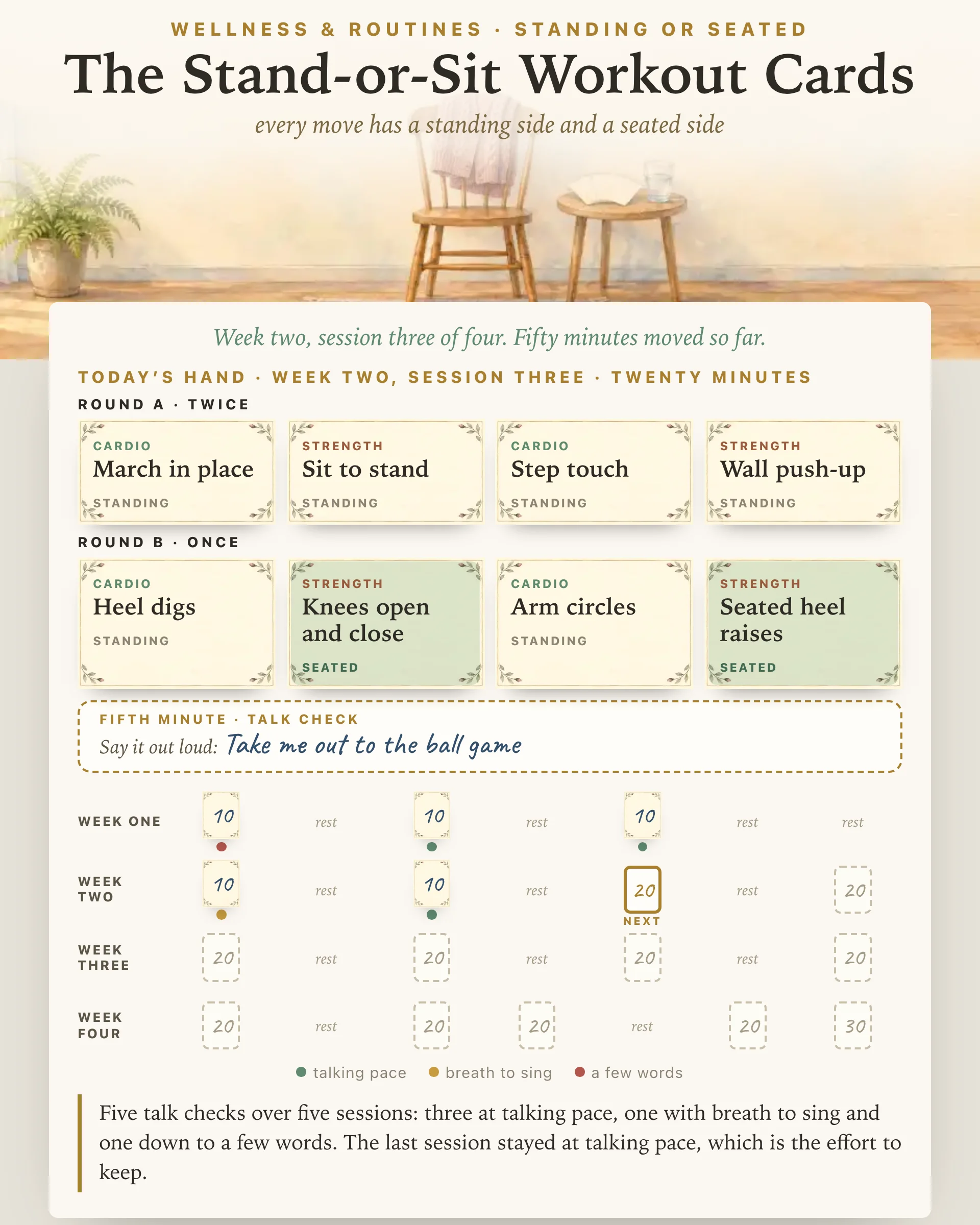
A senior low impact workout has one job: get your heart working and your legs and arms a little stronger without jumping, kneeling or trusting your balance more than you want to. This page deals that workout as a hand of cards. Each card is one minute of one move, with two sides: a standing side with a sturdy chair in reach, and a seated side you do from the chair itself. Pick ten, twenty or thirty minutes, turn over any card you would rather do sitting down, and a timer walks you through the hand.
Every session opens with three minutes of warm-up (an easy march, shoulder rolls, then heel and toe rocks holding the chair back) and closes with two minutes of slow marching and reaching while you breathe out long. In between come five-minute rounds. Round A is marching in place, sit to stand, step touch and a push-up against the wall. Round B is heel digs, side leg lifts, arm circles and calf raises. Cardio and strength take turns, so your breathing climbs and settles inside each round. Ten minutes deals one round, twenty deals three, thirty deals five.
The seated sides are real swaps, not a lesser version. Sit to stand becomes lean and press: lean forward and push through your heels until your weight just leaves the seat. Side leg lifts become knees opening and closing. Turn one card, a few or the whole hand, even in the middle of a session if your knees or your balance ask for it. The record counts your minutes either way.
The fifth minute of each round is the talk check. Keep marching gently and say the same sentence out loud each time, such as a line from a song you know or your street address, then tap how it came out. If you could have sung it, you have room for more, so the next round asks for bigger moves. If you could say it but not sing it, you are right where you want to be. If only a few words came at a time, ease off with smaller steps, slower arms, or a card turned to its seated side.
That plain test has a respectable record. In experiments with healthy young adults, the last stage at which comfortable speech was still possible tracked the ventilatory threshold, the point where breathing shifts from steady to labored (Foster and colleagues, 2008). A later review called the talk test a valid, reliable and inexpensive way to set and monitor exercise intensity, in healthy adults and in people with heart disease alike (Reed and Pipe, 2014). It is a guide to effort, not a safe number for your own heart, and your doctor's advice about your limits comes first.
The plan starts small on purpose: three ten-minute sessions in week one, building to five sessions in week four, the last one thirty minutes long. Days count from your own start rather than from a calendar, and rest days sit between sessions, so a missed day breaks nothing. Each finished session lands on the record as a small painted card holding its minutes, with a colored dot for every talk check. After a couple of weeks the dots show whether you tend to push too hard, or whether ten minutes has started to feel easy.
The World Health Organization's 2020 guidelines recommend 150 to 300 minutes of moderate activity a week for adults, muscle strengthening on two or more days, and, for people over 65, varied activity that stresses balance and strength on three or more days (Bull and colleagues, 2020). They also say plainly that some activity beats none. This plan reaches 110 minutes in its fourth week, so treat it as a beginning and let walks and active chores make up the rest.
A large Cochrane review found that exercise programs cut the rate of falls among older people living at home by nearly a quarter, with the clearest results from balance and functional training (Sherrington and colleagues, 2019). The same review was uncertain about programs built mostly on strength, walking or dance, and found exercise may make little difference to quality of life. These cards are gentle cardio and strength, not a falls program. If steadiness is your main worry, pair them with The Balance Ladder.
Talk with your doctor or a physical therapist first if you have had a fall, get dizzy spells, have a replaced joint, live with a heart or blood pressure condition, or have pain that has not settled. Stop any move that hurts and tap something hurt, so the record notes it and suggests a few days off. Keep a sturdy chair without wheels, or a kitchen counter, within reach for every standing card.
Reach for the cards when you want a short, complete session at home with no equipment. If you would rather follow set sessions laid out across the days of each week, The Low-Impact Stepping Stones does that. If standing is off the table for now, The Chair Circuit builds a seated circuit around the areas you choose. To spread strength, balance, stretching and walking across the whole week, The Patchwork Week lays out a plan.
One that mixes gentle cardio, such as marching, step touches and heel digs, with simple strength moves like sit to stand, a push-up against the wall and calf raises, all with a sturdy chair in reach and nothing that jumps. Ten minutes makes a fair first session, and twenty or thirty can follow once ten feels easy.
Nearly every one has a seated version. On these cards marching becomes a seated march, step touch becomes side taps, sit to stand becomes lean and press, the wall push becomes a palm press, side leg lifts become knees opening and closing, and calf raises become heel raises.
Hard enough that you can say a sentence but could not sing it. That is the talk test, and studies have found it a practical guide to moderate effort. If you could sing, add a little. If only a few words come at a time, slow down or sit for the next card.
This plan opens with three short sessions in week one and builds to five in week four, with rest days in between. The World Health Organization recommends 150 to 300 minutes of moderate activity a week for adults, so walks and active chores count toward what the cards leave.
It can be, once your doctor or physical therapist agrees. Ask before you begin if you have had a fall, dizziness, a joint replacement, a heart or blood pressure condition, or ongoing pain. Keep the chair or a counter within reach, stop anything that hurts, and use the seated side of any card that feels unsteady.
By the team behind Fabulous, the science-based self-care app used by over 30 million people.


