
The Overwhelm Recovery ProtocolWellness & Routines · ~5 min
About this template · Updated November 2026
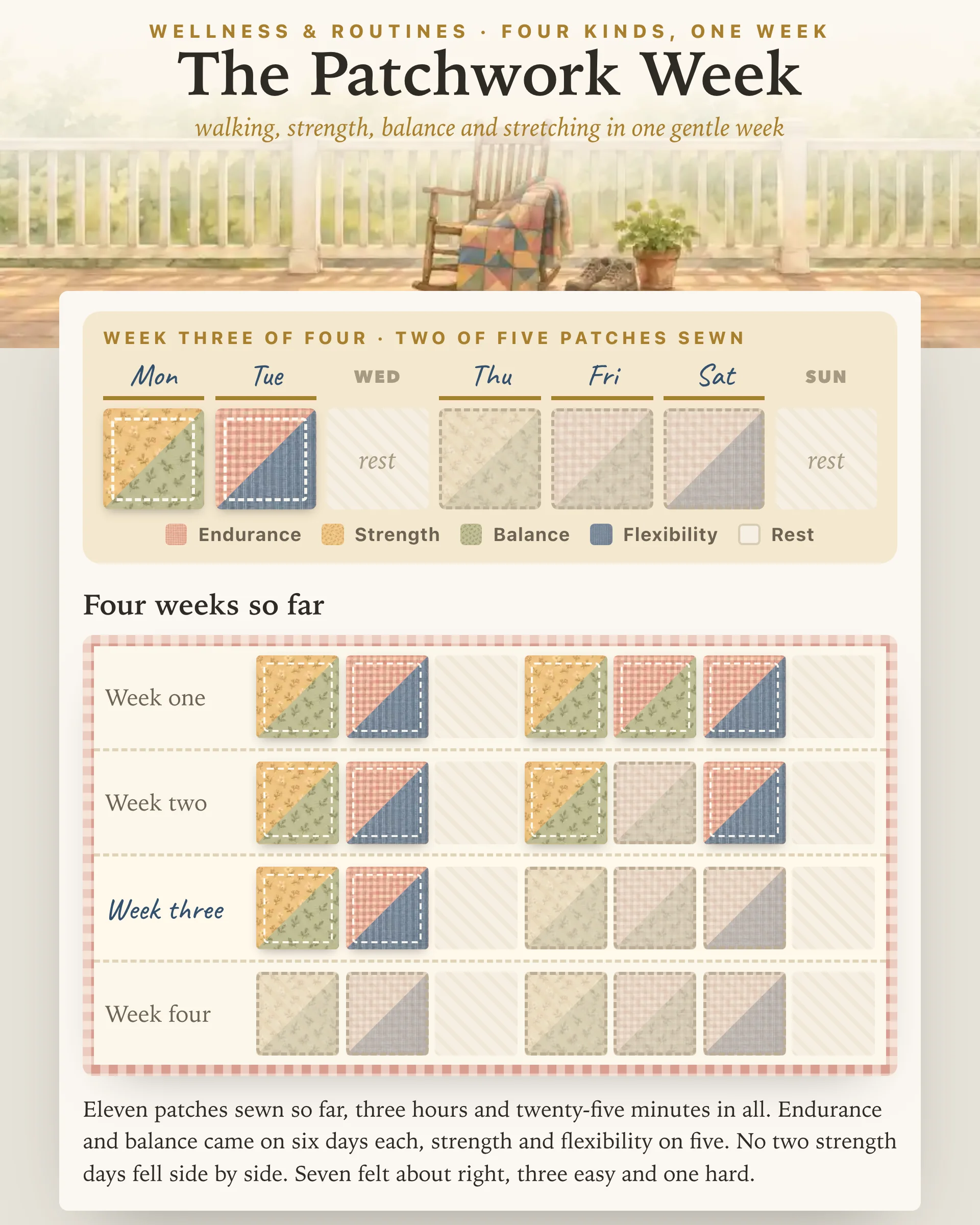
Most people who exercise in later life do one thing well: a daily walk, a weekly class, a few moves a physical therapist taught after a knee went bad. The trouble is what goes missing around it. Walking does little for the strength it takes to rise from a low couch, and a strength routine does not train the steadiness you need on a dark staircase. The National Institute on Aging says as much in its guide to the types of exercise: people tend to settle on one kind and assume it is enough.
This page pieces the kinds together into a single week you can actually follow.
Endurance is anything that lifts your breathing for a while, here a walk. Strength is your muscles working against your own weight: standing up from a chair, pushing away from a wall, rising onto your toes. Balance is staying steady while still or moving, practiced beside a kitchen counter. Flexibility is gentle stretching after the work, so a calf or a shoulder keeps its full range.
You may see these called the four types of exercise. The institute's current page groups the main work into three, aerobic, strength and balance, and asks you to stretch once your muscles are warm, after a walk or strength work. This page keeps stretching as its own short thread, never in place of the other three.
Tap the days you can move, from three to six. Each moving day becomes a patch made of two fabrics: the main work, then a five-minute add-on. A walk followed by balance is rose and sage; strength followed by a stretch is gold and blue. Days you leave free are plain muslin, and they matter as much as the others.
The page follows three rules as it lays the week out. Strength goes on two days that are not side by side, because muscles need a day off between sessions, which is also the institute's advice. Balance lands on two or three days, close to the three sessions a week the institute suggests. Walks fill the remaining days, and stretching follows a walk or the strength work. Days that wrap around the weekend are turned so Sunday's strength does not crowd Monday's.
Week one asks fifteen minutes a session. Each week adds five, so week four runs thirty. Open a patch to see its moves in plain words, each with an easier start built in: sit to stand with the armrests, push-ups against the wall, balance holds with your hands on the counter.
When you finish, sew the patch and say whether it felt easy, about right or hard. Your four weeks fill in row by row, and a tally under the quilt counts the days each kind got. If two sessions in one week felt hard, the sheet suggests repeating that week before moving on, and a missed patch simply stays open.
The World Health Organization's 2020 guidelines ask adults to build toward 150 to 300 minutes of moderate activity a week, with muscle strengthening on two or more days. For people over sixty-five they add varied activity that emphasizes balance and strength on three or more days. With five moving days, this plan reaches seventy-five minutes of walking by week four, about half the low end of that range. That is on purpose. Lengthen the walks or add one once the four weeks feel settled.
A Cochrane review of 108 trials in people over sixty living at home found that exercise programs lowered the rate of falls: by about a quarter for balance and functional work, and probably by about a third when programs mixed several kinds, most often balance with strength. The same review was uncertain about walking or strength training on their own, found no trials that tested stretching or endurance alone, and was much less sure about falls that led to injury. Those are averages across groups of people in trials, not a promise to any one person.
Strength work holds up well on its own terms. A second Cochrane review, of 121 trials, found large gains in muscle strength in older adults and better performance on everyday tasks such as getting out of a chair, though side effects were often poorly recorded and sore joints and muscles were common.
Before you begin, talk with your doctor or a physical therapist if you have fallen, had dizzy spells, had a joint replaced, live with a heart or blood pressure condition, or have pain. Stop any move that hurts. Keep a sturdy counter or chair within reach for every standing balance move, and use a chair without wheels, pushed against a wall, for sit to stand. Chest pain, unusual breathlessness or dizziness means stop and get checked.
This page is the week at a glance. When one thread needs more room, the single-kind pages go further: The Whole-House Strength Routine for eight strength moves with easier and harder versions, The Balance Ladder for balance holds that climb rung by rung, The Chair Circuit for days when standing is the hard part, and The Aerobic Wreath for adding up the week's endurance minutes.
No single move is best. A good week mixes four kinds: endurance such as a brisk walk, strength such as standing up from a chair or a wall push-up, balance such as a heel-to-toe stand at the counter, and flexibility such as a calf stretch. The best ones are those you can do safely and will want to repeat.
World Health Organization guidelines suggest building toward 150 to 300 minutes of moderate activity a week, muscle strengthening on at least two days, and varied activity that stresses balance and strength on three or more days. This plan starts well below that, with fifteen-minute sessions, and adds five minutes a week.
Begin smaller than feels necessary: three to five days a week, fifteen minutes each, with the easiest version of every move. Keep a rest day between strength sessions, add a little each week, and repeat a week whenever it felt hard. Steady weeks matter more than big ones.
Yes. Everything on this page uses a sturdy chair without wheels, a kitchen counter, a stretch of wall, and a hallway or sidewalk for the walks. On a wet or icy day, marching in place beside the counter stands in for the walk.
For most people it is, and some activity beats none at any age. Ask your doctor or a physical therapist first if you have fallen, felt dizzy, had a joint replaced, or live with a heart or blood pressure condition or pain. Stop any move that hurts, and keep a counter within reach for balance work.
By the team behind Fabulous, the science-based self-care app used by over 30 million people.


