
The Overwhelm Recovery ProtocolWellness & Routines · ~5 min
About this template · Updated November 2026
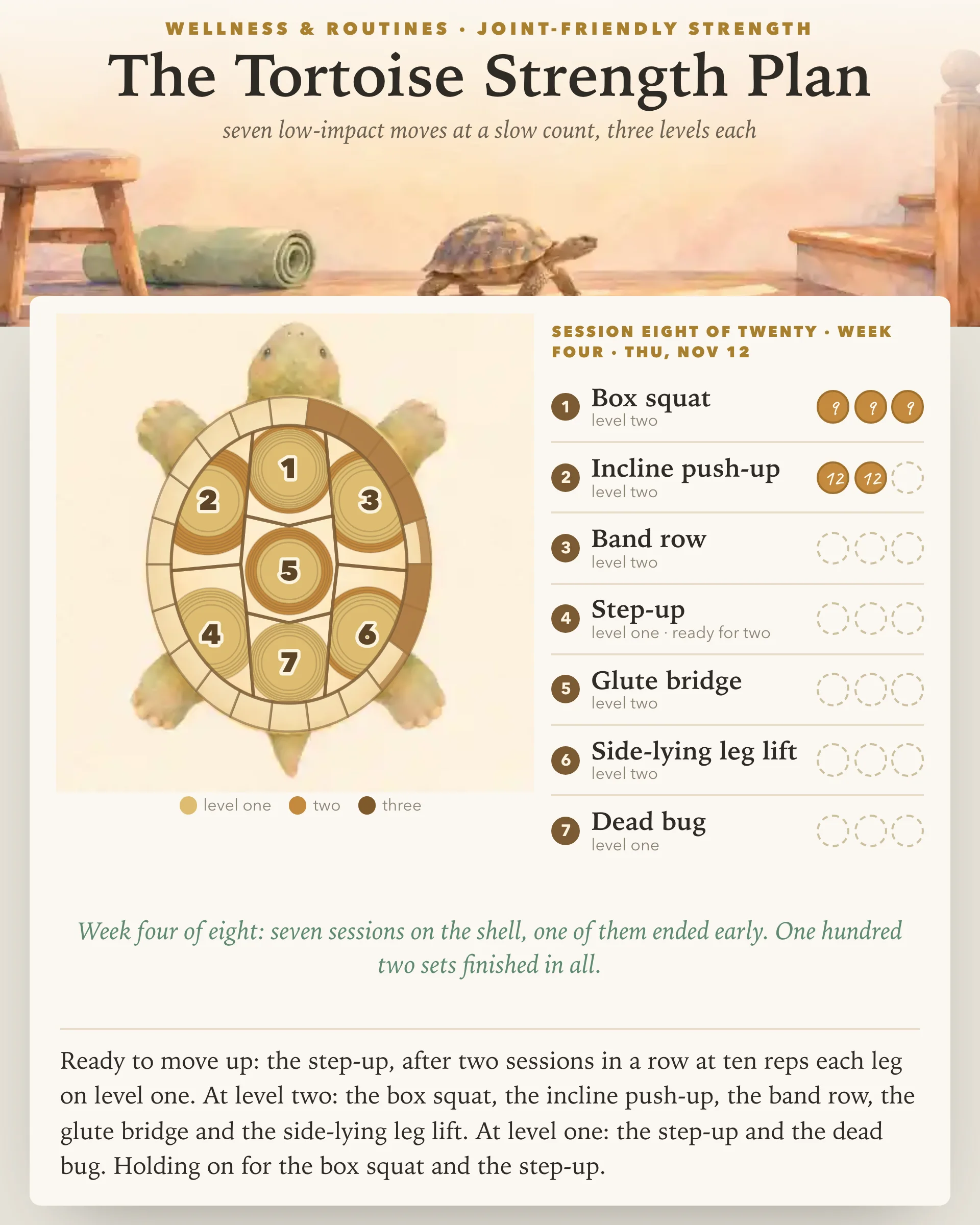
Low impact strength training asks your muscles for real effort while your joints get an easy ride. There is no jumping and no landing, and the heaviest thing you hold is a filled water bottle. The work comes from slow, controlled reps and from choosing a harder version of each move as you get stronger. This page gives you eight weeks of it: seven moves at three levels each, a count that paces every set, and a tortoise shell that grows as the sets go in.
Before week one, talk with a doctor or a physical therapist if you have had a fall or dizzy spells, a joint replacement or recent surgery, osteoporosis, a heart or blood pressure condition, or back or joint pain that does not settle. Stop any move that hurts that day. The squat and the step-up offer a support option at every level, so a rail, a counter or a sturdy chair is always within reach.
A meta-analysis of 21 trials comparing light and heavy loads found that muscle grew by a similar amount either way, as long as every set went on until another rep was not possible. Heavy loads still did more for the heaviest single lift people could manage. The trials enrolled healthy volunteers who trained to failure, which this plan never asks of you, so treat the finding as encouragement rather than a promise.
Slowing each rep down is one way to make a light load count. In a small trial of eighteen adults aged 60 to 77, knee extensions at about a third of each person's maximum, three seconds up and three seconds down with no rest between reps, made the front thigh muscles about five percent larger and measurably stronger after twelve weeks of two sessions a week. The group moving at an ordinary pace got stronger but showed no clear change in muscle size. It was one machine exercise in a handful of people, and it measured muscle, not stairs climbed or chores made easier, so read it as a reason to keep the count slow and nothing bigger.
This page's count is a little quicker: three seconds for the lowering half of each rep and two for the effort.
The World Health Organization's 2020 guidelines ask adults of every age for activities that work the major muscle groups on two or more days of the week. The plan meets that from the first week and builds slowly:
Twenty sessions in all, with a rest day between any two.
A session runs from standing to the floor, so you only get down once: box squat, incline push-up, band row and step-up, then glute bridge, side-lying leg lift and dead bug. The floor moves work just as well on a firm bed. Each move climbs through three levels. The squat starts from a cushioned chair with your hands helping and ends with a hover just above the seat. The push-up travels from the wall to the counter to a heavy chair seat. The step-up goes from both feet on the bottom stair to a slow tap and go, with a hand on the rail for as long as you like.
Pick a level, set the reps, and press start. A three-second count-in leads into the reps, and the page shows which rep you are on, which half of it, and which side is working. A set goes on the shell only once its last rep is done. Stop partway and nothing is logged; the page tells you where you stopped and suggests fewer reps for the next try. Prefer your own rhythm? Tap that the set is done instead.
Each move owns a scute on the tortoise's back. It grows out from its center with every finished set: straw at level one, honey at level two, walnut at level three, so the shell keeps a picture of how each move has climbed. The twenty scutes around the rim are the twenty sessions. A session you end early keeps only the sets you finished, and its rim scute stays part filled.
When a move has two sessions in a row with every set at the top of its range, the list marks it ready for the next level. Start the new level at the bottom of the range and let the reps climb again.
This plan is for getting stronger at the moves you practice. It makes no promise about your weight, your bones or any particular joint, and nothing here takes the place of advice from someone who has examined you.
If you also want some gentle cardio, The Low-Impact Stepping Stones mixes marching rounds with strength moves in short timed sessions. For more ways to use a band, browse The Resistance Band Rack, and for the step-up on its own, try The Step-Up Hill. For a full workout that uses a wall for support, The Marble Run Wall Workout runs eight wall moves in a timed circuit.
It is strength work with no jumping and no heavy weights: your feet, your back or your hands stay in contact with the floor, a chair, a stair or a wall. The effort comes from slow, controlled reps and from moving to a harder version of each exercise as you get stronger.
Yes, within limits. Trials comparing light and heavy loads found muscle grew about as much either way when every set was taken to failure, while heavy loads did more for the heaviest single lift. Slow reps are one way to make a light load harder without adding weight.
Two or three days a week with a rest day between works for most beginners, which matches the World Health Organization call for muscle strengthening on at least two days a week. This plan starts with two days and adds a third in week five.
It is gentler than jumping or lifting heavy, but gentler is not the same as right for you. If you have joint or back pain that lingers, a joint replacement, osteoporosis, a heart condition or a history of falls, ask a doctor or physical therapist which levels suit you, and stop any move that hurts.
A sturdy chair, a wall or kitchen counter, the bottom stair with a rail, a light resistance band and a mat or firm bed. A filled water bottle is the heaviest thing the plan ever asks you to hold.
By the team behind Fabulous, the science-based self-care app used by over 30 million people.


