Leaves on a StreamEmotional Fitness · ~3 min
About this template · Updated September 2026
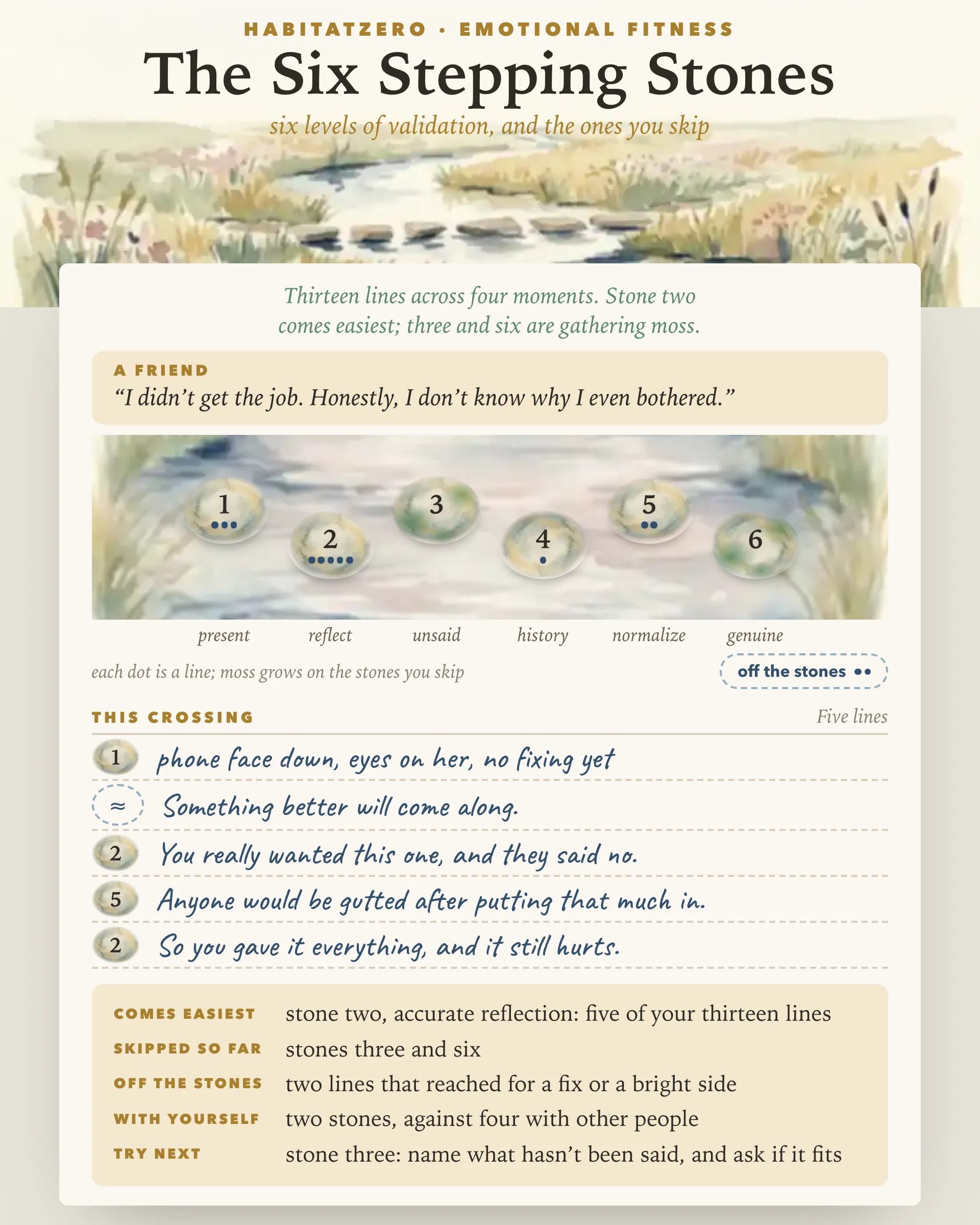
The levels of validation come from Marsha M. Linehan, the psychologist who created dialectical behavior therapy and is now professor emeritus of psychology at the University of Washington (her biography at the Linehan Institute). She treated validation as something you do on purpose, in graded steps, and her chapter Validation and psychotherapy sets those steps out. HabitatZero built these stepping stones on its own. Neither Dr. Linehan nor the Linehan Institute had a hand in the page, and neither has endorsed it.
To validate a feeling is to show that it makes sense. Given what happened, and given who this person is, the reaction follows. You don't have to agree, approve or pretend the facts are different: "you're furious they changed the plan" can sit right beside "and I still think the new plan works." What validation rules out is the quick dismissal: the pep talk, the silver lining, the fix handed over before they finish.
In the research literature the six levels go by paying attention, accurate reflection, articulating the unverbalized, validating in terms of history and biology, normalizing, and radical genuineness, which is how Sheasgreen and colleagues list them. In plainer words:
The levels run roughly from simplest to most complete, but you don't have to climb all six every time. Some days staying present is the whole job.
Pick a moment: a friend who didn't get the job, a kid who ate lunch alone, a coworker whose deadline moved again, or one of your own. Tap a stone to see what that level sounds like there, then borrow its example or write your own line and set it on the stone it belongs to.
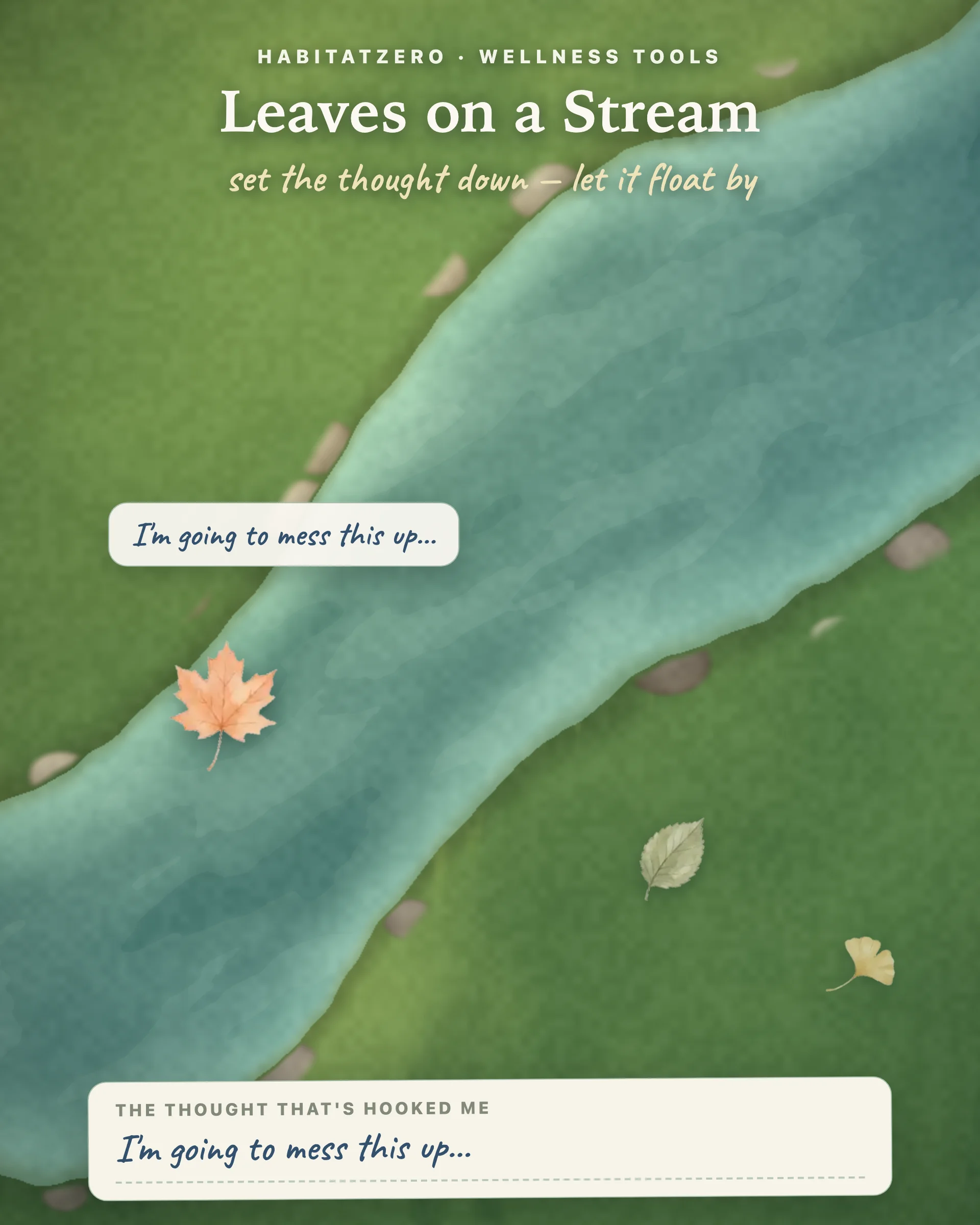
Be honest when your first reply wasn't validation at all. "Something better will come along" is kind, but it steps past every stone, so it goes in the water. Seeing those lines counted is half the value.
Every line leaves a dot on its stone, across all your moments. Once three lines sit on the stones, moss starts growing on the ones you never step on, and a short reading names the stone that comes easiest, the ones you skip and the one to try next. Tagged one wrong? Tap its badge to move it, and the reading follows.
Switch the sheet to yourself and the same six stones point inward. You notice the feeling, name it, look under it, remember why it makes sense, admit that anyone would feel it, and treat yourself as someone who can handle it. DBT programs for families teach this self-validation alongside the outward kind. The reading compares how many stones you reach for yourself with how many you reach for others, and that gap is often the most telling line on the page.
Research on the levels is young. One study coded 121 individual DBT sessions for the levels therapists used (Carson-Wong, Hughes and Rizvi). The total amount of validation did not track changes in how clients felt during a session, but the mix did. More of the higher levels went with more positive and less negative feeling, and more of the lower levels with less positive feeling. Level four on its own went with more negative feeling, while level six went with more positive and less negative. These are correlations from one training clinic, so they hint at what matters rather than prove it.
Teaching the skill directly looks promising but unproven. In a single two-hour online workshop, 34 family members of young people who struggle to manage their emotions learned validation and self-validation, and afterward both their ability to apply it and their sense of hope had risen (Sheasgreen and colleagues). They singled out the practice exercises and the self-validation part as most useful. The study had no comparison group, so it can't show that the workshop caused the change.
Use the stones after a talk that went sideways, while you still remember your words, or before one you expect to be hard. When the relationship itself is on the line, pair them with The GIVE Lanterns, where validating is one of four lights. When you can't find the word for what someone feels, The Feelings Wheel helps you get stone two right. On the self side, the Inner Critic Translator is there for the days the voice turning on you is harsh.
These stones are for practice, not treatment. DBT teaches validation properly in skills groups, and if the talks you rehearse keep ending badly, a DBT-trained clinician can practice them with you.
In order: staying present, accurate reflection, reading what goes unsaid, understanding a reaction through someone’s history or body, normalizing it as what most people would feel, and radical genuineness, which means answering as an honest equal. Marsha Linehan ranked them from the simplest to the most complete, though any one of them can be the right move in the moment.
Picture a friend who just missed out on a job she wanted. Staying present is putting your phone away. Reflecting sounds like ‘you really wanted this one, and they said no.’ Normalizing sounds like ‘anyone would be gutted after putting that much in.’ Radical genuineness could be ‘honestly, I’m gutted for you.’ Each stone on this page offers lines like these for the moments it comes with.
Yes, and DBT family programs teach it that way too. Turned inward, the levels ask you to notice the feeling, name it, look for what sits under it, remember why it makes sense, admit most people would feel it, and treat yourself as able to handle it. The yourself side of this page does exactly that, then compares how many stones you reach for yourself with how many you reach for others.
No. HabitatZero made this practice sheet independently from Linehan’s published levels, and no one at the Linehan Institute or any DBT training body wrote, reviewed or endorsed it. Her own skills materials are published by Guilford Press as the DBT Skills Training Handouts and Worksheets.
You can look without it: the filled example here shows a friend’s job news answered in five lines, with moss on the two stones that sample skips. Choosing your own moments, setting your own lines and watching the dots and moss shift over the weeks opens up once you personalize the sheet in HabitatZero, free of charge.
By the team behind Fabulous, the science-based self-care app used by over 30 million people.