Leaves on a StreamEmotional Fitness · ~3 min
About this template · Updated September 2026
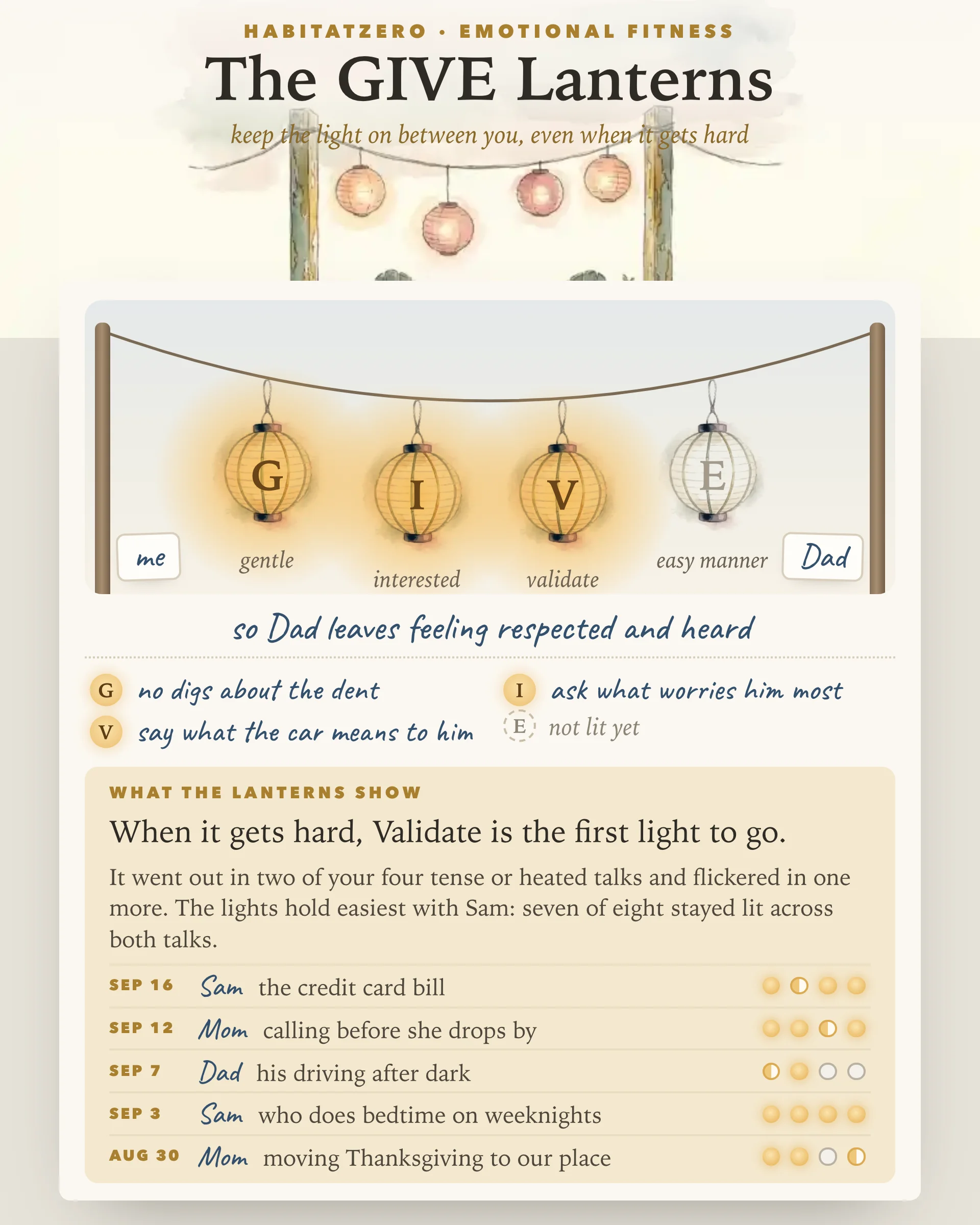
GIVE is one of the interpersonal effectiveness skills in dialectical behavior therapy, or DBT, the treatment that psychologist Marsha M. Linehan created and studied at the University of Washington. Her profile at Behavioral Tech describes that work, and the skill itself is taught in her DBT Skills Training Handouts and Worksheets. The lanterns are an independent HabitatZero tool, with no affiliation to Dr. Linehan, Behavioral Tech or any DBT organization, and no endorsement from any of them.
DBT splits the aims of a hard conversation three ways: what you want out of it, the relationship with the person across from you, and the respect you keep for yourself. DEAR MAN is built for the first, FAST for the third, and GIVE for the one in the middle. Linehan frames it as a question to ask beforehand: how do you want this person to feel about you once the talk is over, whether or not you get what you came for?
That question matters most with people you will see again tomorrow, where winning the point and losing the warmth is a bad trade. GIVE is the set of habits that keeps you from making that trade by accident.
Four paper lanterns hang on a cord between two posts, one for you and one for the person you need to talk to. Name them, add a few words on what the talk is about, and choose up to two feelings you want them to leave with. Those words hang under the cord.
Then light the lanterns: one small move per letter, tapped from a short list or written in your own words, like ask what worries him most. A lantern glows once its move is set, and fewer than four is fine.
Come back after the talk, while it is fresh. Tap each lantern until it says stayed lit, flickered or went out, say how hard the conversation got, and hang it in the log, which keeps twelve talks. From the second one on, the page reads the pattern back to you: which light tends to go out first once a talk turns tense, and the person your lights hold best with. If the same letter keeps going dark, light that one first next time and use it early.
No trial has tested GIVE on its own, so nobody can tell you how much these four habits protect a relationship. The closest evidence is about validation. In a lab study by Shenk and Fruzzetti, undergraduates worked through a stressful math task while hearing either validating or invalidating responses. The invalidated group grew more upset, with heart rate and skin conductance climbing, while the validated group's negative feelings held steady and their heart rates came down. A later experiment by Kuo and colleagues found that the effect of validation depended on which emotion was being validated, and summed up the research so far this way: invalidation tends to escalate emotion, while validation may calm it or may not change it at all.
Read together, those findings suggest the surest gain comes from what GIVE asks you to drop: the sneer, the "you should", the eye-roll. The warm parts help too, less predictably, and a short lab task is a long way from a real argument with your dad.
Use the lanterns before any talk where the relationship matters as much as the outcome, like asking a parent to change plans for the holidays or telling a roommate the dishes have become a problem. If you also need a clear yes or no out of it, write the ask with The DEAR MAN Script and bring the lanterns along. If you are too stirred up to plan anything, find your footing with Wise Mind first, and if the talk is one more round of an old fight with a partner, Our Fair Fighting Rules sets the ground rules on a calm day.
GIVE is for keeping relationships you want to keep. It cannot make a dangerous one safe. If someone hits, threatens, stalks or controls you, the trouble is not your tone, and more gentleness will not fix it. In the US, The Hotline answers day and night at 1-800-799-7233, or you can text START to 88788.
This page is practice, not treatment. If hard talks with someone keep ending in the same place, or you want to learn these skills properly, talk with a therapist, ideally one trained in DBT.
Marsha Linehan's handouts spell it (be) Gentle, (act) Interested, Validate and (use an) Easy manner. Together the four describe how to carry yourself through a hard conversation so the other person still feels respected when it ends, whether or not you got the answer you wanted.
Picture asking your dad to stop driving after dark. Gentle means no digs about the dented bumper. Interested means asking what worries him about giving up the keys, then letting him finish. Validating could be telling him you know how much that car means to him. Easy manner is a warm voice and maybe one small joke at your own expense.
All three belong to the interpersonal effectiveness module of DBT, and each one guards a different aim. DEAR MAN is about the thing you are asking for or turning down. GIVE looks after the relationship. FAST keeps your self-respect intact. One hard talk usually calls for some of each, weighted by what matters most to you that day.
No. Validating means showing you understand why they feel or think the way they do, given where they are standing. You can say their worry makes sense and still keep your own view, or still say no. What it rules out is telling them their feelings are wrong or silly.
The filled-in example on this page shows someone getting ready to talk with their dad. Lighting your own lanterns before a talk, and keeping the log that shows how they held, opens up once you personalize the page in HabitatZero, which is free.
By the team behind Fabulous, the science-based self-care app used by over 30 million people.