Leaves on a StreamEmotional Fitness · ~3 min
About this template · Updated September 2026
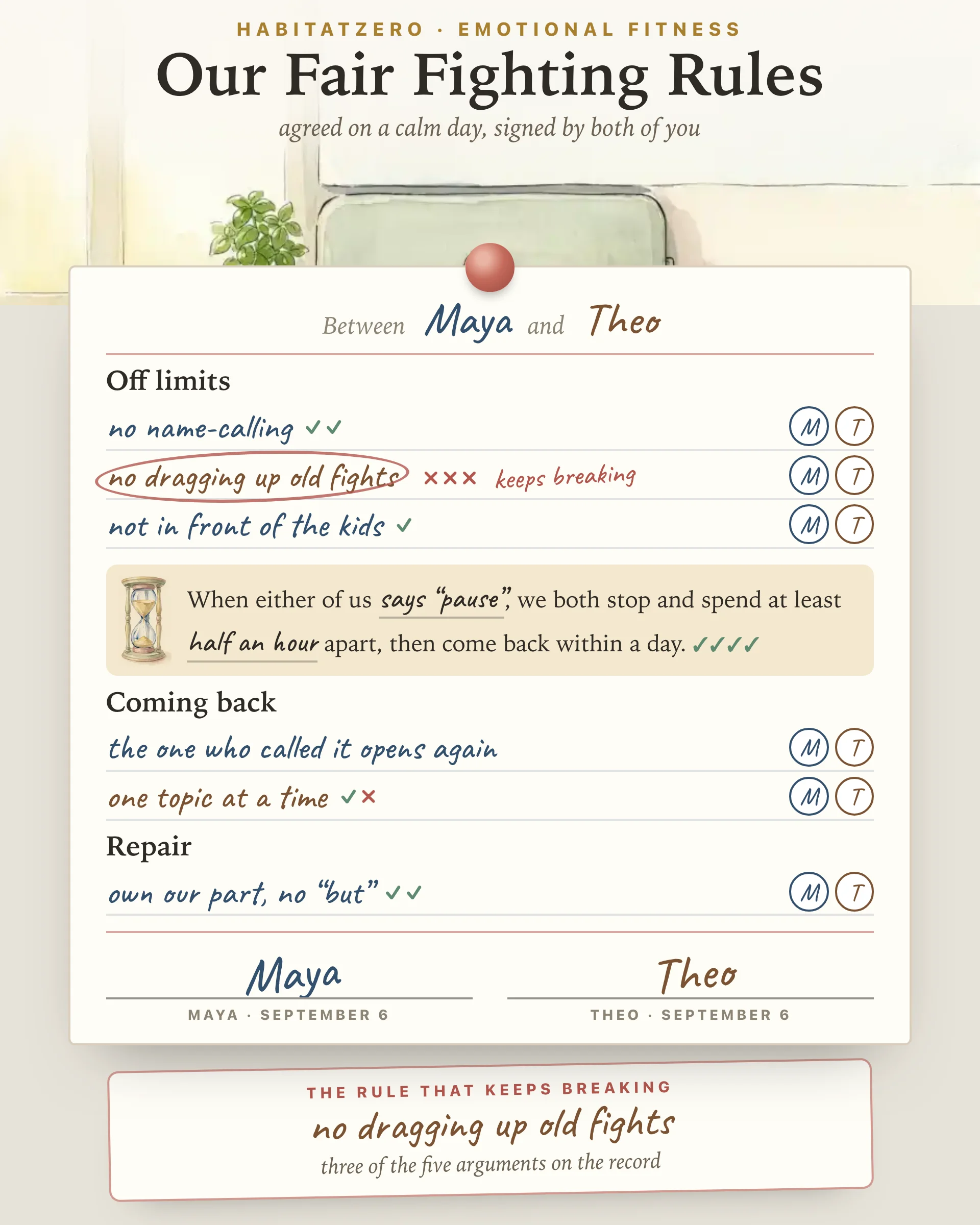
Every couple argues. Whether an argument clears the air or leaves a bruise is mostly decided before it starts: what is off limits, what happens when one of you is too wound up to think, and how you find your way back. Fair fighting rules are those decisions made in advance, on a calm evening, by both of you. This page turns them into a card you sign together and keep somewhere you both look, like the fridge door.
The rules here lean on John Gottman's research into how couples handle conflict, especially his work on flooding and repair. The worksheet is our own reading of that published work; the Gottman Institute did not make it and has neither reviewed nor endorsed it.
The card has four parts, and each one answers a question you will not want to answer in the middle of a row.
Past a certain point, an argument stops being a conversation. The Gottman Institute describes flooding as a heart rate that climbs to around a hundred beats a minute, the point where you can no longer take in what your partner says. Its advice is to agree on a signal for a time-out and to stay apart for at least twenty minutes but less than a day: twenty because a flooded body needs about that long to reset, and a day because a longer silence slides into avoidance. The same article warns against spending the break replaying the fight in your head.
That is why the time-out on this card will not go below twenty minutes, and why its sentence ends with a promise to come back within a day.
Gottman calls any statement or action that keeps negativity from spiraling, silly ones included, a repair attempt, and his work treats a steady run of failed repairs as a sign of trouble ahead. Most lists of fighting rules are all prohibitions. Yours should also spell out what either of you may do to bring the temperature down: a code word, a hand on the arm, the right to ask for a fresh start.
In a study that followed 130 newlywed couples, Gottman and his colleagues found that anger on its own did not predict which marriages ended. Among the patterns that did were harsh openings, a failure to de-escalate, and no physical calming down. So these rules are not about banning anger. They are about how you raise it and what you do when it grows too big for the room.
Be honest about the limits. That research observed couples talking; it did not test written rules on a fridge, and nobody has shown that signing a card prevents a breakup. Use the page to make good intentions specific and to notice where they slip, not as a guarantee.
Write both names at the top. Whoever holds the pen proposes rules, by tapping a suggestion or writing a short line, and each proposal appears in that person's ink. A rule only counts once the other person initials it, so pass the pen back and forth until every rule carries both initials, then sign. Change anything later and the card asks for both signatures again.
After an argument, once you have both cooled down, mark the rules that came up as held or broke. The record keeps your last ten arguments. When one rule has given way twice, it gets circled in red and named at the top of the record, and that is the rule to talk about on a quiet evening. Perhaps it needs rewording. Perhaps it guards something one of you has not said yet.
Fair fighting rules assume two people who can disagree safely and on equal footing. If one of you is afraid of the other, or arguments come with threats, control or violence, no card will make that fair. In the US you can reach the National Domestic Violence Hotline at 1-800-799-7233, or text START to 88788, for free and confidential help at any hour.
If one particular argument is still sitting with you, work it through on its own with the Conflict Resolution Worksheet. To catch small frictions before they grow into this kind of fight, a weekly Couples Check-In gives you a standing calm slot to raise them. And some repair needs no talking at all: an easy evening picked from The Date Night Jar counts too.
They are ground rules two people settle before their next argument: what neither of you will say or do, how either of you can call a time-out and for how long, how the conversation restarts, and how you make up afterwards. Couples use them most, but housemates and families can write a set too.
Drawn from the Gottman Institute's advice, the core is short. Keep criticism, contempt, defensiveness and stonewalling out of it, the four patterns the institute calls the Four Horsemen. When either of you is flooded, stop and stay apart for at least twenty minutes but less than a day. And count small repair attempts, like a joke or an apology, as part of fighting well.
At least twenty minutes, says the Gottman Institute, because a flooded body needs roughly that long to settle, and no longer than a day, since a longer silence starts to become avoidance. Agree the length in advance, and spend the break on something calming instead of rehearsing your case.
It is anything said or done in the middle of a conflict that stops the negativity from running away with you: a joke, a touch, an apology, a request to start over. Gottman treats a steady run of failed repair attempts as a warning sign, which is why repair gets a section of its own on this card.
No. They assume two people who can disagree safely and as equals. If one of you is afraid of the other, or arguments bring threats, control or violence, a rules card cannot make that fair. In the US, the National Domestic Violence Hotline offers free, confidential help at 1-800-799-7233, or text START to 88788.
By the team behind Fabulous, the science-based self-care app used by over 30 million people.