
The Overwhelm Recovery ProtocolWellness & Routines · ~5 min
About this template · Updated November 2026
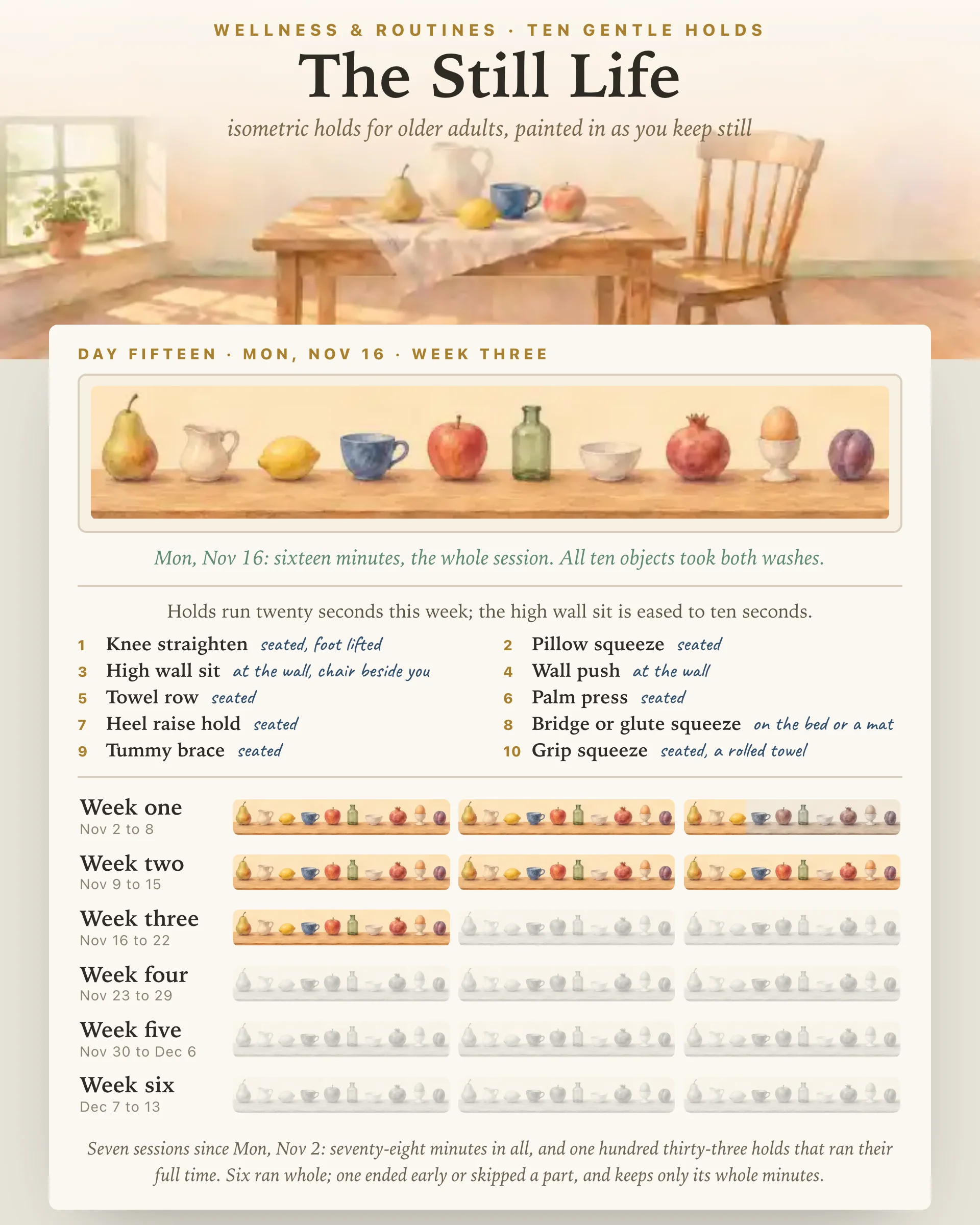
An isometric exercise works a muscle without moving the joint. You press your palms together, squeeze a pillow between your knees or lean into a wall, and then you stay put while the muscle does the work. Nothing swings or bounces, which makes holds like these a common first step into strength work for older adults. This page gathers ten of them into one short routine you can do in a chair or beside a kitchen counter, and paces it over six weeks.
The ten holds run in the same order every session, from the legs up to the hands, starting with a knee straighten and ending with a grip squeeze. Each has two ways to do it, usually one seated and one with support from a wall, a counter or the bed, and you can choose a different way for every hold. A session is a minute of warm-up, then all ten holds twice through.
Weeks one and two hold each for ten seconds, weeks three and four for twenty, and weeks five and six for thirty, three sessions a week. Every hold sits in a fixed slot: the hold, then rest until the slot runs out. Ease one that strains back to a shorter hold and it simply rests longer, so the session still ends on time, at eleven, sixteen or twenty-one minutes depending on the week.
The timer reads the real clock, so a phone that locks partway still knows how far you got. A hold counts only when it runs its full time. Pause in the middle of one and it starts again from its first second when you go on, because a hold is meant to be unbroken. Skipped time is never counted, and a session ended early keeps only its whole minutes.
On the table, ten ordinary things stand in pencil, a pear, a jug, a lemon, a cup and six more, one for each hold. The first round of a hold that runs its full time lays a pale wash of color on its object, and the second round finishes it. Six weeks of these still lifes sit side by side under the plan.
Keeping still tempts people to stop breathing, the one habit worth dropping first. In a 1995 study of ten male athletes whose pressure was read through a line in an artery, heavy leg presses done while straining against a held breath produced far higher readings than the same lifts done while breathing out slowly. Those men lifted close to their maximum, far harder than anything here, so the numbers do not carry over. The lesson does: every hold on this page starts on a slow out-breath, and the timer cues breathing in and out for as long as you hold.
A 2023 network meta-analysis pooled 270 randomized trials, with 15,827 participants in all, that compared exercise programs of two weeks or longer against groups that did not exercise. Every kind of exercise lowered resting blood pressure on average, and isometric training lowered it at least as much as aerobic, resistance or interval training, ranking first for systolic pressure. The pooled trials were not limited to older adults, they measured blood pressure rather than heart attacks or strokes, and their isometric programs, such as a sustained wall squat, were not this routine.
Older adults have been studied directly, in small numbers. A twelve-week trial in fifty-four people over sixty with high blood pressure, average age sixty-nine, gave one group four two-minute squeezes of a handgrip device a session, had a second group walk briskly and cycle, and left a third group without exercise. Both exercise groups lowered their systolic pressure compared with the third, by similar amounts, and the handgrip group's diastolic readings fell further. And in twelve older women whose high blood pressure was treated with medicine, a session of ten-second handgrip squeezes, at light effort one day and moderate effort another, barely raised blood pressure while it lasted.
Neither study tested these ten holds or this six-week plan, both were small, and neither ran long enough to show anything about heart attacks or strokes. This page is a strength routine, not a treatment. It never replaces a medicine you take, and it does not promise a lower reading.
If you have high blood pressure or heart disease, ask your doctor before your first session, and bring this page along. Check with a doctor or physical therapist first, too, if you have had a fall, dizziness, a joint replacement or pain. Stop any hold that hurts or makes you dizzy, and keep a sturdy chair or counter within reach for every standing hold.
The Icicle Eave is the broader isometric plan, with twelve holds, three levels each and floor work such as planks; this page stays seated or supported and grows by time rather than by harder positions. If you would rather move than hold, The Whole-House Strength Routine and The Chair Circuit build strength through movement and seated circuits. And if your doctor has asked you to be more active for your blood pressure, Seven Bud Vases lays out walks and short strength sessions to bring to that conversation.
They are holds in which a muscle works while the joint stays put, such as pressing your palms together, squeezing a pillow between your knees or leaning into a wall. Since nothing moves fast, older adults can do them in a sturdy chair or with a hand on a counter.
Talk to your doctor before you begin. Blood pressure climbs while a hold lasts, and a held breath sends it higher, so let the air out slowly and keep breathing. Trials report lower resting readings on average after isometric training, yet no routine takes the place of the medicine your doctor prescribes.
Start short. This plan opens at ten seconds a hold, moves to twenty in week three and thirty in week five, and lets you keep any single hold shorter. Come out of a hold the moment it hurts or you notice your breath has stopped.
Yes. Nine of the ten holds here have a seated way, and the tenth, the glute squeeze, also works sitting tall in a chair. The other ways lean on a wall, a counter or the bed for support.
This plan asks for three sessions a week with a rest day between them, for six weeks. A session takes eleven minutes at first and grows to twenty-one as the holds lengthen.
By the team behind Fabulous, the science-based self-care app used by over 30 million people.


