
The Overwhelm Recovery ProtocolWellness & Routines · ~5 min
About this template · Updated November 2026
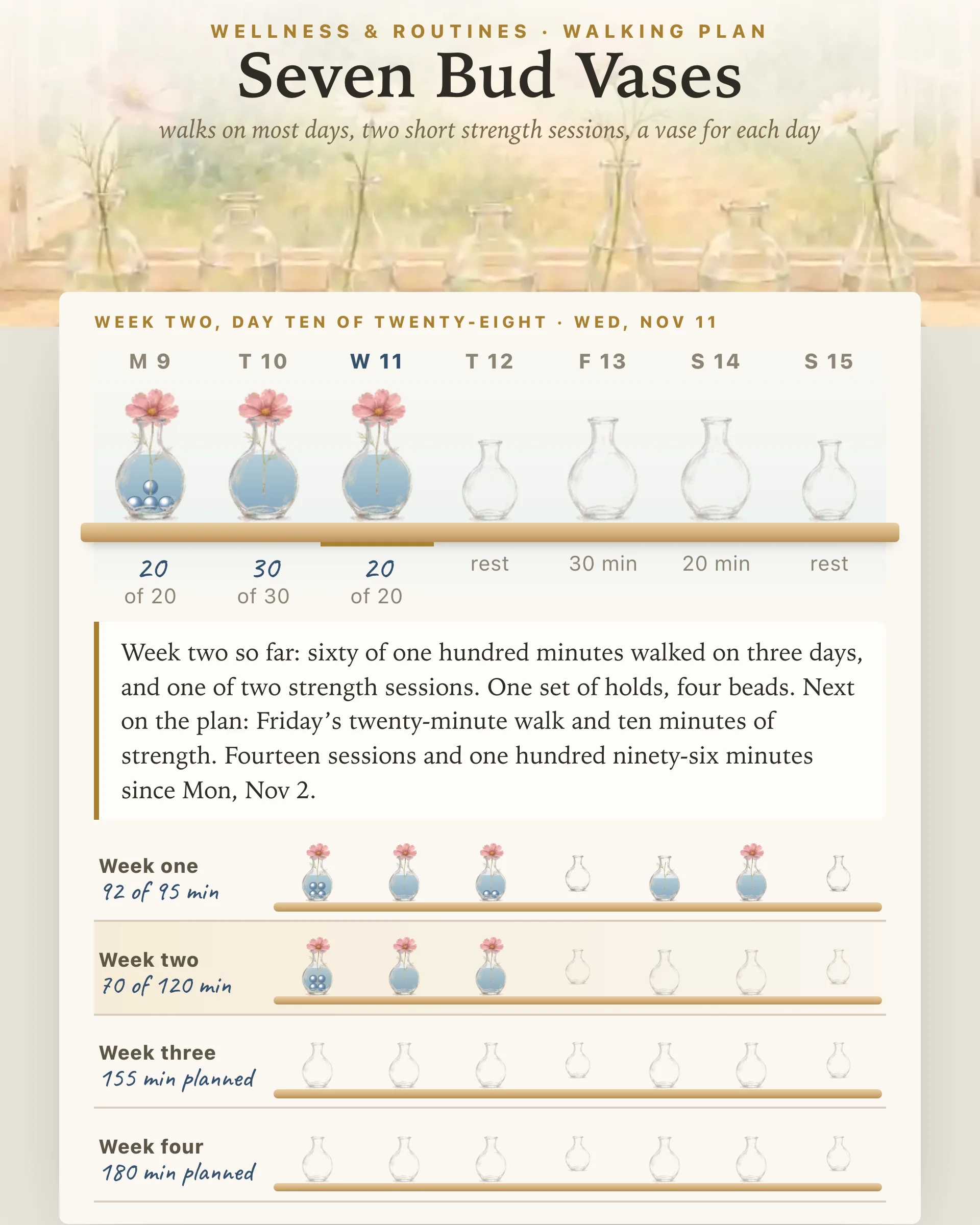
Looking up exercise for high blood pressure usually means a doctor has brought up your numbers. Regular movement is one of the steps doctors recommend alongside any medicine they prescribe, never in its place. This page turns that advice into four weeks you can follow: walks on five days, two short strength sessions, and an optional set of isometric holds. Each day is a small glass vase on a windowsill, and the minutes you move are the water that fills it.
Treat this plan as something to bring to your next appointment, not a replacement for one. Ask your doctor before you begin if you have a heart condition, very high readings or any new symptoms, and ask again before you add the holds. If you have had a fall, dizziness, a joint replacement or pain, a physical therapist can help adjust the moves. Keep taking your medicine as prescribed. The page records minutes only, never asks for a reading and sets no number to reach.
Every week has five walking days and two rest days, and on two of the walking days a short strength session joins the walk. Walks grow from fifteen minutes in week one to thirty in week four. Strength sessions last ten minutes for the first two weeks and fifteen after that. Week one adds up to ninety-five minutes, and week four to one hundred eighty.
Press begin and a clock runs the session. A walk opens with three easy minutes, holds a steady stretch at a pace where you could talk in short sentences but not sing, and ends with two easy minutes. A strength round is five moves at a sturdy chair, the wall and the bottom stair, forty-five seconds each with fifteen seconds to ease off. The clock keeps real time when your phone locks, and a pause stops it.
Only finished work counts. A session you stop early keeps its whole minutes, a round counts once all five of its moves have run out, and anything under a minute saves nothing. Water rises in today's vase as you go, and once the day's plan is done, a flower opens. Below the sill, a reading tallies the week's walking minutes and days, the strength sessions, and what comes next.
The American College of Sports Medicine's position stand on exercise and hypertension recommends moderate activity on most, preferably all, days of the week, chiefly endurance work such as walking, with resistance exercise added. It also reports that blood pressure stays lower for up to twenty-two hours after a single endurance session, which fits the advice to spread walks across the week. The American College of Cardiology's summary of the 2025 US guideline asks for at least seventy-five to one hundred fifty minutes a week of aerobic exercise, resistance training or both, combined with medication when it is needed.
Isometric exercise for blood pressure means holding a muscle still under load, such as sitting back against a wall with your knees bent or squeezing a hand gripper. A 2023 network meta-analysis of 270 trials found that each of the five kinds of training it compared lowered resting blood pressure on average. Isometric training lowered it the most, and the wall squat ranked highest for systolic pressure.
The wall squat holds here follow the home trials: four holds of two minutes with two minutes of rest, three days a week. In a 2024 pilot of home wall squats with thirty adults, one group set its own depth by feel, aiming for effort that climbed from about four to about eight on a ten-point scale across the four holds, and everyone was told to breathe normally the whole time. That trial lasted four weeks, its volunteers were mostly young adults with normal or mildly raised readings, and none took blood pressure medicine. A 2024 review of handgrip training that looked at readings taken across a whole day and night found only a small effect on daytime diastolic pressure and no clear change in the rest.
So the trials are encouraging, but they are short and small. They measured blood pressure rather than heart attacks or strokes, and they compared exercise with no added exercise, not with medicine. That is why the holds are optional here, and why none of it replaces your prescriptions.
Breathe out on every effort and never hold your breath, least of all during a hold. Counting out loud keeps the air moving. Stop, sit down and rest if you feel dizzy or lightheaded, chest pain or pressure, a sudden severe headache, or simply unwell, and call 911 if chest pain does not ease within a few minutes of rest. Stop any move that hurts, and keep a sturdy chair or the kitchen counter within reach while you stand.
To check your pace, The Brisk Walking Metronome has you tap your steps for a minute. The Daily Steps Ladder turns a week of step counts into a gradual climb, and The Walking Workout Ribbon varies the walking days once these four weeks feel settled. Once thirty-minute walks feel settled, The Thirty-Minute Window times a daily half hour as one walk or a few shorter ones.
Steady aerobic movement such as walking on most days is where the guidelines start, with strength work on a couple of days. In a large 2023 review of trials, isometric holds such as wall squats brought the biggest average drop in resting blood pressure, but many of those studies were short and small. The best choice is the one you will keep doing and your doctor agrees with.
In trials, short holds done three times a week, such as four two-minute wall squats, lowered resting blood pressure on average within a few weeks. Many of those studies enrolled a few dozen people with normal or mildly raised readings who took no medicine, so they say little about years of practice or about people already on treatment. When readings were taken around the clock, handgrip training showed only small and mostly unclear effects.
The 2025 US blood pressure guideline from the American Heart Association and the American College of Cardiology suggests at least seventy-five to one hundred fifty minutes a week of aerobic exercise, resistance training or both. This plan begins at ninety-five minutes in its first week and reaches one hundred eighty in its fourth, spread over five days.
For many people a moderate walk is a sensible start while a doctor looks after the rest of their care, but ask first if you have a heart condition, very high readings or new symptoms. Keep breathing through every move and hold, and stop for dizziness, chest pain, a sudden severe headache or any sense of being unwell.
Do not make that swap yourself. The trials compared exercise with no added exercise and did not test going off medicine, so keep taking what you are prescribed and talk to your doctor before changing anything. This page logs minutes only and never asks for your readings.
By the team behind Fabulous, the science-based self-care app used by over 30 million people.


