
The Overwhelm Recovery ProtocolWellness & Routines · ~5 min
About this template · Updated November 2026
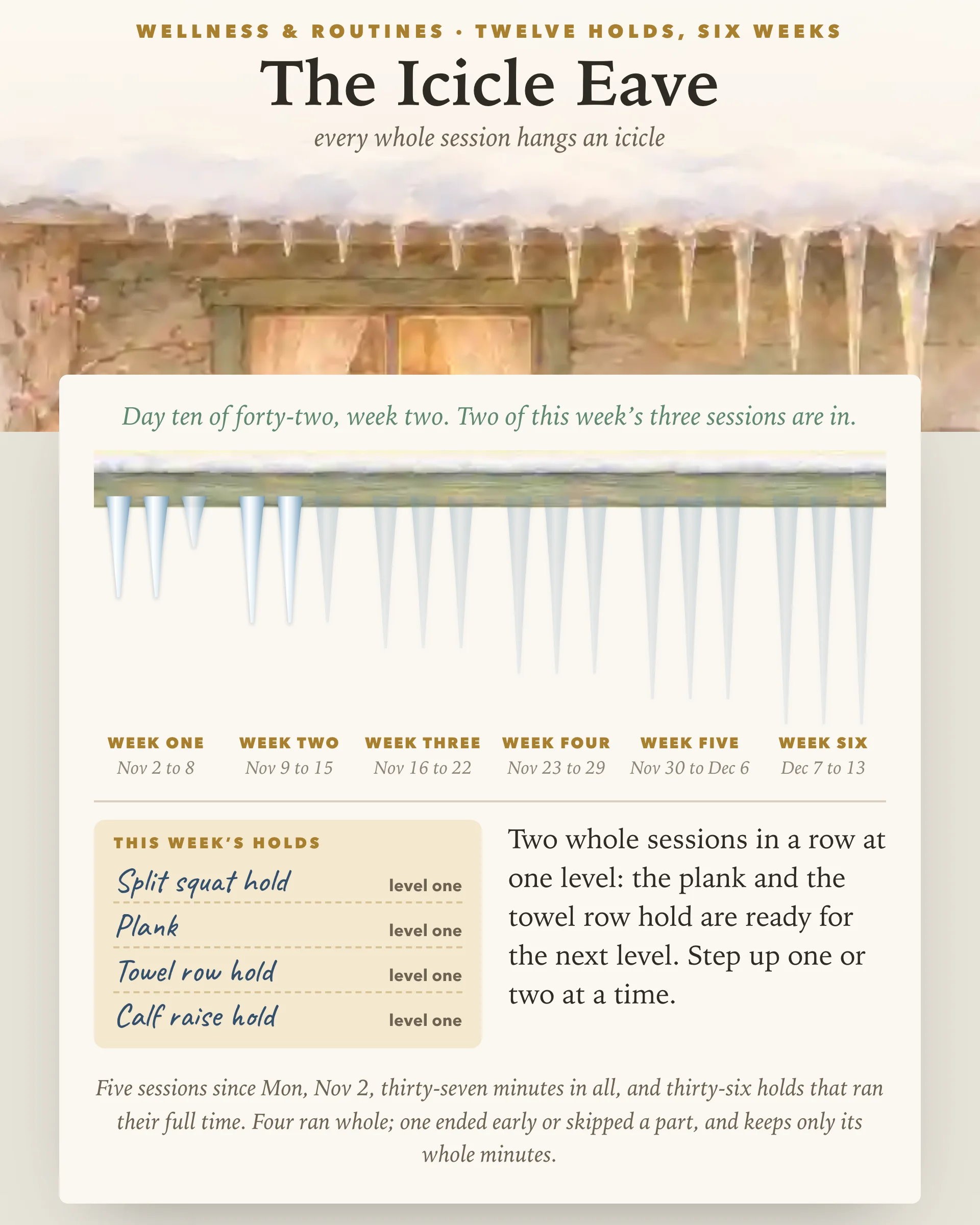
An isometric exercise asks your muscles to work while nothing moves. You press, pull or hold up your own weight in one position and stay there, the way an icicle hangs from a roof edge. This page gathers twelve of those holds, gives each one three levels, and turns them into six weeks of short sessions, three days a week, with holds that grow from twenty seconds to forty-five.
The twelve holds sit in three families. Legs and hips: the wall sit, split squat hold, calf raise hold and glute bridge hold. Middle and back: the plank, side plank on the knee, hollow hold and face-down back hold. Arms and grip: the push-up hold at a wall, towel row hold, towel squeeze for grip and towel pull-apart. Each session takes one hold from each family in turn, so your legs, middle and upper body all get some work. Week one asks for four holds, week three adds a fifth and week five a sixth. You choose which ones, and a hold already in today's session cannot take a second place in it.
Press begin and a timer runs the session: a minute of warm-up, then each hold twice, with twenty seconds of rest after each round. The clock reads real time, so a phone that locks mid-session still knows how long you held, and a pause stops it. A round counts only when its hold runs to the end. Stop early and you keep the whole minutes you were there, never a rounded-up number, and anything under a minute saves nothing. Time you skip never comes back.
Each whole session hangs an icicle on the eave, under the week it belongs to. Week six's icicles hang more than twice as long as week one's, because the holds do too. A session cut short hangs a shorter icicle, as long as the share of its holds that ran in full.
Every hold starts at level one, which usually means a counter, a wall or bent knees. Levels two and three take you down to the floor, deeper into a bend, or onto one side at a time. The towel holds grade by effort instead: a gentle pull, a firm one, then a strong one that is never all-out. After each session, tap how it felt. When a hold has run whole in two sessions in a row at the same level, and neither felt hard, the page says it is ready for its next level. An ended-early session in between starts that count again. A session that felt hard, even one you stopped partway, points the other way: ease the hold that strained back down a level.
Holding still tempts people to hold their breath, and that is the one habit to drop. In a 1985 study of five experienced bodybuilders, blood pressure measured inside an arm artery climbed to extreme peaks during heavy lifts, and part of that rise came from straining against a closed throat. Those were heavy weights lifted to failure, far harder than anything on this page, and the study says nothing direct about gentle holds. Its lesson still carries: breathe out as you settle in, keep breathing, and count the seconds out loud, since you cannot count aloud and hold your breath at once.
A study of thirty-five middle-aged and older adults gave twenty-eight of them twelve weeks of whole-body isometric training. Their knee strength, measured on a lab machine, rose, while the seven people in the comparison group showed no such gain. The group was small and lopsided, and it tested its own program rather than these twelve holds or this six-week plan.
Isometric training also turns up in blood pressure research. A 2023 network meta-analysis pooled 270 randomized trials with 15,827 participants, each lasting two weeks or more, and found that isometric training lowered resting pressure the most, on average, of the exercise types it compared. In a home trial with eighty-four adults averaging seventy-one years old, whose readings ran from high normal to stage one hypertension, eight weeks of handgrip squeezes lowered readings taken at the clinic within that group, yet readings across a whole day and night did not change, and the groups did not differ from one another. Both measured blood pressure, not heart attacks or strokes. This page is a strength plan, not a blood pressure treatment, and nothing here replaces a prescription.
Get your doctor's okay first if you have high blood pressure, a heart condition or a hernia, or if you are pregnant. Check with a doctor or physical therapist, too, if you have had a fall, dizziness, a joint replacement or pain. Stop any hold that hurts or makes you dizzy, and keep a sturdy chair or counter within reach for the standing holds.
If one hold becomes a favorite, The Sunflower Wall Sit Challenge builds a month around a single timed sit, and The 30-Day Plank Challenge does the same for planks on a ramp of rising times. If your doctor has asked you to move more for your blood pressure, Seven Bud Vases pairs walks on most days with two short strength sessions a week. For a hold you walk with, The Six-Week Hay Wagon builds the carry three ways: two weights, one weight, or a load held at the chest.
They are exercises where a muscle works hard while the joint stays still, such as sitting back against a wall with bent knees or holding a plank. The muscle keeps the same length, which is what isometric means, so the effort comes from staying in a position rather than moving through one.
It can be a gentle way in, since nothing moves fast and every hold here has an easier version at a counter, a wall or a chair. In a small study of thirty-five middle-aged and older adults, twelve weeks of whole-body isometric training raised knee strength on a lab machine. It was one small group and tested its own program, so start at level one and see how your body answers.
There is no single right number. This plan starts at twenty seconds a hold in week one and reaches forty-five seconds in week six, with each hold done twice. Come out of a hold as soon as your form slips or you notice you have stopped breathing; only rounds that run their full time count, and the next session is another try.
Ask your doctor first. Holding still under effort raises blood pressure while the hold lasts, and holding your breath pushes it higher, so breathe steadily and count out loud. Trials of isometric training report lower resting blood pressure on average, but this page is a strength plan rather than a blood pressure treatment, and it never stands in for your medicine.
No weights at all. A bare stretch of wall, a sturdy chair, a kitchen counter, a mat or rug for the floor holds, a bath towel for the row and a hand towel for the squeeze and the pull-apart cover all twelve.
By the team behind Fabulous, the science-based self-care app used by over 30 million people.


