
The Overwhelm Recovery ProtocolWellness & Routines · ~5 min
About this template · Updated November 2026
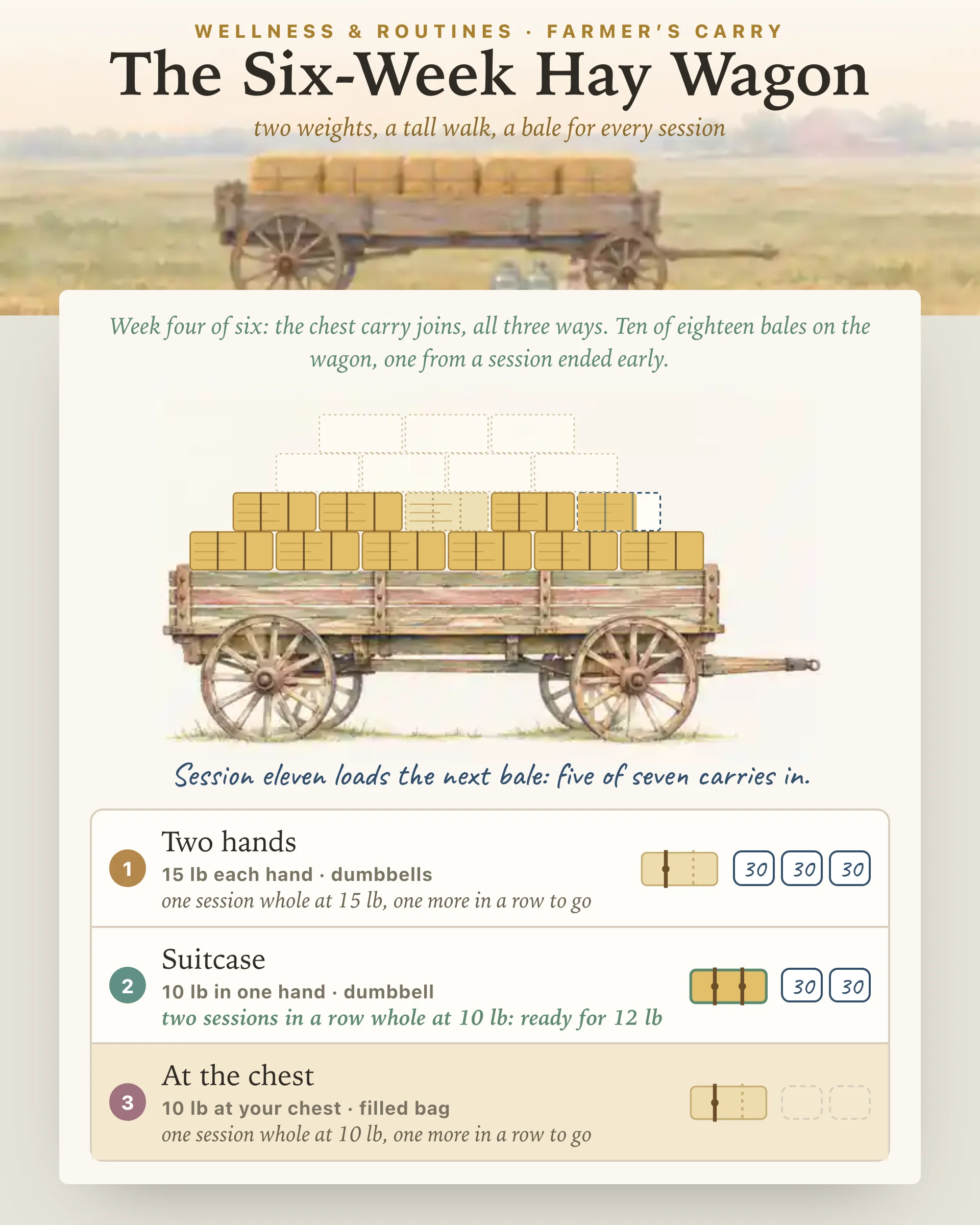
A farmer's carry asks little in the way of skill. You pick up something heavy in each hand, stand tall, walk, and set it down. The hard part is holding your shape: grip closed, shoulders down, trunk steady, steps even. This page turns that into six weeks of short sessions, three days a week, with a hay wagon that takes one bale for every session you carry through.
Talk to your doctor or a physical therapist before week one if you have a hernia, back pain, a heart condition or high blood pressure, or if you are pregnant. A heavy carry makes your trunk brace, and bracing tempts you to hold your breath. Keep breathing, out and in, through every carry. Set the weights down if anything hurts or you feel dizzy, and carry on clear, level ground with room to stop.
Pick up. Stand between the two weights with the handles beside your ankles. Push your hips back with a long back and soft knees, grip both handles, then stand by pressing the floor away.
Carry. Shoulders down and back, chest tall, eyes ahead, short and even steps. Turn in small steps, never twisting at the waist.
Set down. Stop with your feet planted and hinge back the way you came up until the weights rest on the floor. Never drop them or let them swing down.
Splitting a load between two hands is kinder to the back. In a lab study by McGill, Marshall and Andersen, six people walked with buckets; thirty kilograms in one hand gave higher estimated low back compression than the same weight split fifteen and fifteen, and even thirty in each hand loaded the spine less than thirty in one. It estimated load in a lab and tracked no injuries. So keep the suitcase weight no heavier than one of your two-hand pair. When three strongman competitors were measured, their suitcase carry called on most of their hip strength to hold the pelvis level, with trunk muscles helping. The authors suggested carrying could round out a lifting program but did not test it, and none of the three were beginners.
You can start without dumbbells or kettlebells. A full gallon jug of water weighs about eight pounds, and two of them make the starting load for week one. Filled shopping bags work too: double-bag cans or rice, then step on a bathroom scale holding each one and subtract your own weight.
The card at the top builds today's carry: what is in your hands, how heavy, and whether you go by the clock or by a measured distance. Tap start, take five seconds to pick up, and the clock counts down from the real time, even if your phone locks. A carry counts whole only when it runs its full time or you tap that you reached your mark. One set down early goes in the log marked that way and keeps nothing toward going heavier. The one-minute rest after each carry logs nothing.
Each way of carrying has a small bale with two twines. A twine ties for each whole session in a row at one weight, reading the latest sessions in order; two tied twines bring an offer of the next weight on the list. A session ended before that way, a carry set down early, or another weight undoes the run. Every finished session loads a bale on the wagon; one ended early goes on loose.
Week one is four two-hand carries of twenty seconds; week two stretches them to thirty. The suitcase carry joins in week three and the chest carry in week four, so each session then holds seven carries. Weeks five and six lengthen every carry to forty and then forty-five seconds, about fifteen minutes in all with a warm-up of marching in place.
The World Health Organization advises adults to do muscle-strengthening activity for all the major muscle groups on two or more days a week. Carries alone do not cover every group, but they make a steady start. The breathing rule draws on work such as MacDougall and colleagues, who measured blood pressure in five experienced bodybuilders lifting near their maximum and found extreme peaks, partly from straining against a held breath. Those were young, trained men on near-maximal lifts, not beginners with water jugs. No study cited here followed people through a carry program, so none promises a result from these six weeks.
If your hands give out before the rest of you, The Grip Tray trains them on their own. A single kettlebell has its own beginner plan in The Kettlebell Woodpile. And for longer walks with light weights moving in your hands, see The Hand-Weight Boardwalk. For holds that stay in one place, The Icicle Eave times twelve of them, a towel squeeze for grip among them.
It is a loaded walk. You pick up a weight in each hand, stand tall, walk for a set time or distance, then set them down with the same care you used to pick them up. Grip, shoulders, trunk and legs all work at once, much as they do on the trip in from the car with the groceries.
Yes, the two names describe one exercise. Strongman contests call it the farmer's walk and race it over a course with very heavy handles. Training plans tend to say carry and do it slower, for a set time or a measured distance, with a weight you can hold without leaning.
Heavy enough that the last seconds take real effort, light enough that you never lean, shuffle or feel your grip opening. This plan starts at eight pounds in each hand, about what a full gallon jug of water weighs, and moves up one step at a time. If your posture slips before the time is up, go lighter rather than shorter.
Here the carries start at twenty seconds, or fifty feet if you measure by distance, and grow to forty-five seconds, or a hundred and ten feet, by week six. A minute of rest follows each one. The clock suits a hallway; a measured distance suits a driveway or a path.
Ask a doctor or physical therapist first if you have a hernia, back pain, a heart condition or high blood pressure, or if you are pregnant. Carrying makes your trunk brace, and bracing while holding your breath drives blood pressure up sharply, so breathe out and in through every carry.
By the team behind Fabulous, the science-based self-care app used by over 30 million people.


