
The Overwhelm Recovery ProtocolWellness & Routines · ~5 min
About this template · Updated November 2026
A kettlebell is a cast-iron ball with a handle, and one is enough for a whole beginner program. Exercise with a kettlebell as a beginner starts with three questions: which bell, which moves in which order, and how often. This page answers all three for six weeks, then keeps count while you work.
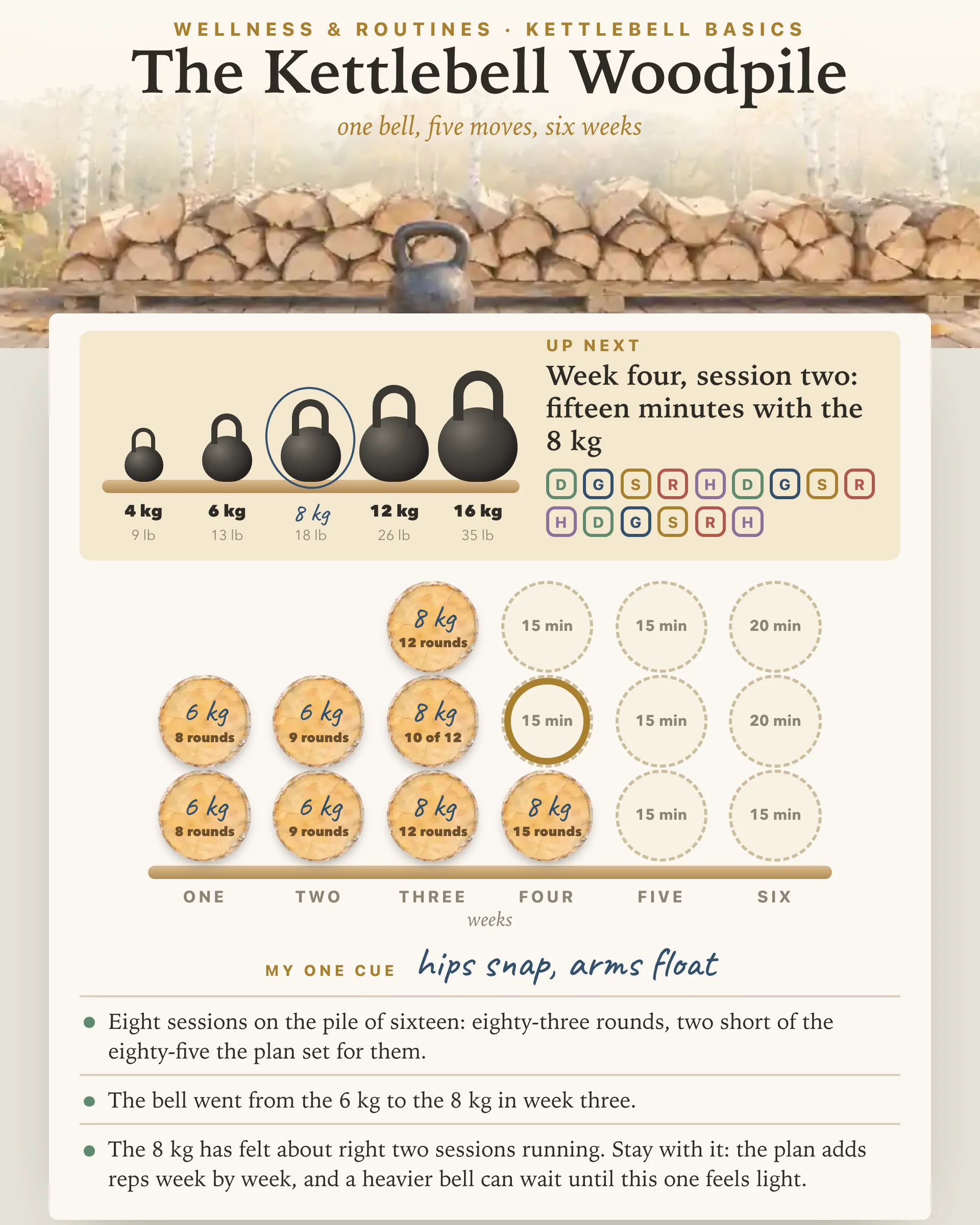
Plenty of charts hand women one starting bell and men another. This page asks what you have lifted before instead. New to weights, or back after a long break: start near six kilograms, about thirteen pounds. Some light dumbbell or bodyweight training: start near eight. Lifting most weeks: start near twelve.
The shelf circles a bell, and your body has the final say. Ten slow deadlifts with a long back, then a thirty-second hold at your chest, should both feel steady. If either one strains, go down a bell; lighter is never wrong while you learn.
Each new move leans on the ones before it.
Each move on the page comes with three cues and an easier version.
The swing is where beginners most often go wrong. It is a hip hinge, not a squat and not an arm raise. Your hips throw the bell and your arms only guide it. In a lab study of the swing with a sixteen-kilogram bell, McGill and Marshall recorded a hip-hinge pattern with rapid bursts of muscle effort and real compression on the low back, and noted that while many people credit swings with helping their backs, a few find them irritating. So the rule here is plain: stop if your back hurts. When you mark a session as one where your back hurt, the pile tells you to rest and see a doctor or physical therapist if it lingers, and the next session swaps its swing minutes for walking in place.
Each session runs on a clock. At the top of each minute you do that minute's reps and recover for what is left of it, while the moves take turns down a row of colored squares. Week one is eight minutes of deadlifts and goblet squats; week six ends with twenty minutes of all five moves. The clock works out where you are from the real time since you pressed start, minus any pauses, so a phone that locks mid-session or a long pause never pushes it off count.
When the clock stops, you note your rounds, how the bell felt and how your back felt, and stack the session. A painted log joins that week's column of the woodpile, your bell and rounds written on its face. Underneath, the pile reads itself back: rounds against what the plan asked, when you changed bells, and whether the bell has felt light, about right or heavy two sessions running. Two light sessions with every round done suggest the next bell up; two heavy ones suggest fewer reps or a lighter bell for a week.
If you want a clock for moves of your own choosing, this minute-by-minute timer lets you set them up yourself.
The World Health Organization's 2020 physical activity guidelines ask adults for muscle-strengthening work on two or more days a week, and a kettlebell plan two or three days a week fits that well. In one randomized trial, forty workers with neck, shoulder or low back pain, most of them women and forty-four years old on average, trained with kettlebells three times a week for eight weeks. Their pain dropped more than in a group that did not train, and their back muscles grew stronger, but their aerobic fitness did not change. A scoping review of kettlebell research found effects that were mostly small and studies that were mostly small too, so treat the bell as a sound way to train strength, not as a cure for anything.
Check with your doctor or a physical therapist first if you have had a fall, dizziness, a joint replacement, a heart or blood pressure condition, back trouble or ongoing pain. Stop any move that hurts. Keep a sturdy chair or a counter within reach for the row and for any moment you feel unsteady, and clear the floor before you swing.
If you would rather build strength without a bell for now, Strength Training for Women Over 50 works with the dumbbells, bands or chair you already have, and The Resistance Band Rack uses bands that fit in a drawer.
Go by what you have lifted before, not by whether you are a woman or a man. Someone new to weights often starts near six kilograms, about thirteen pounds; someone who already uses light dumbbells near eight; a regular lifter near twelve. The right bell lets you do ten slow deadlifts with a long back.
It is built for anyone starting out, and that includes women at any age. The bell is matched to your experience, the sessions run eight to twenty minutes, and the moves work the hips, legs, back and grip. In one workplace trial of kettlebell training, most of the forty volunteers were women, and the group's average age was forty-four.
Two or three, with a rest day between sessions. This plan starts with two short sessions a week for the first two weeks and then moves to three, so your hands, hips and back get used to the bell before the minutes grow.
Done as a hip hinge, the swing works the muscles of the hips and back hard, and many people find their back feels better for it. Done as a squat or an arm raise, it can irritate the low back. Learn the deadlift first, keep the first swings small, and stop if your back hurts.
By the team behind Fabulous, the science-based self-care app used by over 30 million people.


