
The Overwhelm Recovery ProtocolWellness & Routines · ~5 min
About this template · Updated September 2026
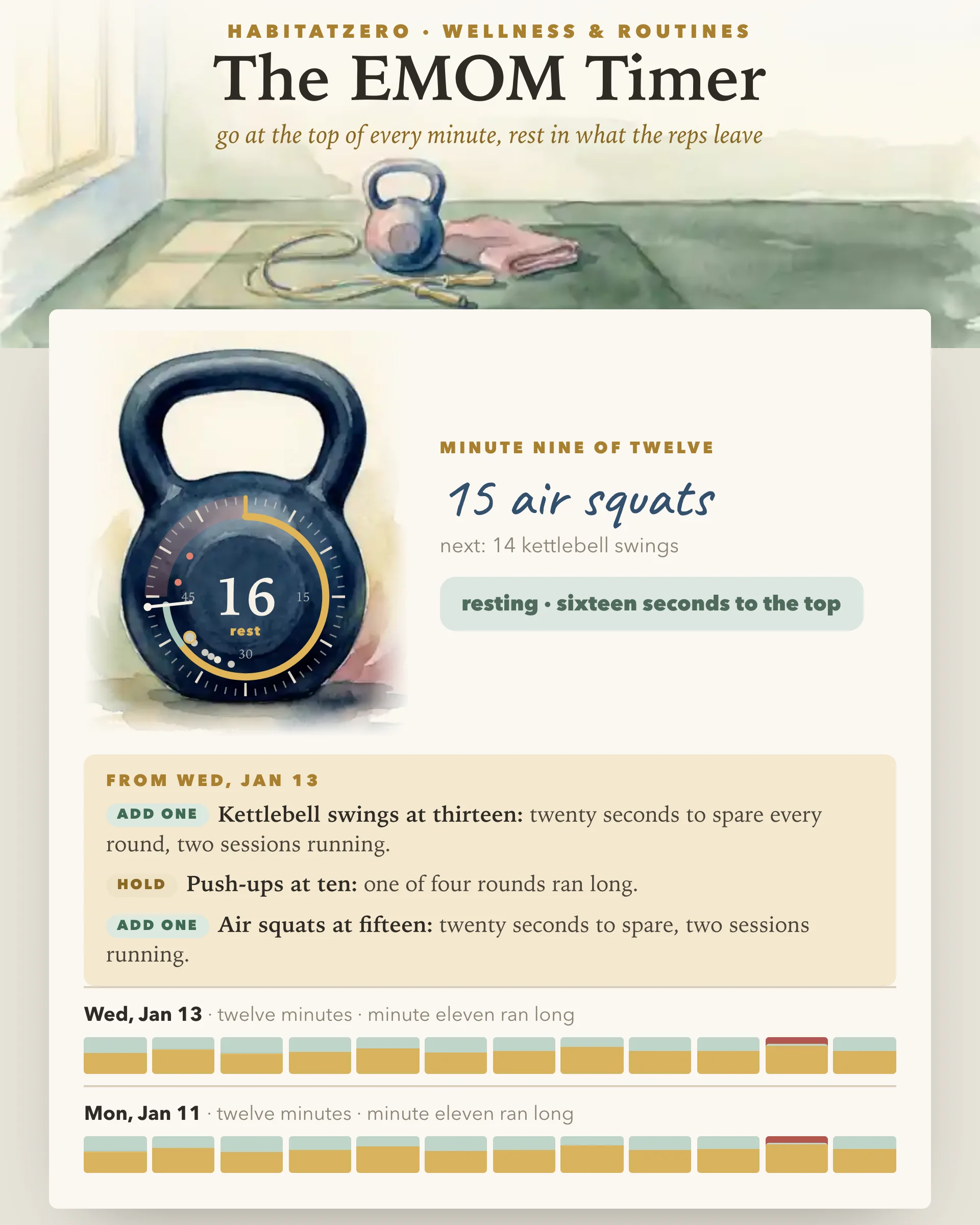
EMOM stands for every minute on the minute. When the clock reaches the top of a minute, you start a set number of reps. However long they take, the rest of that minute is yours to recover, and the next minute begins on time whether you feel ready or not. Ten rounds of twelve kettlebell swings becomes ten minutes, each one a fresh start.
No single person is credited with inventing the format. Today it sits beside AMRAP (as many rounds as possible) and rounds-for-time as one of the common ways cross-training workouts are built. What sets it apart is who sets the pace. In an AMRAP you do; in an EMOM, the minute does.
The timer on this page is a painted kettlebell with the minute chalked around its body, and the handle marks the top. You fill the minute first: tap a suggested move or name your own, give each one its reps, and choose how many rounds to run. With two or more moves, you can let them take turns, one move a minute, or fit them all inside every minute. The line under the rounds adds up the session, up to forty minutes.
Press chalk up and go, and a ten-second count-in leads to the first top. Each new minute opens with a gold flash on the bell and a short spoken line for screen readers. If you switch the sound on, three quick pips count down to a chime at the top. Sound starts off.
When your last rep lands, tap reps done. A chalk dot goes on the bell where the sweep stood, and the arc behind it turns from gold to green; that green stretch is your rest. Every second is worked out from timestamps, so switching tabs or letting the screen dim will not throw the minute off.
The page calls a round long when the reps leave less than fifteen seconds of rest. That line is this timer's rule of thumb, not a figure from research, and its job is to make a pattern easy to see. A minute that reaches the top with no tap counts as long too, since finished reps would have left you time to tap. If you finish right on the top, a tap in the first two seconds of the next minute still counts for the minute you just closed.
After each session the page reads every move on its own. When each round of a move left twenty seconds or more in two sessions running, the reading says add one, with a button that sets the new number. One roomy session earns one more like it before the page asks for more. A few long rounds mean hold, and more than half mean take one off. The log keeps twenty sessions, one bar per minute, so the rounds that ran long stand out at a glance.
Studies of EMOM itself are small. In one, twelve experienced athletes did the same squats, pull-ups and shoulder presses in three formats, and the EMOM version showed the least slowing within each set, while rounds-for-time showed the most. That fits the idea that built-in rest keeps each set crisp, but it was one session of each format with a dozen trained people. It does not show that EMOM builds more strength or fitness over months.
Rest length matters when strength is the goal. A systematic review of rest intervals in resistance training found solid strength gains even with rests under a minute, yet trained lifters seemed to need more than two minutes between sets to get the most strength from their work. The rest an EMOM leaves is always less than a minute, so if the heaviest possible effort is your aim, plan other sessions for that and use EMOM for steady, repeatable work.
A group of exercise scientists has also argued that AMRAP, rounds-for-time and EMOM formats make training load and recovery hard to control when the aim is health, while noting they had not measured it directly. Watching how much rest each minute really leaves is one practical way to keep that load in view.
For general health, the Physical Activity Guidelines for Americans ask adults for muscle-strengthening activity at least two days a week, alongside regular aerobic activity. A short EMOM of push-ups and squats is one tidy way to cover the strength part.
Stop at once if something hurts sharply or you feel dizzy or faint, and never push through chest pain or breathlessness that feels wrong. If you live with a heart condition or trouble in a joint, talk with your doctor or a physical therapist before adding timed intervals. Warm up first, and choose moves you can still do cleanly when you are tired.
Reach for it when you want structure without much planning: a ten-minute EMOM before breakfast, swings and squats taking turns at lunch, or a short finisher after a run. For longer work and rest splits, The HIIT Timer lets you set both, and for twenty seconds on and ten off, The Tabata Timer is built around that rhythm. The Workout Journal keeps the rest of your training week in one place.
EMOM stands for every minute on the minute. At the top of each minute you start a set number of reps, and whatever time the reps leave before the next minute begins is your rest.
Choose a number you can finish with fifteen to twenty seconds to spare. This timer suggests adding a rep once every round of a move leaves twenty seconds or more in two sessions running, and taking one off when most rounds run long.
There is no fixed length. This timer runs anywhere from one minute to forty, so start around ten and lengthen the session only while your finishes stay steady and your form holds up.
The next minute starts anyway. Here, a minute that reaches the top with no tap counts as one that ran long, and a move where more than half the rounds run long gets a reading to take a rep off.
This page shows a filled example so you can see how the bell and the log behave. Running your own sessions and keeping the log happens in HabitatZero, and it costs nothing.
By the team behind Fabulous, the science-based self-care app used by over 30 million people.


