
The Overwhelm Recovery ProtocolWellness & Routines · ~5 min
About this template · Updated November 2026
Think about the last jar you handed to someone else to open, or the trip back to the car because the grocery bags were cutting into your fingers. Grip is the strength you use all day without noticing, until it slips. Training it takes a few minutes, three times a week, and six things you already own.
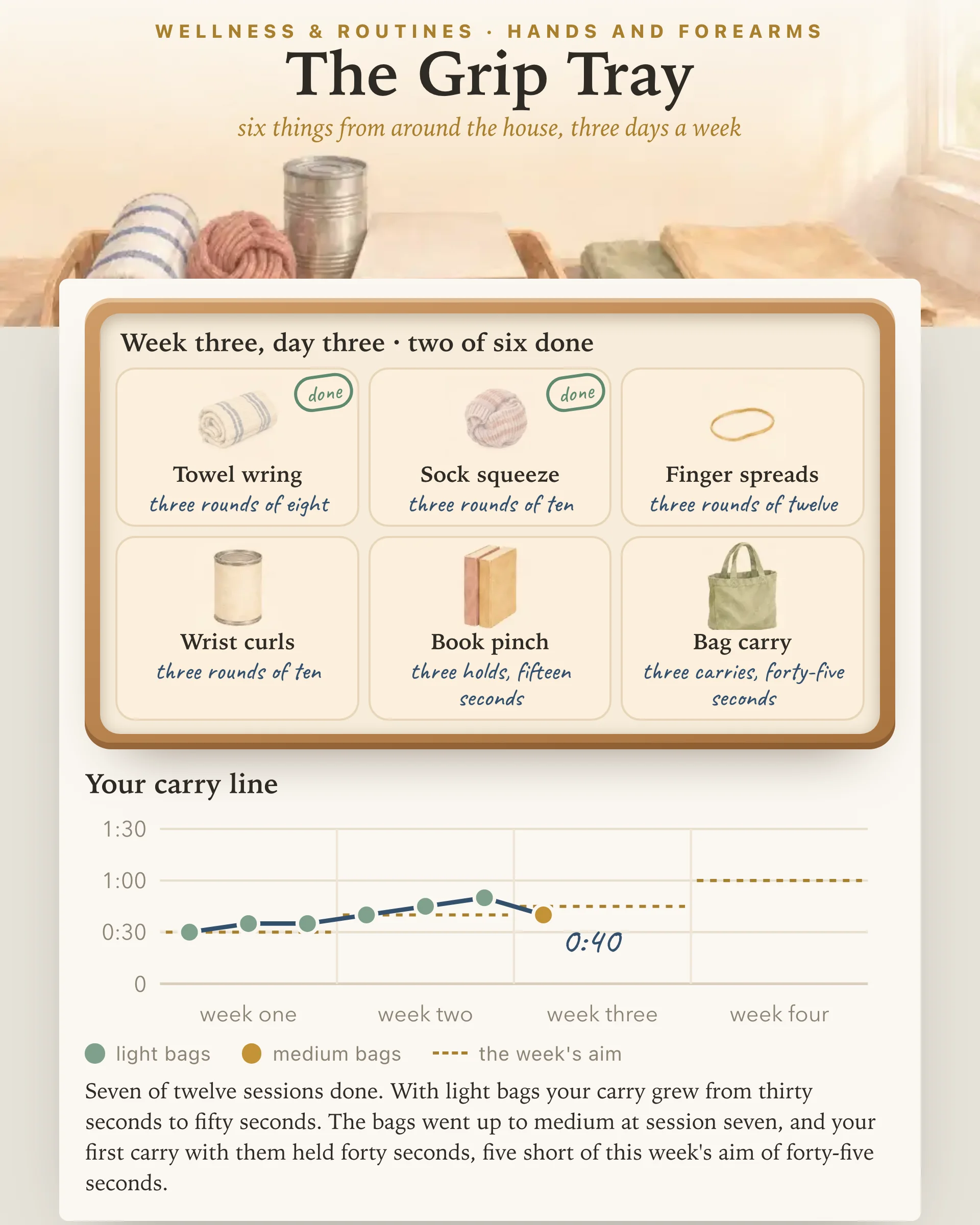
This page sets those six things out on a tray. Each one carries a single move, and the rounds grow over four weeks. The one move you time, carrying two grocery bags, draws a line you can watch climb.
Hands do several jobs, so the routine trains several kinds of grip instead of one squeeze repeated.
Tap a thing on the tray and its move opens underneath with this week's rounds: two rounds of five twists each way in week one, three rounds of ten by week four. Mark a move done and the next thing opens, so you never plan the order.
The carry has its own timer. Pick up the bags, start it, walk beside the counter and stop it the moment you set them down. Timed it with a clock? The five-second buttons let you enter it. The sheet keeps your longest carry of the session and asks how heavy the bags were: light with a couple of cans in each, medium with a half-gallon jug, heavy with a full gallon.
When you put the tray away, the session fills a square in your four weeks and adds a point to your carry line. Each point is colored by bag weight, and a dotted mark shows the week's aim: thirty seconds in week one, rising to a full minute in week four. The reading under it says how far you have come at each weight. Expect the line to dip when the bags get heavier. A shorter carry with more in the bags is still progress.
The plan runs twelve sessions on three days a week, ten minutes at first and fifteen by week three. If you miss a day, the next session simply waits for you.
Grip strength gets attention because it is easy to measure and tracks with health. The large PURE study, which followed nearly 140,000 adults in seventeen countries, found that weaker grip went along with a higher risk of death from any cause and from cardiovascular disease over a median of four years. The authors are careful here: their data show a link, and they call for research into whether getting stronger lowers those risks. Nobody has shown that squeezing a sock ball adds years.
What training can do is make your grip stronger. A review of twenty-four trials in healthy adults over sixty found small but real gains in grip strength across many kinds of exercise, and suggested that practice close to the task, along with mixed programs, gives grip a fitting challenge. That is the reasoning behind practicing with the things you actually carry and twist.
The World Health Organization's physical activity guidelines recommend regular muscle-strengthening activity for every age group, and these six moves can be one part of it.
Squeeze to a firm effort, not to strain. If you live with arthritis, notice numbness or tingling, or are recovering from a hand or wrist injury or surgery, talk to a doctor or hand therapist before you start, and ask which moves suit you. Stop any move that hurts. Walk the carry beside a counter or along a hallway wall you can reach for, and if you feel unsteady, stand still and hold the bags instead.
Set the tray out on your three strength days and keep it somewhere you will see it. If you want more for your arms and shoulders, The Resistance Band Rack pairs well on the same days. For strength around the whole home, The Whole-House Strength Routine turns your rooms into stops, and The Wall Push-Up Ladder adds a pushing move your wrists will feel too. For the rest of the arm on those days, The Arm Toning Workout adds presses, rows and curls.
One that covers the different jobs a hand does: squeezing, opening the fingers, twisting, pinching, moving the wrist and holding a load while you walk. Two or three sessions a week with a rest day between them is a sensible start. The routine here uses six moves for ten to fifteen minutes, three days a week for four weeks.
Yes. A rolled dish towel gives you twisting, a ball of socks gives you squeezing, a rubber band works the muscles that spread your fingers, a soup can trains the wrist, two paperbacks train your pinch, and grocery bags give you something real to carry. Add weight to the bags as the weeks go by.
No. A spring gripper trains one movement well, closing the hand against a spring. It can be a useful extra later on, but it leaves out opening the fingers, pinching and carrying, which make up much of what your hands do in a day.
It depends on where you start. A review of twenty-four trials with people over sixty found that many kinds of exercise raised grip strength by a small amount on average. Treat these four weeks as a first block, then repeat them with heavier bags rather than expecting a big change in a month.
Ask a doctor or hand therapist before starting if you have arthritis, numbness, tingling, or a recent hand or wrist injury or surgery. They can say which moves to keep and how hard to squeeze. On any day, stop a move that causes pain instead of pushing through it.
By the team behind Fabulous, the science-based self-care app used by over 30 million people.


