
The Overwhelm Recovery ProtocolWellness & Routines · ~5 min
About this template · Updated November 2026
High-intensity interval training, or HIIT, has a simple shape: work hard for a short spell, ease off long enough to recover, and repeat. For weight loss, here is the plain version first: intervals are worth doing, on their own they change your weight very little, and what you eat and how much you move through the rest of the day matter more.
One 2017 review pooled thirteen trials that set interval training against steady, moderate exercise in adults aged eighteen to forty-five with overweight or obesity, on average ten weeks of three sessions a week. Both kinds of training trimmed a little body fat, with no difference between them, and body weight barely moved in either; the interval groups simply trained for about forty percent less time. A second review of thirty-one studies, from an Australian exercise science team, found similar small drops in body fat from both, neither large enough for the authors to call clinically meaningful.
Those trials were short, and the first took in only adults under forty-six, so they say little about a year of training or about people over fifty. The case for intervals rests on time and fitness, not on a faster route to a smaller number. Nothing on this page promises extra calories burned after you stop, fat leaving one chosen spot, or a new shape.
In a year-long trial of 439 inactive postmenopausal women in Seattle, one group built up to forty-five minutes of moderate exercise on five days a week, one changed how they ate, and one did both. The exercise group lost a little weight, the eating group about three and a half times as much, and the pair together did best.
Total movement matters for the same reason. The American College of Sports Medicine's 2009 position stand found that 150 to 250 minutes of moderate activity a week brings only modest weight loss, with clearly larger losses above 250. Two or three sessions here come to between twenty minutes and an hour and a quarter a week. Walks, stairs and time on your feet hold the rest, which is why this sheet records no weight, no calories and no measurements.
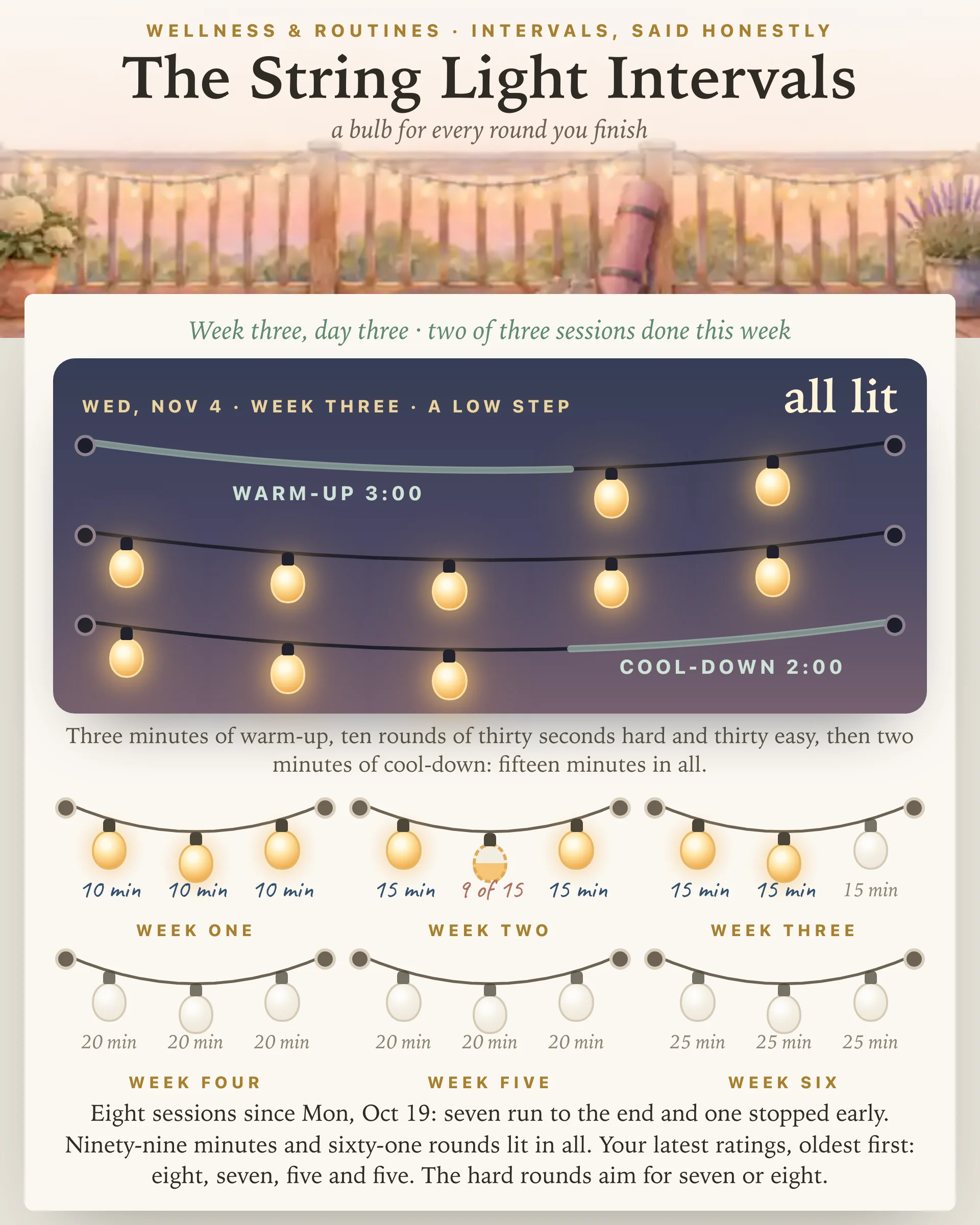
Each session hangs as a string of cafe lights, one swag of cord for every five minutes, with a bulb for every round between the warm-up and the cool-down. Pick ten to twenty-five minutes and hard and easy parts of twenty to sixty seconds; the page fits in as many whole rounds as the time allows and hands spare seconds to the cool-down, so the parts always add up. No jumping keeps one foot on the floor, a low step uses the bottom stair with a rail in reach, and jumps are only for knees, ankles and a pelvic floor that are fine with landings.
The timer keeps real time, so a phone that locks mid-round does not lose your place, and a bulb lights only once its whole round, hard part and easy part, has run. Stop early and the page keeps whole minutes and whole rounds; under a minute logs nothing. One tap for feeling unwell ends the session and brings up the stop note.
Work each hard part until you can manage only a few words at a time, about seven or eight out of ten, and use each easy part to get back to full sentences. Two heart rehabilitation researchers in Ottawa found the talk test a valid, reliable way to set exercise intensity, while noting it may suit short intervals less well, so the page also asks for a number from one to ten afterward.
Week one is ten minutes of twenty seconds hard and forty easy. Sessions lengthen first, then the hard parts grow, up to minute-long rounds across twenty-five minutes in week six. Two or three sessions a week, with an easier day between, light six smaller strings, one bulb per session, one string per week.
The Beginner HIIT Pinwheels teaches five set moves to someone new to intervals, while this page lets you shape your own session around a weight goal and says plainly what it can do. The HIIT Timer is a bare clock for intervals you already know. The Training Consistency Planner maps whole weeks around showing up. For the walking that fills most of a week, the Walking Plan for Weight Loss is the natural partner.
The 2015 update to that college's screening advice weighs how active you are now, any symptoms or known heart, metabolic or kidney disease, and how hard you plan to work. Talk to your doctor before starting if you have a heart or blood pressure condition, if effort has brought on chest pain, dizziness or faintness, if you are pregnant or had a baby in the past year, if you have joint problems or a joint replacement, or if you have not exercised in a long while. Stop at once for chest pain or pressure, dizziness, a racing or uneven heartbeat, or sharp pain, and call 911 if chest pain does not ease within a few minutes of rest.
It is good for fitness and modest for weight. Reviews of trials that set interval training against steady exercise found both trimmed a little body fat and neither moved body weight much on its own. Alongside changes in eating and more movement through the day, it is a useful, time-saving part of the picture.
Two or three sessions a week, with an easier day between them, is what most trials used and what this plan follows. Hard days need easy days around them, so let walking and everyday movement fill the rest of the week.
Not clearly. When the two were compared head to head, the fat lost came out about the same. Intervals reach that point in less time, so pick the kind you will actually keep doing.
Yes. Fast marching, step jacks, squats with a reach and knee drives raise your breathing with no landings at all, and a low step adds effort while one foot stays down. Save jumps for knees, ankles and a pelvic floor that are happy with them.
Anyone with a heart or blood pressure condition, anyone who has had chest pain, dizziness or faintness with effort, anyone pregnant or within a year of giving birth, people with joint problems, and anyone coming back after a long break. Stop at once for chest pain, dizziness or sharp pain.
By the team behind Fabulous, the science-based self-care app used by over 30 million people.


