
Leaves on a StreamEmotional Fitness · ~3 min
About this template · Updated September 2026
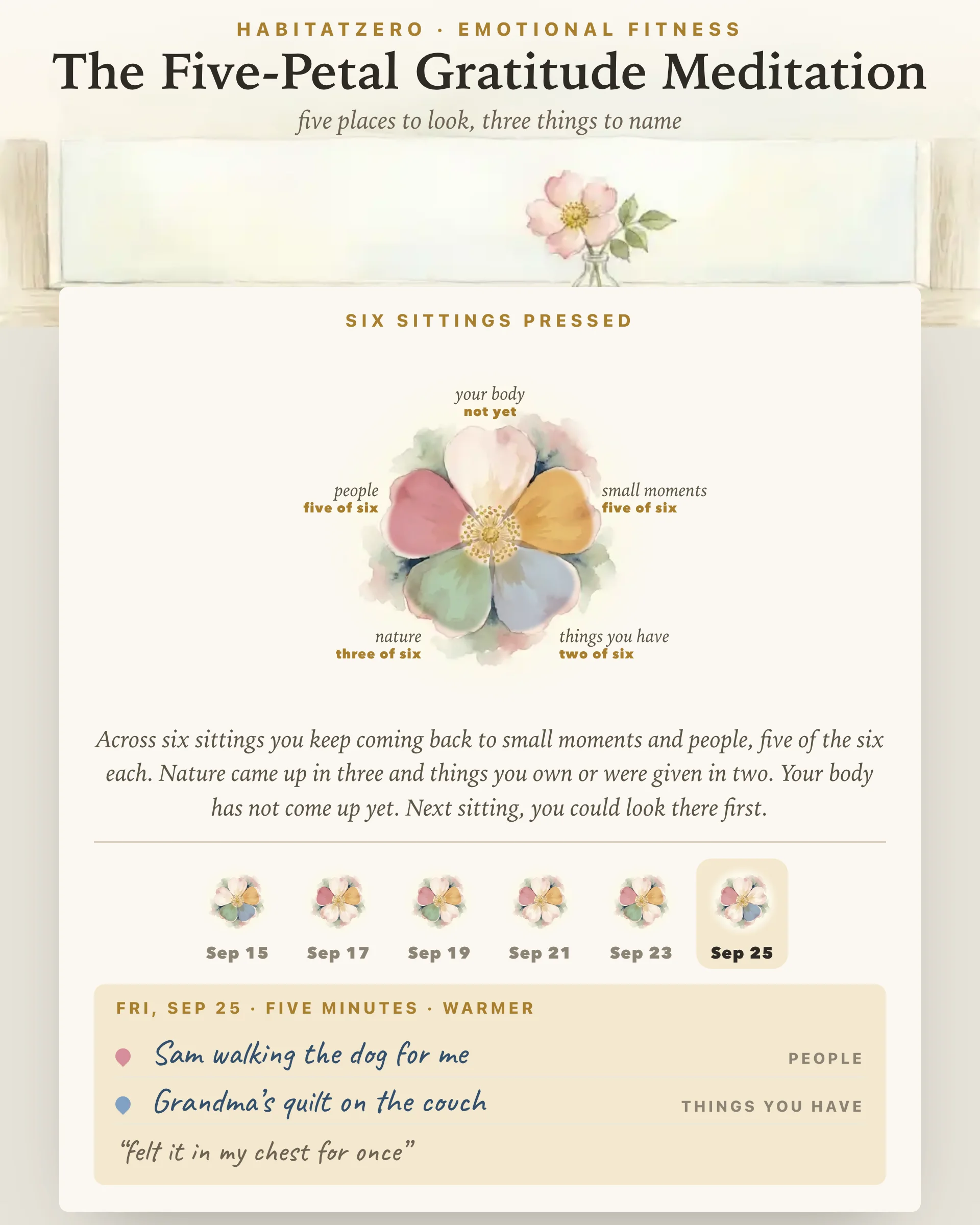
Most gratitude exercises hand you a pen. This one asks you to sit still for five or ten minutes and look, and it does the pacing so you never have to check a clock. The script moves through five places where thanks tend to hide, then goes quiet so you can name three things of your own. Afterward you note what came up, and over several sittings the page shows where your attention keeps returning.
Sit down and try to feel grateful with nothing to aim at, and the mind usually reaches for the same large items: family, health, a roof. They are true, and they go stale fast, because nothing about them is new today. It helps to be sent somewhere specific. Not "my family," but the voicemail your mother left on Tuesday. Not "health," but the knee that let you take the stairs.
So the script visits five places, widening as it goes:
Then the words stop. A first thing, a second, a third, each held for a few breaths. The script closes by asking you to notice how you feel without needing it to be different.
Choose five or ten minutes and press begin. Each line appears by itself and stays up through the quiet that follows, and the petal for each place fills with color while the script is there, so one glance tells you where you are. Hold pauses it, and ending early takes two taps. Glance at another app and the script is still in step when you come back.
When the sitting ends, tap where each of the three things came from, then pick a suggestion or write a few words. Add anything else that surfaced, say how the sitting landed ("it felt forced" is one choice, because sometimes it does), and press it. It joins the others as a small rose.
After a few sittings the large rose starts to mean something. Each petal deepens with every sitting its kind came up in, and a short reading says it plainly: which kinds you keep coming back to, which turn up now and then, and which have not appeared at all. If your body never shows up, that is worth knowing, and the next sitting is a chance to look there first.
To read it aloud to a class or into a recording, open the whole script, where every line shows roughly how long it and the quiet after it should last.
Most gratitude research tests writing exercises, such as lists and letters, not meditation, and together those studies point to a real but small benefit. The largest pooled analysis so far, covering 145 papers and nearly 25,000 people in 28 countries, found that gratitude exercises raised well-being by a small amount on average, with results that differed from country to country.
What they are compared against matters too. An earlier set of meta-analyses found that gratitude exercises beat a neutral activity on well-being but did not ease anxiety more than the comparison activities did, and did no better than other psychologically active exercises. If anxiety is what brought you here, treat this as a gentle habit of attention, not a treatment.
Studies of gratitude meditation itself are few and small. In one, 176 college women listened to a short gratitude meditation, a mindfulness meditation or a recording of a history textbook. Both meditations raised reported gratitude and mindfulness compared with the textbook, yet body dissatisfaction dropped after all three recordings, the textbook included. Some of what a gratitude sitting does may come from sitting quietly at all.
That is why the page asks how each sitting landed. Your own record is better evidence for you than an average.
On a hard week, being asked for gratitude can sound like being told to cheer up. This script does not ask you to feel anything. It asks you to notice one real thing, however small, and to let the rest of the week stay as hard as it is. If nothing comes, look smaller. If the sittings keep leaving you worse, stop, and if low mood or worry settles in for weeks, a doctor or therapist is a better next step than any script.
Early, before the day starts making requests, or at night once the house has gone quiet. A few sittings a week give the rose enough to say something. If you would rather write than sit, The Gratitude List builds toward a hundred lines. For silence with no words at all, The Meditation Timer keeps time for an unguided sit, and when you want to move from thanking people to wishing them well, The Loving-Kindness Circle is the natural next step.
It is a short set of lines, read aloud or silently, that steers your attention toward things you are thankful for and leaves pauses long enough to actually feel them. This one moves through five places to look and ends with a quiet stretch for naming three things of your own.
Five minutes gets you through all five places, and ten gives each one longer pauses. Pick the length you will actually finish, since a short sitting you keep doing is worth more than a long one you keep postponing.
Yes. Open the whole script and read at an unhurried pace; the time beside each line covers the line and the quiet after it. Leave the pause for the three things fully silent, because that is where each listener does their own looking.
Modestly, and not for everyone. Reviews of gratitude exercises find small average gains in well-being, and one analysis found they did not ease anxiety more than a comparison activity. Studies of gratitude meditation itself are few and small, so try it and notice how each sitting leaves you.
This page shows the rose filled in from six sample sittings. Timing your own sittings, noting the three things and keeping the pressed roses that build your reading all happen in HabitatZero, free of charge.
By the team behind Fabulous, the science-based self-care app used by over 30 million people.


