Leaves on a StreamEmotional Fitness · ~3 min
About this template · Updated September 2026
Ask most people what they are grateful for and you get the same six lines: family, health, friends, a roof, a job, the dog. All true, and all written on autopilot. A gratitude list only starts doing something once those are out of the way, when you have to stop reciting and start looking. That is the reason this one runs to a hundred.
A short list lets you stay general. A long one cannot. Somewhere past line fifteen, "my friends" has been used up and you are forced down to the level of Dana, who drove two hours when the car died. Past line forty you run low on people and comforts and have to go hunting in places you rarely think to thank: the tap that runs clean, the bad year that ended, the thing you yourself did on a hard day. The length is not a measure of how blessed you are. It is a device for pushing attention past the obvious.
Ten lines an evening for ten evenings is a sensible pace, and the roll keeps your place in between.
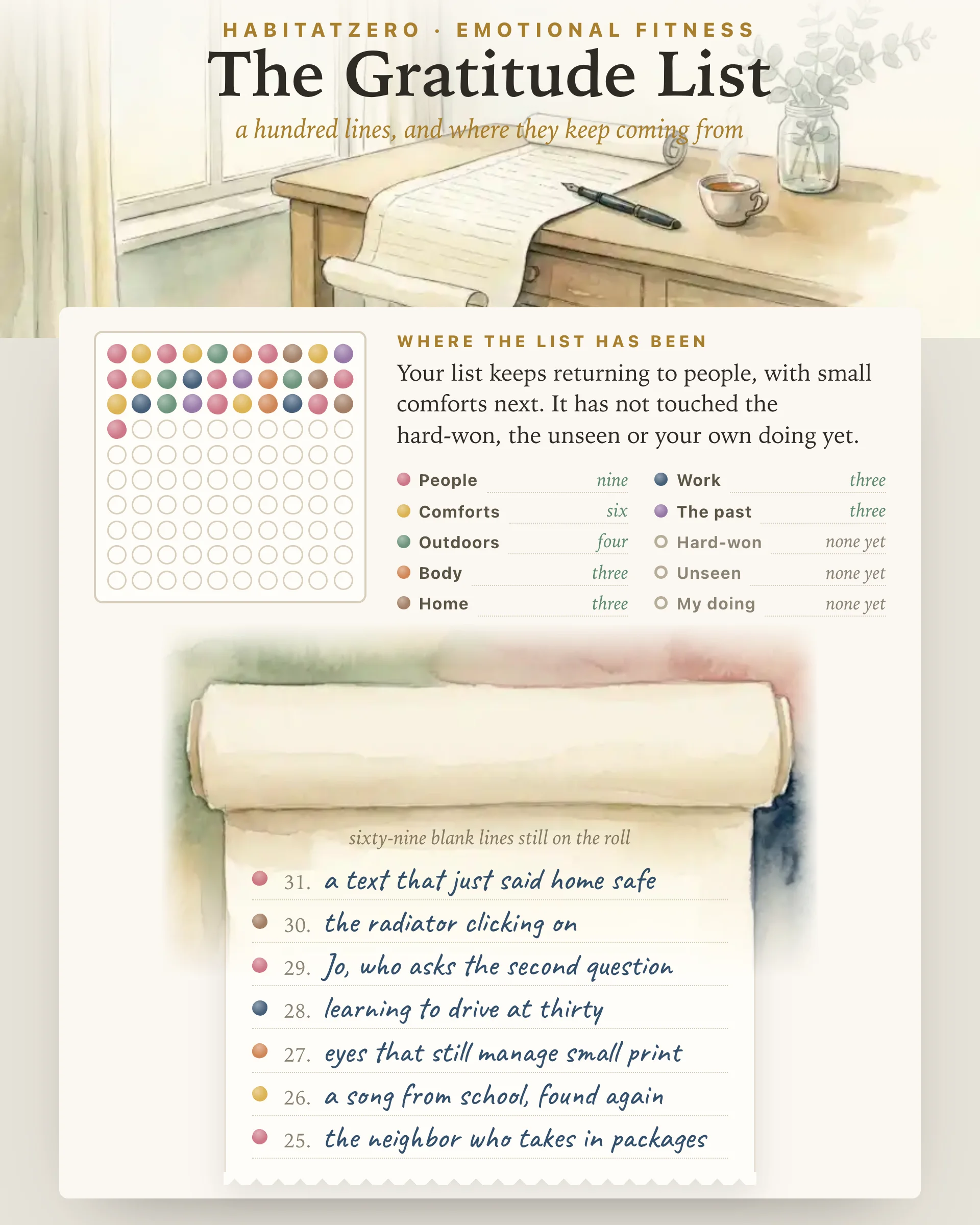
The list lives on a single roll of paper. Blank lines wait on the roll, the newest line you wrote sits nearest to it, and the older ones trail away below, so the last few things you noticed are always in view.
Above the roll is a tray with ten areas of life: people, comforts, body, outdoors, home, work, the past, the hard-won, the unseen and your own doing. Pick one and the sheet asks you a question about it, offers a handful of examples you can tap straight onto the roll, and leaves a line for an answer in your own words. Ask me another swaps the question and the examples when the first ones draw a blank.
Every line also leaves a colored mark in a ten-by-ten square, and that square is the part a sheet of paper cannot do. After a few lines it starts reading your list back to you: which areas you keep returning to, which you have not touched, and whether your last several lines all came from the same place. A button beneath it opens prompts from the area you have visited least. If yours leans hard on people and small pleasures, the untouched areas are where the surprising lines tend to turn up.
The roll stops at one hundred. To write a hundred-and-first you have to let one go.
The gratitude list examples on the chips are deliberately plain, because they are starting points. "Clean sheets" is fine. "Clean sheets on a Sunday" is better, and the version only you could write is better still. If a stranger could have written the line, add the detail that makes it yours: a name, a place, a time of day. You are noticing, not performing.
The modern interest in gratitude listing traces back to a 2003 set of experiments by Robert Emmons and Michael McCullough. Students in the first study were asked, once a week for ten weeks, to write down up to five things they were grateful for, while comparison groups listed hassles or neutral events. The gratitude groups came out ahead on several measures of well-being, though, as the authors put it, not all of them. Their participants' lines ranged from "the generosity of friends" to "the Rolling Stones", which is a fair picture of what a real list looks like.
Later work has been cooler. A 2016 meta-analysis of gratitude interventions pooled the trials and found that they beat doing nothing by a modest margin, beat a matched neutral activity by a slim one, and did no better than other psychologically active exercises. A series of meta-analyses published in 2017 landed in a similar place: improvements on some outcomes, happiness among them, none on others, and a warning that the unique benefits of gratitude practice may be overemphasized.
So the honest summary is a small, unspectacular lift in well-being on average, and no evidence that a list treats anything. The original experiments asked for up to five lines at a time, not a hundred. The length and the ten areas here are a format chosen to keep the noticing fresh, not a finding. And if the roll starts to feel like a tally of what you ought to be feeling, put it down. That says something about the exercise, not about you.
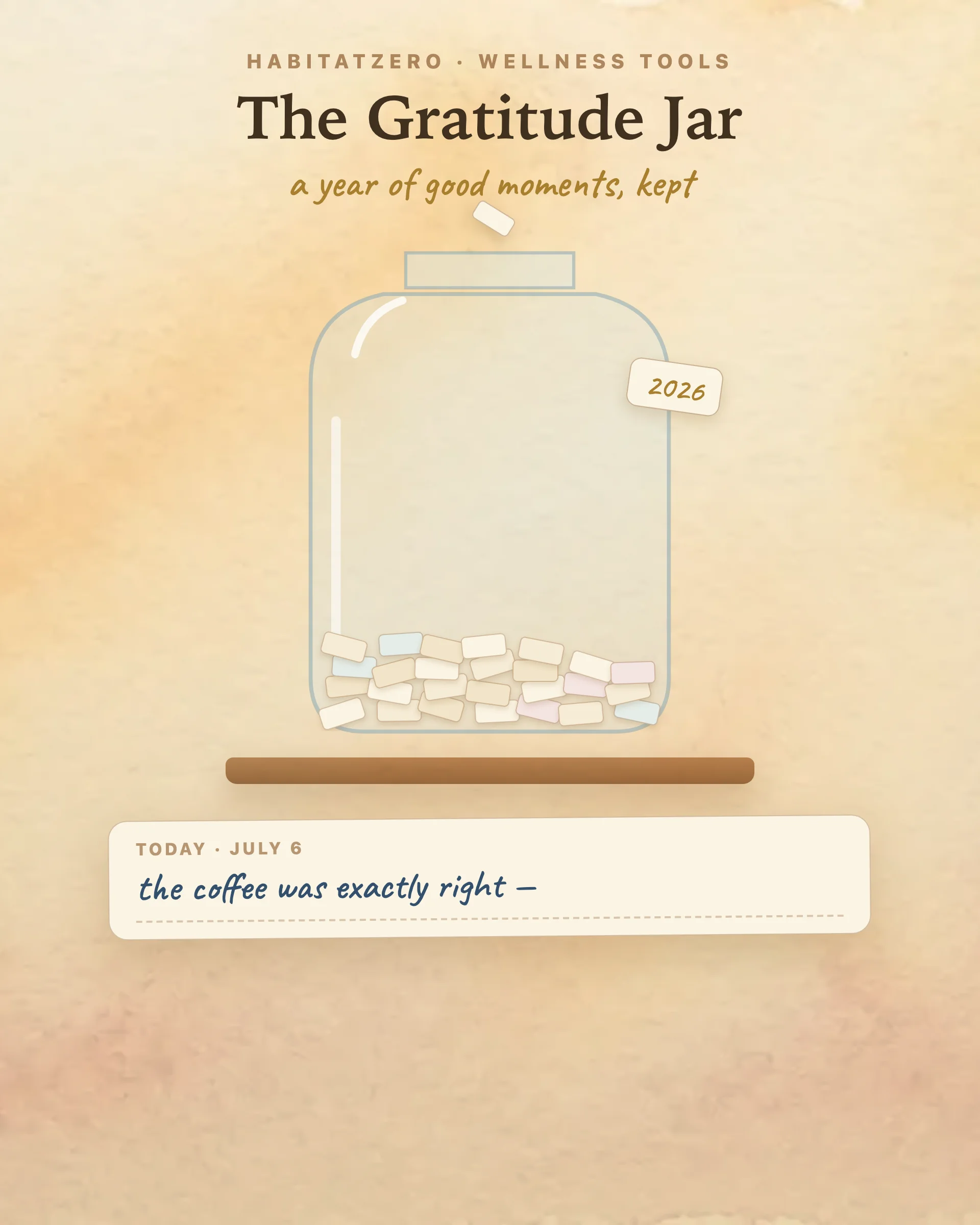
Reach for the list when thankfulness has gone stale and general, or when a rough season has narrowed what you notice. If you would rather answer a single question each evening than build one long list, the Gratitude Prompts Deck deals them one by one. If a name keeps turning up on your roll, the Thankfulness Journal turns that line into a short letter you can actually send. And if what you want is to bank good moments for a bad day, The Gratitude Jar is built for pulling one back out.
A finished roll is worth keeping. Read from the bottom up a year later, it is a fairly exact record of what your life was made of.
A gratitude list is a plain running list of specific things you are glad to have in your life, from a particular person to a tap that runs clean. It is one document that keeps growing rather than a dated entry, and its value comes from being pushed past the obvious first few lines.
Good lines are small and particular: the friend who texts back, clean sheets on a Sunday, knees that still do the stairs, the tree outside the bedroom, a bad year that ended, clean water from a tap. This page offers one hundred starting examples across ten areas of life, and each one improves once you swap in your own names and details.
Change where you are looking. A list usually runs dry because it keeps circling the same two or three areas. Try your body, your street, your past, the hard things that taught you something, the services that work out of sight, and the things you did yourself. The square of marks on this page shows which of those areas your list has not reached yet.
Modestly, on average. The original 2003 experiments by Emmons and McCullough found higher well-being on several measures, though not all, among people who listed up to five things weekly or daily. Later meta-analyses found small effects that were no larger than those of other psychologically active exercises. Treat it as a pleasant habit of attention, not as a treatment.
You can read the filled example and every prompt on this page without signing in. Writing your own hundred lines and having the roll remember them between sittings happens inside HabitatZero, which costs nothing.
By the team behind Fabulous, the science-based self-care app used by over 30 million people.