
The Overwhelm Recovery ProtocolWellness & Routines · ~5 min
About this template · Updated November 2026
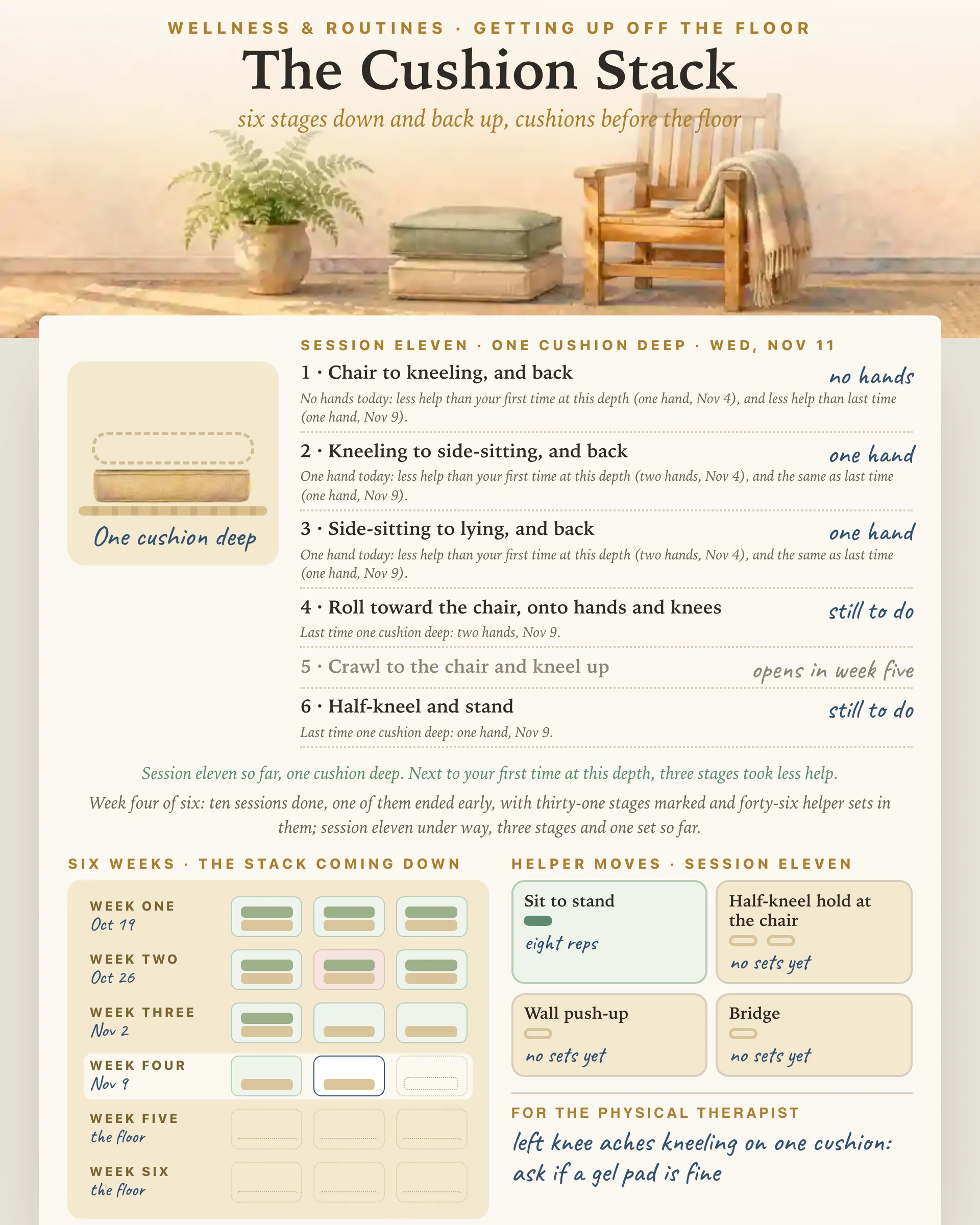
Getting up off the floor is a skill, and it breaks into pieces you can rehearse. This page walks you through them beside a sturdy chair, on firm cushions first, and records how much help each piece needed. Over six weeks the cushions come down until you practice on the floor itself.
When researchers in Cambridge, England, followed 110 people over ninety for a year, 80 percent of those who fell could not get up on their own at least once, and 30 percent lay on the floor for an hour or more. Long lies went with serious injuries and hospital stays, and in most of them a call alarm went unused. Knowing a route up, and when not to take it, is worth an hour a week.
Six stages, each beside the chair:
Week one practices the first and last stages only. Each later week adds the next position down, so the way back up runs through stages you know. Physical therapists call this backward chaining: you learn the end of the movement first.
Every stage starts on a raised surface. In weeks one and two you kneel, sit and lie on two firm cushions stacked on a carpet or mat. Weeks three and four allow one cushion, and weeks five and six the floor. The stack never drops below what the week allows, and staying higher is always fine. Have someone nearby for the first sessions and again the first time you go lower.
After each stage, tap the help you used: two hands on the chair, one hand, no hands, or not today. A mark is set only beside your own earlier marks for that stage at the same depth, so a session on one cushion is never weighed against sessions on two. There is no score and no fall-risk rating.
Four helper moves build the strength the route needs: sit to stand, a half-kneel hold, wall push-ups and bridges. Each runs on a real-time clock that gives you three seconds to get set, then counts only whole reps or seconds; a set you stop partway goes in with what you finished, marked stopped early.
The studies are small. Geriatric medicine researchers at the University of Michigan randomly assigned 35 older adults who needed help with daily activities to six sessions of training in rising strategies or to chair-based stretching. The trained group completed more of the rising tasks and rated rising as less difficult, though their rise times did not change.
The closest match to this page is a 2026 pilot trial by health researchers in Glasgow. Sixty-one adults aged 65 and older in a weekly exercise class either practiced five 20-minute sessions using backward chaining or watched a demonstration video. Of the 49 who finished, the practice group rose faster from lying, side-sitting and half-kneeling, all of them could rise from lying afterward against 63 percent of the video group, and they felt more able to manage a fall. Their fear of falling, as measured, did not change, and no one was hurt.
A team at Curtin University in Perth reviewed 41 studies of interventions for rising from the floor. Pooled trials showed no clear change in rise time, strength training leaned toward helping, and plain practice of the task still needs study. None of this shows that practice prevents falls or injuries, so treat the page as rehearsal, not a guarantee.
Do not rush to get up. Stay still and check yourself for pain. If you are hurt, dizzy, or a leg will not take your weight, stay down, call 911 or press your alarm, and keep warm with a coat or blanket until help arrives. If nothing hurts and you feel steady, use the route: roll, hands and knees, crawl to a chair, half-kneel, stand, sit. Tell your doctor about any fall, even a painless one.
Talk with your doctor or physical therapist before starting if you have had a fall, dizziness, a joint replacement, a heart or blood pressure condition, osteoporosis, or pain in your knees, hips, back or wrists. After a knee or hip replacement, ask about kneeling and hip positions before week one. Stop any stage that hurts, sit for a few breaths if you feel lightheaded, and keep the sturdy chair within reach every time.
The Sitting Rising Test scores one sit to the floor and back; this page practices the full route and never scores it. Balance Exercises for Seniors trains standing holds at a counter, while Squats for Seniors and Strength Training for Seniors build the strength each stage leans on.
Rise in stages instead of one big push. Roll onto your side, come up onto hands and knees, crawl to a sturdy chair, put both hands on its seat, bring one foot forward, stand, and turn to sit. Practicing each stage on firm cushions first shortens the distance while you learn it.
Stay still for a moment and check yourself for pain before you move. If you are hurt, dizzy or a leg will not take weight, stay down, call 911 or press your alarm, and keep warm until help arrives. If nothing hurts, rise in stages beside a chair, then tell your doctor about the fall.
The rise asks for several things at once: strong thighs and hips, knees and hips that bend far, steady balance through a turn, and arms that can push. When one of them fades the whole rise gets harder, which is why the page pairs the route with sit to stand, a half-kneel hold, wall push-ups and bridges.
Small studies suggest it can. In a 2026 pilot trial, older adults who practiced in five short weekly sessions rose from lying faster than a group who only watched a video, though their fear of falling did not change. Larger trials have not been done yet.
Anyone who has fallen recently, gets dizzy, or lives with a heart or blood pressure condition, osteoporosis, or pain in the knees, hips or wrists. After a knee or hip replacement, ask your surgeon or physical therapist which kneeling and hip positions are safe before you begin.
By the team behind Fabulous, the science-based self-care app used by over 30 million people.


