
The Overwhelm Recovery ProtocolWellness & Routines · ~5 min
About this template · Updated November 2026
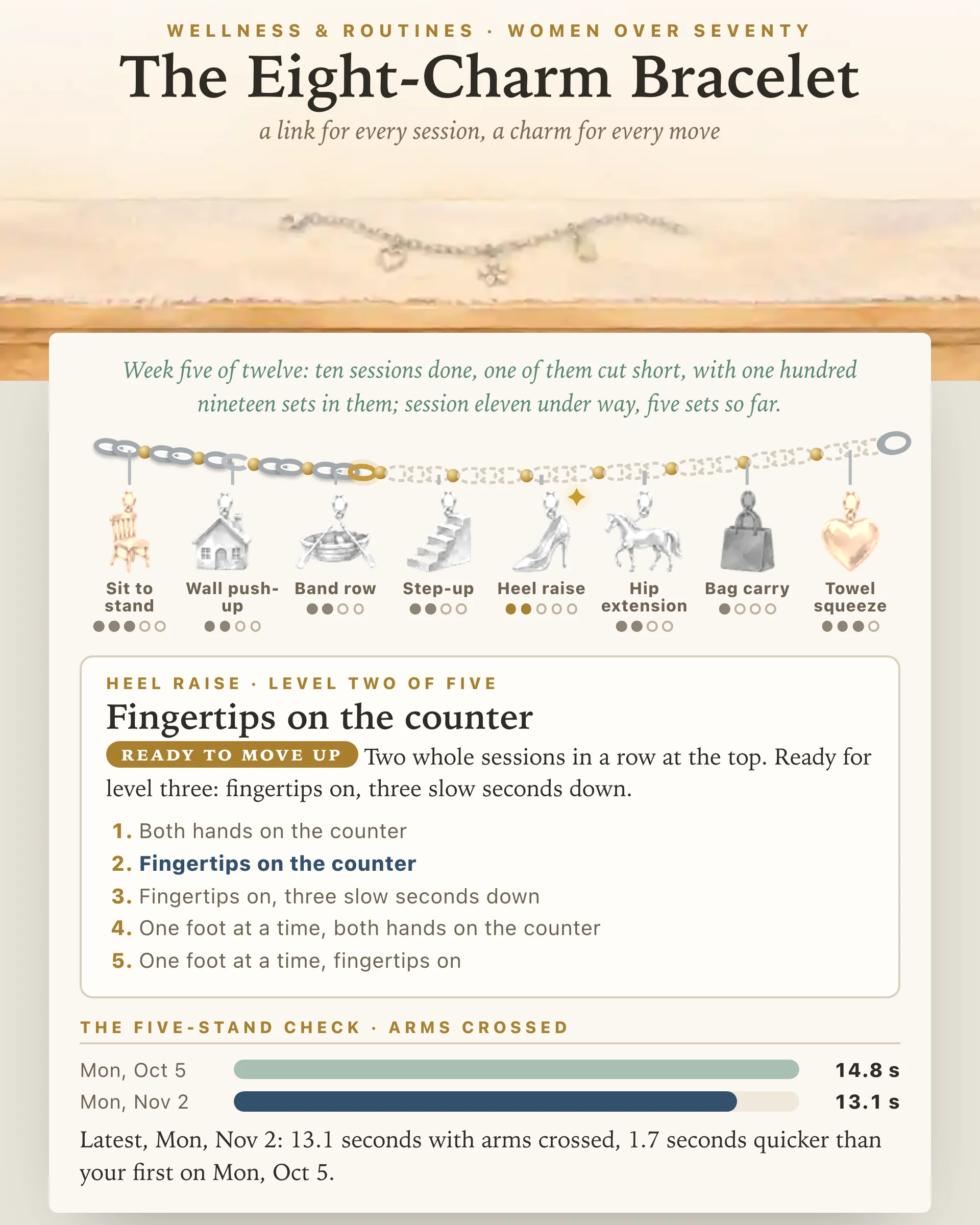
Strength training for women over 70 is less about machines than about keeping the jobs you already do: rising from a low chair, carrying groceries in, climbing the porch steps, opening a stiff jar. This page turns those jobs into a twelve-week plan of eight moves at home, using a sturdy chair, the kitchen counter, the bottom stair, a resistance band and a shopping bag. You train two days a week for four weeks, then three, for eighteen to thirty minutes a session.
Talk with your doctor or a physical therapist first, and show them the moves, if you have osteoporosis or have broken a bone in a minor fall, have fallen in the past year, get dizzy, have had a joint replaced or recent surgery, live with a heart or blood pressure condition, or have pain that keeps returning. Stop any move that hurts, and if chest pain, faintness or unusual breathlessness does not ease when you sit down, call 911.
Every move starts at a level that holds you up:
Each then climbs four or five levels, such as a 3 lb weight hugged at the chest or a heavier band. Staying at level one on a move is fine.
Each move has its own charm, from a chair for standing up to a heart for the squeeze. A charm starts pewter and warms through silver and rose to gold as its move climbs. Every session adds a link, whole when all eight moves are in and open when the session ends early, with a gold bead between weeks.
After each set you tap your reps and a one-minute rest clock starts; it keeps true time even if your phone locks. The bag carry has its own clock, from thirty seconds to a minute, and a carry set down early keeps only its whole seconds.
When a move reaches the top of its range in two whole sessions in a row at the same level, its charm sparks and the page names the next level. A session cut short or a carry set down early breaks that run.
Before week one and after weeks four, eight and twelve, time how long you take to stand up and sit down five times. Each time sits only beside your own earlier ones: no score, no comparison with other women, no forecast about falls. A sore knee or a short night can shift it.
A UK consensus statement on exercise for osteoporosis, written by physiotherapists, doctors and exercise scientists, recommends resistance and impact exercise for bone strength, strength and balance work against falls, and avoiding postures that bend the spine far forward. Common advice adds twisting under load. None of these eight moves rounds your back or twists it while you hold weight.
The World Health Organization's 2020 guidelines ask adults for muscle strengthening on two or more days a week and older adults for varied balance and strength work on three or more, alongside 150 to 300 minutes of moderate activity, so pair this plan with walking.
In the LIFTMOR trial, an Australian bone research team gave 101 postmenopausal women with low bone mass eight months of supervised, twice-weekly, thirty-minute sessions of heavy lifting and impact training, or a light home program. Spine bone density rose about 3 percent with lifting and fell about 1 percent at home, and the lifters did better on every physical test, five stands from a chair included. Their average age was 65, the training was far heavier than anything here, and the trial did not measure fractures.
Closer to this page's readers, a Canadian trial placed 98 women aged 75 to 85 with low bone mass in twice-weekly classes of resistance training, agility training or stretching for 25 weeks. A fall-risk score built from lab tests of sway, reaction time, strength and vision fell 57 percent with resistance training and 20 percent with stretching. That is a score, not counted falls, and the women trained in group classes at a community center rather than alone. Neither study shows what twelve weeks at your counter will do, and this page promises no younger bones or toned look.
The Bocce Court Plan is for anyone over seventy, five days a week, mixing balance, walking and stretching with strength. This page is strength only, for women, with logged loads, a bone note and the five-stand check. The Strength Trellis suits women in their sixties who want dumbbells, and The Whole-House Strength Routine is a shorter four-week start. To count stands in thirty seconds instead of timing five, use The Thirty-Second Chair.
Moves that copy daily jobs serve well: rising from a chair, pushing away from a wall, rowing with a band, stepping onto a stair, lifting onto your toes, carrying a bag and gripping. Doing them two or three days a week, and making each one a little harder once it gets easy, matters more than any single exercise.
World Health Organization guidance asks older adults for muscle strengthening on two or more days a week, and for varied balance and strength work on three or more. This plan opens with two short sessions a week and adds a third in week five, with a rest day between sessions.
Many women with osteoporosis can strength train, and a UK expert consensus encourages it. The usual caution is to avoid rounding your back forward or twisting while you hold weight. Ask your doctor or physical therapist which levels suit you, above all after a fracture.
Begin with your own body and a light band, and add load only when a move has been easy for two whole sessions in a row. Here the first weight is a 3 lb one hugged at the chest for the sit to stand, and the bag carry grows a can or two at a time.
It times how long you take to stand up and sit down five times, and sets that time beside your own earlier ones. It gives no score and no comparison with other women. A slower day can follow a poor night or a sore knee, so bring a steady change to your doctor rather than a single number.
By the team behind Fabulous, the science-based self-care app used by over 30 million people.


