
The Overwhelm Recovery ProtocolWellness & Routines · ~5 min
About this template · Updated November 2026
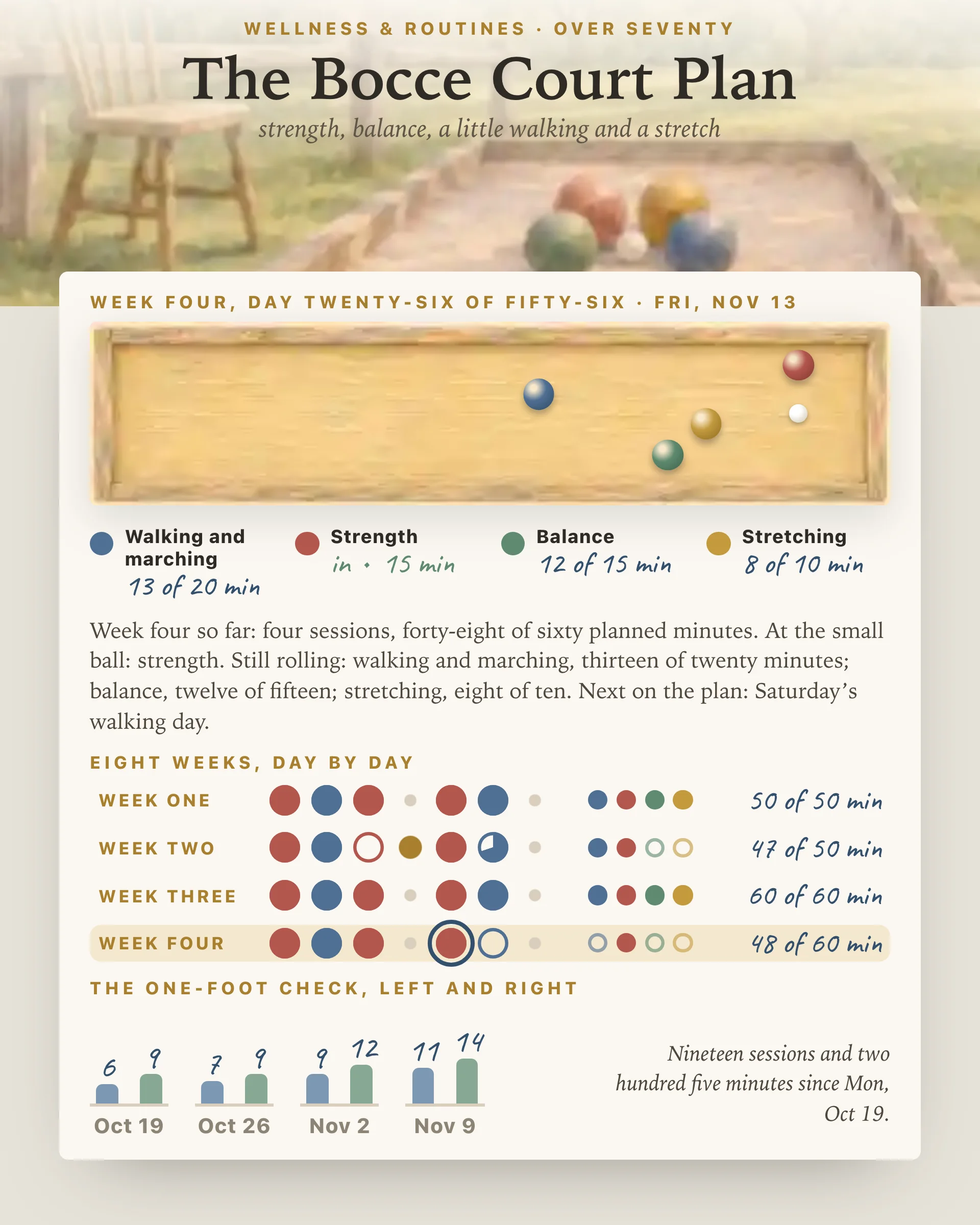
Past seventy, the hard part is rarely knowing what to do. It is finding a routine short enough to start today, safe enough to repeat alone, and varied enough to cover what your body needs. This page offers one: eight weeks of sessions that last ten minutes at first and twenty by the end, five days a week, built from four kinds of movement. You need a sturdy chair and the kitchen counter.
Think of a bocce court. Four colored balls wait at the near end, and a small white ball sits at the far end. Each colored ball stands for one kind of exercise: blue for walking and marching, red for strength, green for balance and gold for stretching. Every move you finish rolls its ball forward by its share of the week. When a kind gets all of its planned minutes, that ball comes to rest beside the small one. At a glance you can see which kinds are still short this week.
The plan alternates two kinds of day. A strength day opens with a few minutes of marching in place, then four strength moves (sit to stand, counter push-ups, heel raises and side leg raises), three balance holds and three stretches. A walking day swaps the strength block for a longer walk at a talking pace. Strength days fall on days one, three and five, walks on days two and six. Week one asks for fifty minutes in all, week eight for a hundred.
Each move has a counter version and a chair version. The mini squat at the counter can become sit to stand from a chair pushed against the wall. The one-foot stand with both hands on the counter can become a seated knee raise. Choose per move, any week. A real-time timer gives each move its time, counts each repetition, says when to switch sides, and pauses whenever you need it. If you stop early, only whole minutes and fully finished moves count, so the court never shows more than you did.
Once a week, stand facing the counter with both hands resting on it, raise one foot just off the floor, and tap when it comes down. The clock stops itself at thirty seconds. Your result sits beside your own earlier checks as a pair of bars, left foot and right, and the page tells you how today compares with your first check. It never grades the number, compares you with other people or estimates your risk of falling.
The World Health Organization's 2020 guidelines ask adults to build toward 150 to 300 minutes of moderate activity a week with muscle strengthening on two or more days, and they ask older adults to add varied activity that stresses balance and strength on three or more days. This plan gives strength three days a week and balance five, but its walking stays well short of those aerobic minutes: about thirty a week by the end. Once week eight feels settled, lengthen the walks.
A Cochrane review of 108 trials, covering 23,407 people with an average age of seventy-six, found that exercise programs lowered the rate of falls by about a quarter, and that programs mixing kinds, most often balance with strength, probably lowered it by about a third. The authors were uncertain about strength training or walking alone and found no trials of stretching alone. These are averages from studies, not a forecast for you.
Stretching is here for ease of movement rather than for falls. An American College of Sports Medicine position stand on older adults includes flexibility work alongside aerobic and strengthening exercise.
Age is not a reason to skip the strength block. In a 1994 trial with frail nursing home residents, a geriatric research team in the Boston area gave 100 people, average age eighty-seven, ten weeks of progressive strength training, a nutrition supplement, both or neither. Muscle strength more than doubled in those who trained, and their walking speed rose a little; the supplement alone did not help. That was high-intensity training, much harder than ten minutes at a counter: it shows muscles still respond late in life, not what this plan will do for you.
Talk with your doctor or a physical therapist before week one if you have had a fall, dizzy spells, a joint replacement, a heart or blood pressure condition, or ongoing pain, and show them the moves. Keep the counter or the chair within reach for every standing balance hold. Stop any move that hurts, and mark it on the page to ask about later. Chest pain, unusual breathlessness or faintness that does not ease when you sit down means calling 911.
The Patchwork Week is the broader weekly plan for older adults, with longer sessions on days you choose. This page is shorter and gentler, made for people over seventy, with a timer for every move, a chair version of everything and the one-foot check. When one kind needs more room, The Balance Ladder climbs through harder balance holds, and The Whole-House Strength Routine gives strength moves easier and harder versions.
There is no single best move. What helps most is a mix: a little walking or marching, strength work such as standing up from a chair, balance holds at a counter, and gentle stretching. The right version of each is the one you can do steadily and without pain.
World Health Organization guidance asks older adults to build toward 150 to 300 minutes of moderate activity a week, muscle strengthening on two or more days, and balance and strength work on three or more days. This plan starts at fifty minutes a week and reaches a hundred by week eight, so think of it as a first step toward those numbers.
For most people, short and supported sessions are a sensible place to begin. Speak with your doctor or a physical therapist first if you have fallen, had dizzy spells, had a joint replaced, or live with a heart or blood pressure condition or pain. Stop any move that hurts, and call 911 for chest pain or faintness that rest does not ease.
Yes. Every move on this page has a chair version beside its counter version, from a seated march to seated heel raises and a seated side reach. You can mix the two in one session and change them from one week to the next.
Only how many seconds you stood on each foot that day, set beside your own earlier checks. It gives no score, no fall-risk rating and no comparison with other people. If the number worries you, bring it to your doctor or physical therapist.
By the team behind Fabulous, the science-based self-care app used by over 30 million people.


