
The Overwhelm Recovery ProtocolWellness & Routines · ~5 min
About this template · Updated November 2026
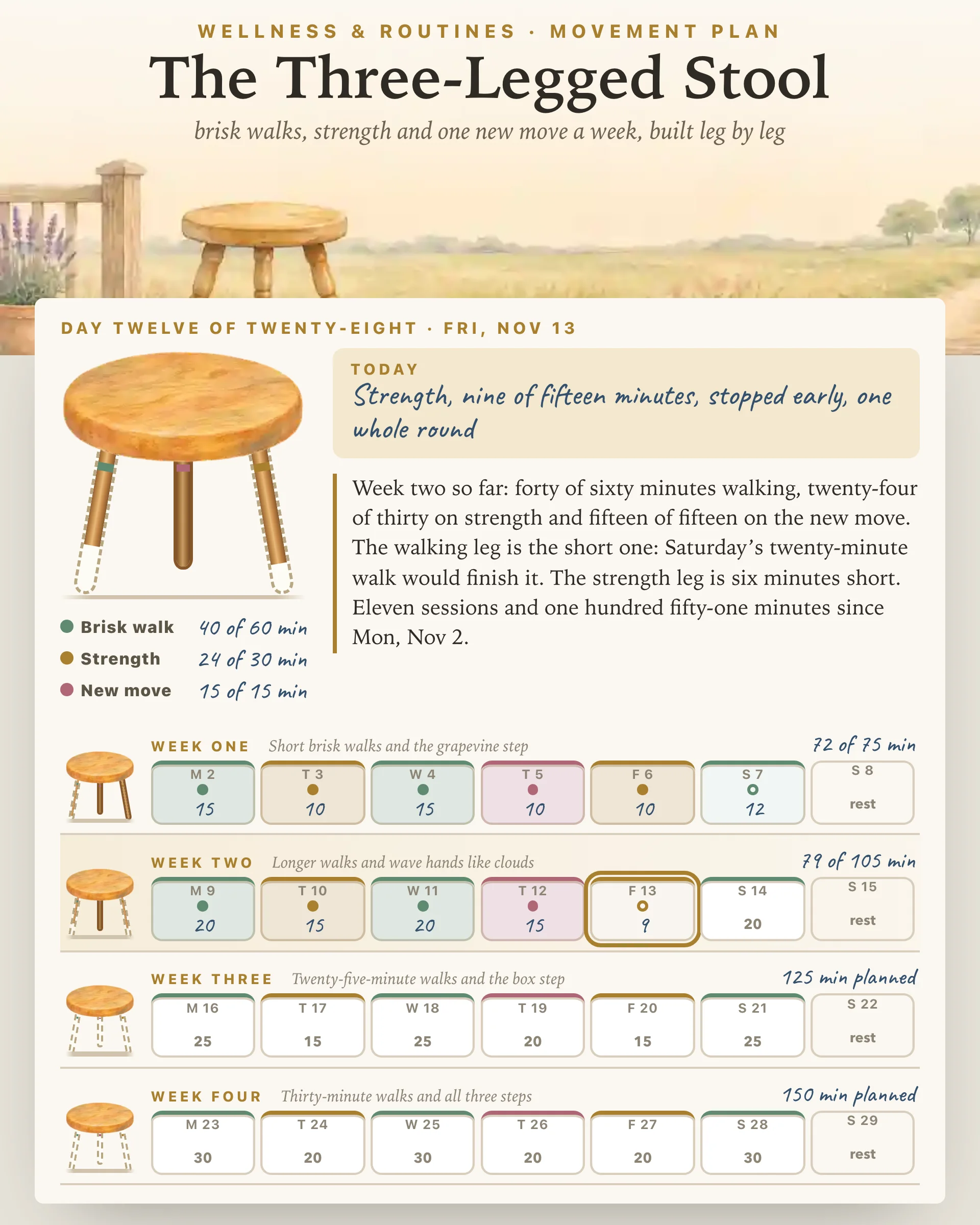
People looking up exercise for brain health usually want two things: which kind of movement to do, and an honest sense of what it can and cannot do for the mind. This page gives you a plan for the first and plain words on the second. The plan stands on three legs, like a milking stool: brisk walks, strength work and one new move to learn each week. Over four weeks you build one stool a week, and the page shows which leg is coming up short.
Many trials in this area test aerobic exercise such as brisk walking or cycling. Strength training, tai chi and dance have smaller sets of trials of their own. A 2018 meta-analysis in the British Journal of Sports Medicine pooled randomized trials in adults over fifty living at home and found that exercise programs raised scores on thinking tests by a small amount on average. Aerobic, resistance, mixed and tai chi programs all pointed the same way, and sessions of forty-five to sixty minutes at moderate effort or more went with the clearest results.
Dance has been studied on its own. A 2020 review of thirteen dance studies with about 1,600 people aged sixty and over found better scores on tests of general thinking after dance programs, no clear difference in planning and switching tasks once a weak study was set aside, and no sign that dance beat other exercise. Learning a step means holding a sequence in mind while you move, and whether that learning adds anything is still an open question.
Other careful reviews reach cooler conclusions. A Cochrane review of twelve trials in cognitively healthy people over fifty-five found no benefit from aerobic exercise in any area of thinking it measured, even in trials where fitness clearly improved. A 2018 review for the US Agency for Healthcare Research and Quality looked at trials lasting six months or more and judged the evidence too thin to say that aerobic training, strength training or tai chi improves thinking, or that any physical activity program prevents dementia.
So the honest summary is mixed. Some reviews find small gains on test scores, others find none, and none of these reviews shows that exercise prevents, delays or reverses dementia or memory loss. The trials were often small and short, and measured test scores rather than daily life. This page does not test your memory, and the stool says nothing about your brain. It counts minutes of movement, which is the part you control.
If you or someone close to you has noticed changes in memory or thinking, talk to a doctor. A movement plan is not a way to check for, treat or rule out anything.
At the top of the page sits this week's stool. Its left leg is brisk walking, its back leg is the new move, and its right leg is strength. Each leg starts as a pencil outline and fills with wood as minutes of that kind come in, measured against what the week's plan asks for. When all three reach the floor, the stool stands. The reading under it names the shortest leg and the planned session that would finish it.
Each day, the page offers the session the plan asks for, and you can swap in another kind or a shorter length. A walk eases in for three minutes, holds a brisk pace you can talk through but not sing through, and eases out for two. Strength is rounds of five moves at a chair, a wall and the kitchen counter. The new move is learned in three parts: slowly, step by step, then to your own count, then to a song you like.
The clock keeps real time even when your screen locks, and pauses never count. Only what you finish counts: a session stopped early keeps its whole minutes, and a part or a strength round counts only once it runs to its end.
Week one asks for three fifteen-minute walks, two ten-minute strength sessions and ten minutes learning the grapevine, a sideways traveling step: seventy-five minutes in all. Week two lengthens the walks to twenty minutes and teaches wave hands like clouds, a slow tai chi sweep of the arms from side to side. Week three brings twenty-five-minute walks and the box step. Week four reaches thirty-minute walks and strings all three steps into one short routine, a hundred and fifty minutes across the week.
If one leg appeals more than the others, The Brisk Walking Metronome paces your walks, The Whole-House Strength Routine takes strength further around the home, and The Living Room Dance Floor teaches a new step with each song. If you would like a new skill and some cardio in the same session, The Basket Drum builds drumming rounds to music you choose.
Check with a doctor or physical therapist before you begin if you have had a fall or dizziness, a joint replacement, a heart or blood pressure condition, or pain. Stop any move that hurts. Keep a sturdy chair or the kitchen counter within reach for the standing steps and the strength moves, and take the seated version of any new step whenever your balance asks for it.
No single kind has been shown to be best. Many trials have tested aerobic exercise such as brisk walking, and reviews also cover strength training, tai chi and dance, with mixed results. A week that mixes walking, strength and something new to learn touches each of the kinds researchers have studied.
The research does not show that. A 2018 review for the US Agency for Healthcare Research and Quality found too little evidence to say any physical activity program prevents dementia, and a Cochrane review found no thinking-test gains from aerobic exercise in healthy older adults. Treat this plan as a way to move more, not as protection against dementia.
Nobody knows an exact dose. In a 2018 review of trials in adults over fifty, sessions of forty-five to sixty minutes at a moderate pace or harder went with better thinking-test scores, but those are averages from short studies. This plan begins with fifteen-minute walks and builds to a hundred and fifty minutes of movement in week four, so you can find a level you can keep up.
Some trials of dance and tai chi found small gains on thinking tests, and both ask you to remember a sequence while you move. Whether the learning itself makes a difference is not settled. A new step also keeps the week from turning into the same walk again and again.
Talk to a doctor or physical therapist before starting if you have had a fall or dizziness, a joint replacement, a heart or blood pressure condition, or pain. If memory or thinking worries you, see a doctor about that too. This page does not test memory, and a movement plan is no substitute for that conversation.
By the team behind Fabulous, the science-based self-care app used by over 30 million people.


