
The Overwhelm Recovery ProtocolWellness & Routines · ~5 min
About this template · Updated November 2026
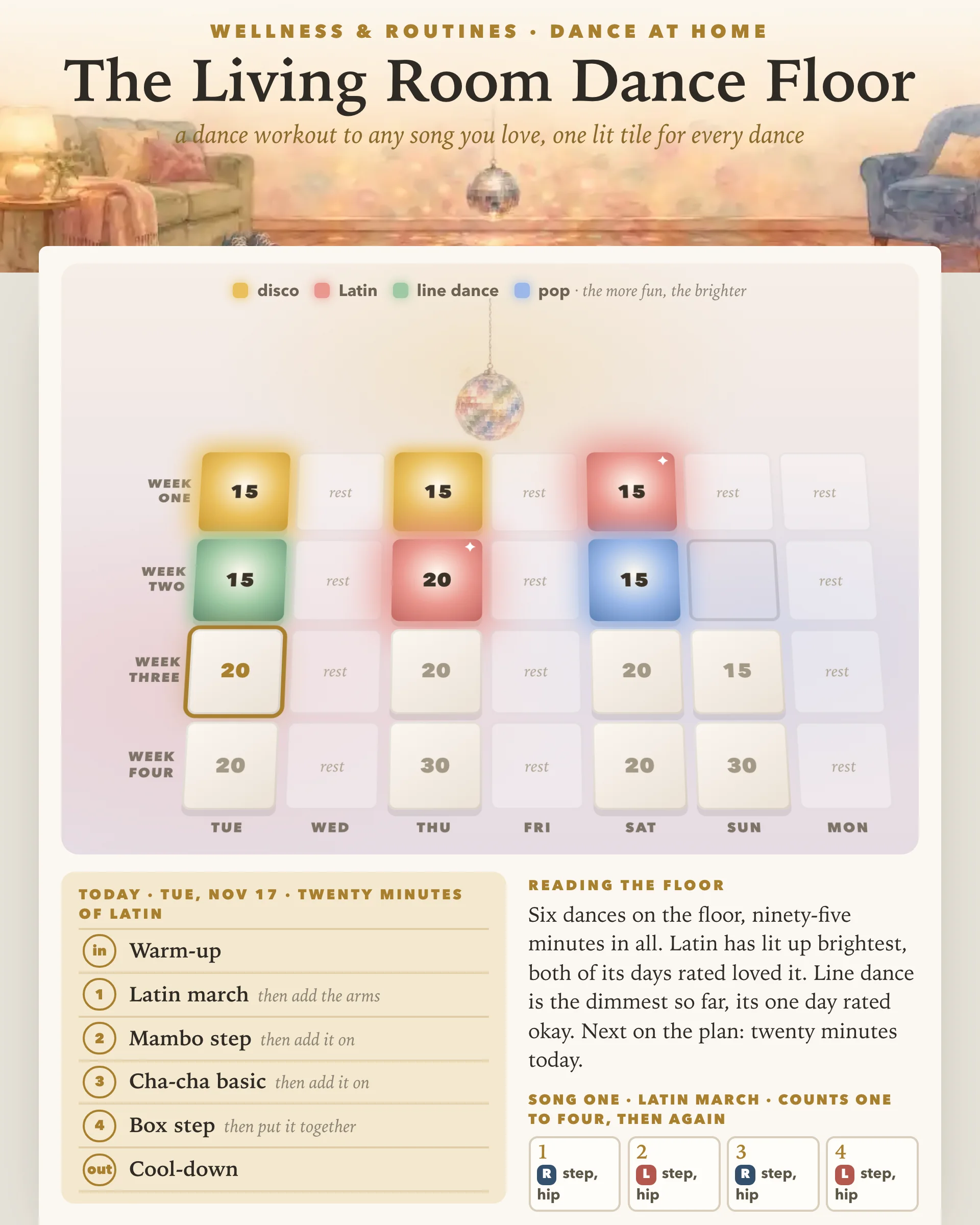
A dance workout needs less than people think: a patch of floor, shoes that grip, a song you like and someone to tell you what your feet do next. This page is that last part. You choose a style and a length, it lays out a session song by song with every step written in counts of eight, and each dance you finish lights a tile on a four-week floor. The tile glows brighter when the dance was more fun, so after a few weeks you can see which kind of dancing actually pulls you off the couch.
Every session opens with a warm-up song and closes with a cool-down song, three minutes each. Between them, fifteen minutes holds three dance songs, twenty holds four and thirty holds six.
Each dance song teaches one step. For its first half you do only that step, eight counts after eight counts, until your feet stop thinking about it. The second half builds. In the first song you add arms. In the middle songs you alternate the new step with the one before it, two eights of each. In the last song you string every step together, one eight apiece, from the top. Dance teachers call this layering, and it is why a routine that looks complicated by the end never felt hard at any single moment.
The counts are what make any song work. Most popular music moves in groups of eight beats, so a step written across counts one to eight fits whatever you put on. Each count sits in its own small box with the right or left foot marked, so a grapevine reads as side, behind, side, touch and clap, then back the other way. Clap along for a few seconds to find the beat, then start on a strong one.
Shorter sessions use the first steps of each list, and thirty minutes reaches all six. Nothing involves jumping, and every step has a gentler version printed under its counts: tap a toe instead of stepping onto it, sway instead of circling the hips, march in place instead of traveling backward. Switch to those whenever a knee, hip or ankle asks, and the music will never know.
Below the session sits the floor: four rows of seven tiles, one row per week. Unlit tiles show the minutes the plan suggests, starting with three fifteen-minute days and building to four days a week, two of them thirty minutes long, by week four. Finish a dance, or stop after at least a minute, and today's tile lights in the color of the style. Then the page asks how fun it was, from a slog to loved it. That answer sets how brightly the tile glows, and a note under the floor reads back which style has lit up brightest and which the dimmest.
The question is there for a practical reason. A review of 102 studies on how people feel about exercise found that enjoying an activity went hand in hand with doing more of it, a medium-sized link that held across very different groups of adults. Most of those studies were correlational, so they cannot prove that enjoyment builds the habit, but the pattern is worth acting on. If Latin nights feel better than pop nights, that is useful to know when you choose tomorrow's music.
A 2018 systematic review and meta-analysis pooled 28 studies, about 1,276 people in all, comparing structured dance programs of more than four weeks with other structured exercise. Dance matched the other workouts on heart and lung fitness and on how mobile people felt, and it did better on body composition, blood markers and muscle and joint function. The studies were small and the styles varied widely, so read it as good company for dancing rather than proof that one style beats the gym.
The World Health Organization's 2020 guidelines suggest adults aim for 150 to 300 minutes of moderate activity a week, and they say plainly that some activity beats none. This plan starts well under that and climbs to a hundred minutes in its fourth week, leaving room for walks and everything else you do.
If you have had a fall, dizzy spells, a joint replacement, heart or blood pressure trouble, or pain that does not settle, check with a doctor or physical therapist first. Clear rugs and cords away, keep a sturdy chair or counter within reach for the stretches and the rocking steps, and stop if anything hurts or you feel faint.
Three or four days a week, whenever the house is quiet enough to turn the music up. If standing for a whole session is hard right now, The Chair Cardio Mixtape keeps the beat while you sit. On days you would rather walk, The Living Room Mile uses the same floor space, and The Low-Impact Stepping Stones suits a week when your joints want something quieter.
Yes. Dancing keeps your heart working, moves your whole body and asks for coordination and balance as you go. A 2018 review that compared structured dance with other structured exercise found dance did as well, and on body composition and muscle and joint function it sometimes did better.
Yes. Every step on this page is one most people already half know, like a step touch, a grapevine or a box step, and each song spends its first half on that one step before adding anything. If a step feels fiddly, keep marching to the beat and pick it up on the next eight.
Fifteen minutes is a fine start, and this plan opens with three fifteen-minute sessions in the first week. By the fourth week two of the four sessions run thirty minutes. Shorter sessions you actually enjoy count for more than long ones you dread.
Any song with a steady beat you can clap along to. Most popular music is built in groups of eight beats, which is why every step here is counted to eight. Slower songs suit the warm-up and cool-down, and something with more bounce suits the songs in between.
It can be. None of the steps on this page involve jumping, and each one shows a gentler version, such as tapping a toe instead of stepping or swaying instead of rolling the hips. Switch to those versions whenever a knee complains, and talk with a doctor or physical therapist if a joint keeps hurting.
By the team behind Fabulous, the science-based self-care app used by over 30 million people.


