Leaves on a StreamEmotional Fitness · ~3 min
About this template · Updated September 2026
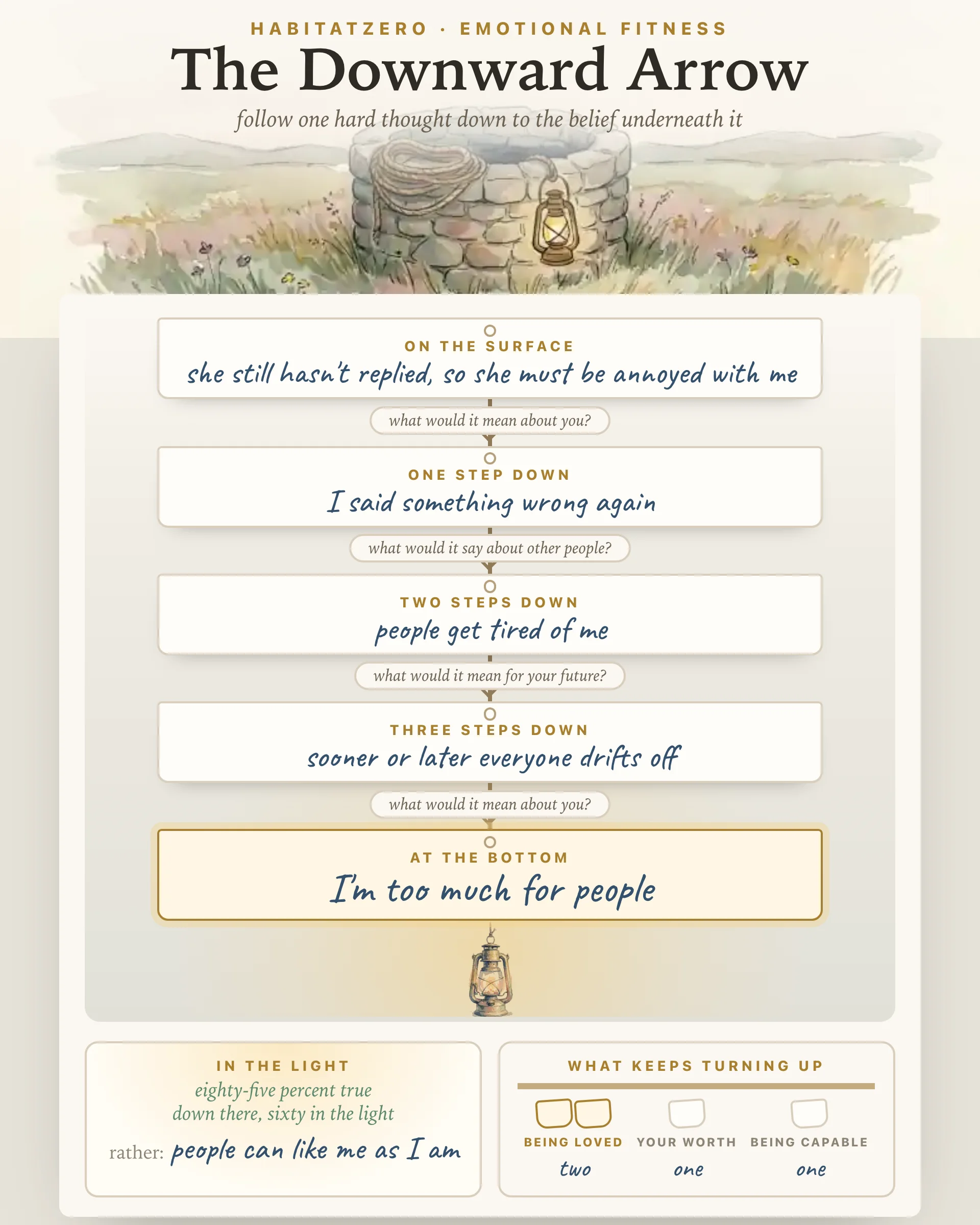
The downward arrow is David Burns's technique. He introduced it in Feeling Good in 1980, building on an idea of Aaron Beck's, as the Common Language for Psychotherapy entry on the procedure records, and on his own site he still teaches it as an uncovering method. We made this worksheet on our own; Dr. Burns had no part in it and has not endorsed it.
You start with a single automatic thought from a hard moment, in the exact words it arrived in: she still hasn't replied, so she must be annoyed with me. Under it you draw an arrow and ask the question Burns asks: if that were true, why would it upset you, and what would it mean to you? The answer is a new thought, and it gets the same question. Each answer tends to say less about the situation and more about you, until one lands that sounds like a verdict: I'm too much for people. That line is the belief the whole chain was resting on.
Finding it matters because automatic thoughts change with every situation and the belief under them usually doesn't. A slow reply, a canceled plan and a quiet table at dinner can all run down to the same sentence, and once you know it, you stop fighting each situation as if it were new.
The page is a lantern lowered into a well. Your thought hangs on the rope as a paper tag, with the question written out beneath it. Tap a suggestion to start an answer, change any word to make it yours, and lower the line. The question can point at you, at other people or at your future, echoing the self, others and world questions Christine Padesky uses to bring beliefs to the surface.
Seven steps is as deep as the line goes, and most chains need fewer. You have hit bottom when the answers begin to repeat, or when one reads like a rule about who you are rather than a forecast. The page watches for both: it flags an answer that starts with I'm as a possible bottom, and it turns away an answer you already gave, since circling back usually means there is nothing further down.
Finding the belief is half the work. When you mark the bottom, the page carries it up into a lit panel and asks what the belief is about, how true it feels from zero to a hundred, what you would rather believe instead, in your own words, and which small things lately fit that new belief. Then you rate the old one again.
That order follows Padesky's paper on changing core beliefs. An old belief, she explains, protects itself because you fail to notice, discount or explain away whatever contradicts it. Her answer is a daily log of evidence for the new belief, down to very small things, and she expects the shift to take weeks or months of steady practice rather than one sitting.
Keep each finished arrow and it hangs on a rail of pegs, one per theme. This is the part a sheet of paper can't do: after a few weeks the rail shows which themes keep turning up at the bottom, and which sentences come back word for word.
The rail's themes come from research: Abigail Millings and Katherine Carnelley coded the core beliefs that more than eighteen hundred patients reached with the downward arrow inside the online course Beating the Blues. The most common were a sweeping judgment of the whole self, attachment, and competence, and people with anxiety more often landed on power and control (Millings and Carnelley, 2015). That study describes what the arrow turns up. It doesn't show that finding a belief, on its own, makes anyone feel better, and this page is a self-help exercise drawn from cognitive behavioral therapy, not treatment.
The same study found something to know before you start: people who had thought about suicide in the week before were more likely than chance to name a belief that rejected the whole self, such as I am useless. The arrow heads for tender places on purpose, so go at your own pace, and if a chain reaches thoughts of not wanting to live, stop and reach out. If you are in crisis or thinking about hurting yourself, call or text 988 (US) right now, or reach your local emergency number.
For beliefs that are old and heavy, a CBT therapist can help. That slow work is what the therapy is for, and a rail of kept arrows gives you both a place to begin.
Use the arrow when a small moment hurts more than its size: a short text, a meeting moved without warning, a plan you heard about secondhand. The mismatch between event and sting is the clue that a belief was touched. To test the surface thought itself, the Thought Record Journal weighs it against the evidence. If a step in your chain looks like fortune telling or labeling, the Thinking-Trap Spotter helps you name it. And when the belief you found shows up again next week, Thoughts Are Not Facts practices noticing it as a thought instead of taking its orders.
It is a cognitive therapy method for finding the belief underneath an upsetting thought. You take the thought, ask what it would mean if it were true, and put that same question to each answer until you reach a short, sweeping statement about yourself, other people or the world.
The psychiatrist David Burns introduced it in his 1980 book Feeling Good, building on an idea of Aaron Beck's, and some worksheets call it the vertical arrow technique. This page is an independent practice sheet with no connection to Dr. Burns, who has not reviewed it.
Start with: she still hasn't replied, so she must be annoyed with me. If that were true, what would it mean? I said something wrong again. And if that were true? People get tired of me. And then? Sooner or later everyone drifts off. What would that say about you? I'm too much for people, which is the belief at the bottom.
Keep asking until one of two things happens. Either the answers start to circle back to something you already said, or one sounds like a rule about who you are rather than a prediction, such as I'm unlovable or I'm a failure. That line usually carries the strongest feeling of the chain.
For everyday upsets it is a reasonable self-help exercise, but it can bring painful beliefs into view, so go slowly. If a chain turns toward not wanting to live, stop and call or text 988 in the US or your local emergency number. For long-standing beliefs, a CBT therapist can guide the work.
By the team behind Fabulous, the science-based self-care app used by over 30 million people.