Leaves on a StreamEmotional Fitness · ~3 min
About this template · Updated September 2026
The what and how skills come from dialectical behavior therapy (DBT), the treatment developed by psychologist Marsha M. Linehan, and they sit at the center of its mindfulness module. They appear in her DBT Skills Training Handouts and Worksheets, and the short quotes here follow the 2015 second edition, where they fill Mindfulness Handouts 4 and 5. Linehan also founded Behavioral Tech, which trains clinicians to deliver DBT. HabitatZero made this loom independently. It has no affiliation with Dr. Linehan, Behavioral Tech or any DBT organization, and none of them has reviewed or endorsed it. Treat it as a practice space, not as treatment.
Linehan splits mindfulness into two sets of three. The what skills name the action.
The how skills name the manner.
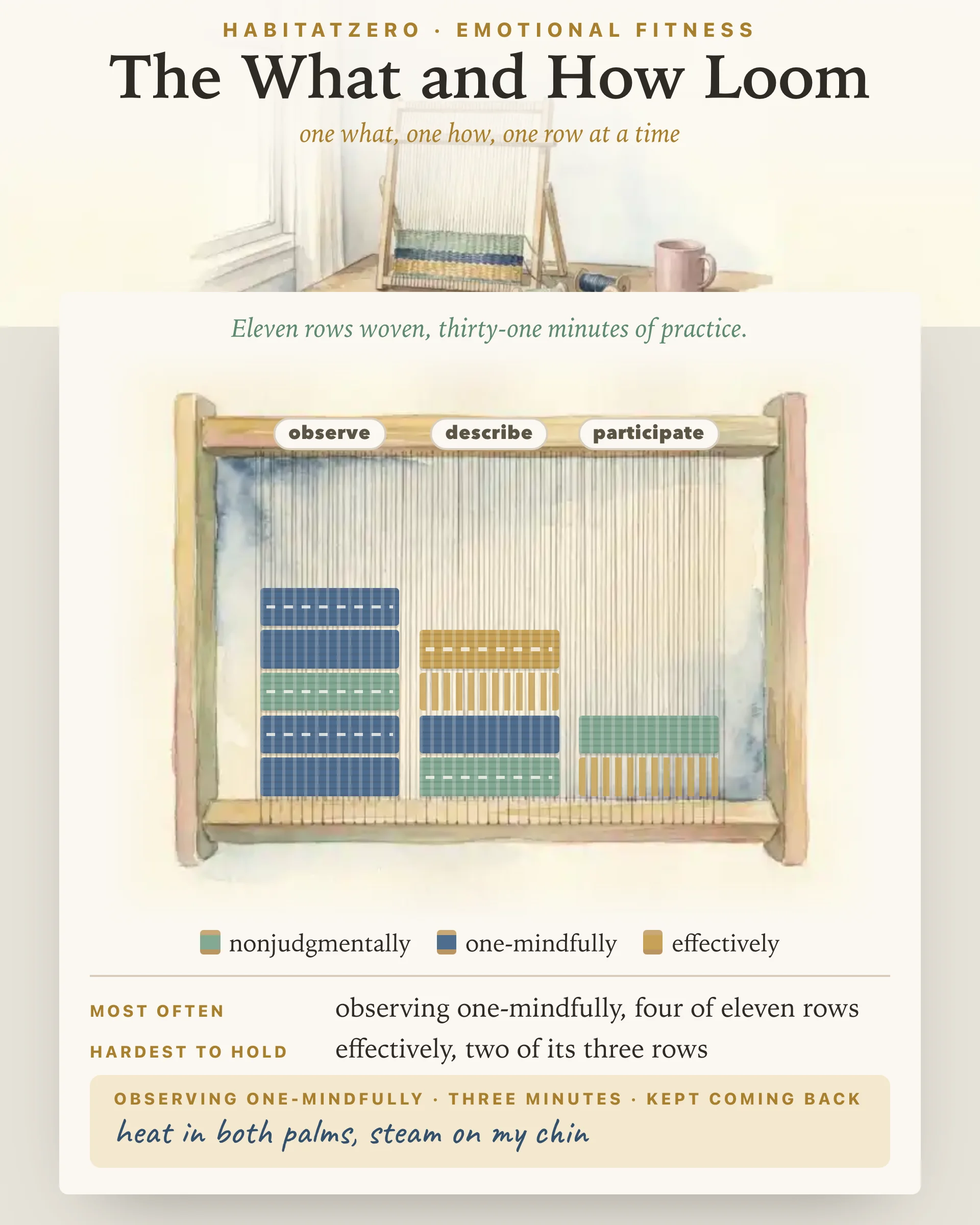
This page turns those six skills into a small frame loom. The what skills are the warp, strung top to bottom, and the how skills wait on spools below. Tap a warp and a spool and you have a practice, such as observing one-mindfully. Pairing one of each is this page's choice, not a DBT rule, and it keeps each practice small enough to finish while the coffee brews.
Choose a suggested practice or write your own, then time it here for up to ten minutes while a row weaves across the frame, or practice away from the screen. Then comes the part a printed handout cannot do: you write one line in your own words about what you noticed, say whether the how held steady, kept coming back or was hard to hold, and weave the row in.
The cloth records that honestly. A steady row is woven tight. A row where you kept coming back carries a thin broken line through the middle. A row that was hard to hold is an open weave with the warp showing through. None of these is a failed row, because coming back is the practice.
After three rows the cloth starts reading itself back to you: the pairing you return to most, the how that is hardest for you so far, and any part of the warp still bare. A section holds eight rows, and the loom refuses a ninth until you unpick one or give another what a turn.
Most research on DBT mindfulness comes from clinics, alongside other care. In one study of sixty people with borderline personality disorder, the forty who added the DBT mindfulness module to general psychiatric care scored better afterward on a computerized test of attention and impulsivity, and the people who logged more minutes of formal practice tended to improve more on general and mood symptoms. That last finding is a correlation in a small group, not proof that minutes cause change, and it says little about people outside that setting.
The case for one-mindfully also rests on how often attention drifts. A study that used smartphones to sample people's thoughts through the day found their minds were on something other than the present almost as often as they were on it, and the wandering usually came with a lower mood. It does not show that practicing one-mindfully fixes that, only that the drifting you keep noticing is ordinary, not a sign you are doing it wrong.
What this page cannot do is teach you DBT. The skills were designed to be learned in a program with a trained therapist, a skills group and coaching between sessions, and anyone whose emotions feel unmanageable should start there. The loom is for the practice in between.
Reach for it while you are learning the mindfulness module, in the spare minutes of a day: waiting in line, before a hard call, on the walk home. A row a day is plenty, and the reading needs a week or two before it says much. If you are in a skills group, bring the cloth along; your hardest how is worth talking about.
Wise mind belongs to the same module, and Wise Mind gives it a page of its own for decisions that need feeling and facts at once. When you are unsure which DBT skill a moment calls for, The Skills Compass points you to one. For longer, unguided sits, the Mindfulness Journal keeps a plain record of each one.
They are the core mindfulness skills of dialectical behavior therapy, the treatment developed by Marsha Linehan. The what skills are the actions: observe, describe and participate. The how skills are the manner you bring to them: nonjudgmentally, one-mindfully and effectively. Together they turn mindfulness from an idea into something you can practice in a few minutes.
Nonjudgmentally means sticking to what happened and dropping labels like good, bad, stupid or perfect, including the ones you aim at yourself for judging. One-mindfully means doing only the thing in front of you and returning to it each time your attention slides away. Effectively means acting on what works in the situation you actually have, even when another move would feel more satisfying.
Observing is noticing without words, the way you might listen to rain on a window. Describing puts plain words on what you noticed and leaves interpretation out, so a tight jaw stays a tight jaw rather than proof that the day is ruined. Participating means joining an activity so fully that you stop watching yourself do it, like singing a whole song or dancing in the kitchen.
Yes. Short practice between sessions is what the skills are built for, and this loom is made for that kind of practice. DBT itself is more than practice, though: a therapist, a skills group and coaching between sessions. If strong emotions are running your days, learn DBT with a trained therapist. This page is an independent practice tool, not an official DBT resource.
The loom on this page is a filled-in example you can look over. Weaving rows of your own, timing your passes and keeping the cloth between visits all happen once you personalize it in HabitatZero, which costs nothing.
By the team behind Fabulous, the science-based self-care app used by over 30 million people.