
Leaves on a StreamEmotional Fitness · ~3 min
About this template · Updated September 2026
Everything on this page traces back to Marsha M. Linehan, the psychologist who developed dialectical behavior therapy, or DBT, at the University of Washington. Her interpersonal effectiveness skills, the part of DBT about asking, refusing and keeping hold of the people you care about, are set out in her DBT Skills Training Handouts and Worksheets, and the Linehan Institute keeps a plain-language overview of all four skill modules. HabitatZero built Three at the Table on its own. Dr. Linehan, the Linehan Institute and Behavioral Tech had no hand in it, and none of them has endorsed it.
When you need something from someone, or need to refuse them, DBT counts three things at stake. The outcome is the yes, the no or the change you were after. The relationship is how the other person feels about you afterward. Self-respect is how you feel about yourself when you replay it later. Each has its own skill.
The three aims often pull against each other. Say your brother still owes you four hundred dollars from the spring. Press hard and you may get the money back along with a chilly Thanksgiving. Let it drop and the peace holds, but something in you sags every time he mentions a new purchase. DBT's move is to settle, before you open your mouth, which aim matters most this time. That choice tells you which skill to lead with and which trade-offs you are willing to make.
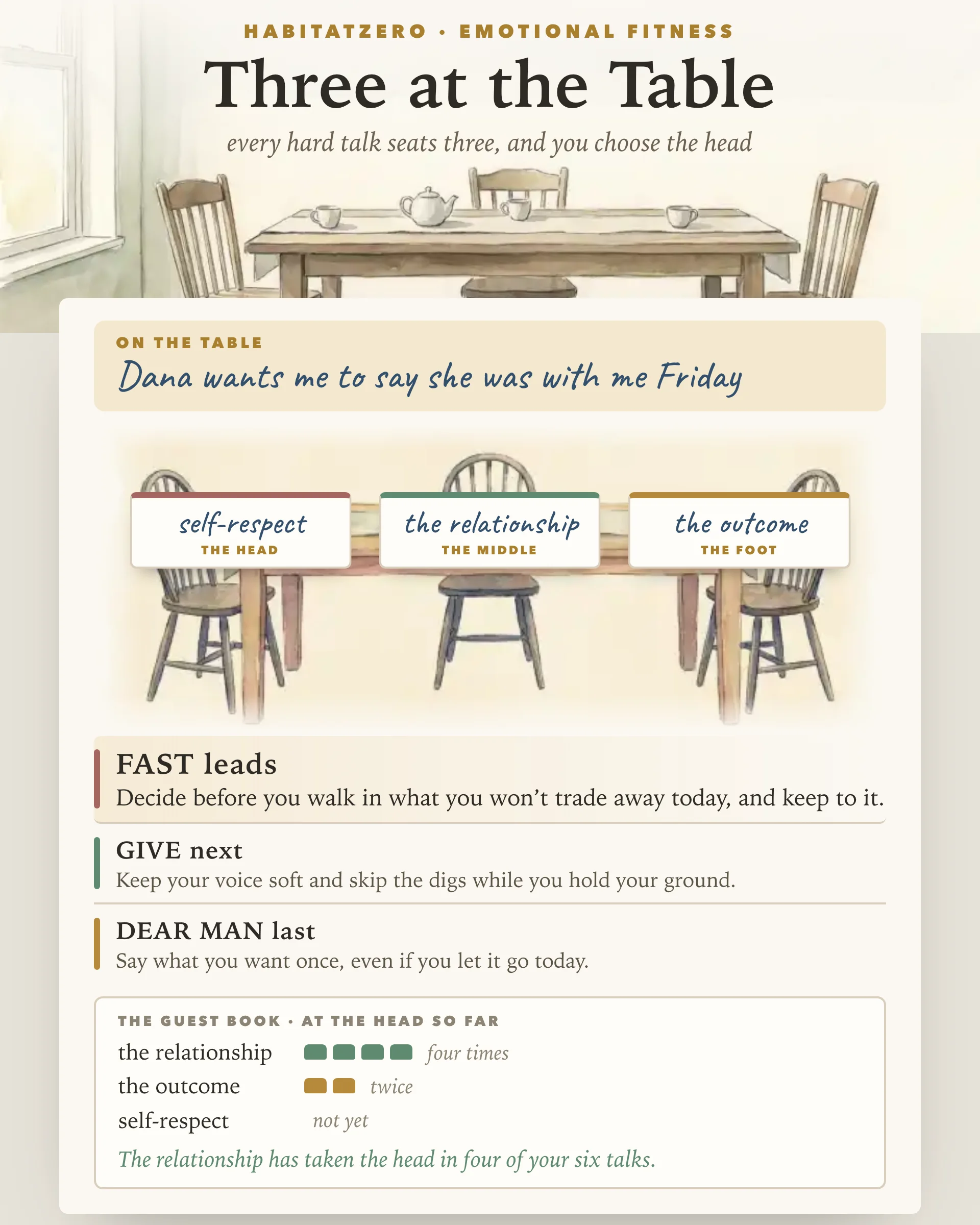
This page turns that decision into a seating plan. Tap the guest that matters most and it takes the head of the table; your second tap fills the middle chair, and the last guest settles at the foot by itself. Nobody gets sent home: the guest at the foot still has a seat, and the order only decides where most of your attention goes.
The three skills then line up in your order, each with one line to practice, and the line depends on the chair. At the head, DEAR MAN asks you to put the ask in one plain sentence and return to it whenever the talk drifts; at the foot, it asks only that you say what you want once. Even from the foot, FAST keeps one floor: whatever you agree to, give only reasons that are true.
Keep a named talk and it goes into a guest book that holds twelve. Once a few talks are in, the book counts who has taken the head, points out any guest who never has, and names the one who keeps ending up at the foot.
We could not find a study that tests this ranking step by itself, so the table gives you structure rather than a measured effect. Two findings from outside DBT suggest why the choice is worth making on purpose.
The first is about knowing what you came for. A meta-analysis of twenty-two research reports on negotiation found that negotiators who went in with specific, challenging goals consistently came out with more than those who had vague goals or none. A bargaining table is not a kitchen table, but the lesson travels: an outcome you have not named is hard to defend.
The second is about putting the relationship first. In a two-week daily study of college students in dating relationships, giving things up for a partner in order to gain something good, such as their happiness or more closeness, went with better well-being and relationship quality. Sacrifices made mainly to avoid something bad, such as a fight or a partner's disappointment, went with worse, and over time they were especially hard on the relationship. Leading with the relationship is not automatically the kind choice; why you seat it there matters.
Open the table before any conversation that pulls you two ways: asking a friend to pay back a loan, turning down a parent who is counting on you, asking your manager for a schedule that fits. Then take the leading skill further: write the ask on The DEAR MAN Script, plan the warmth with The GIVE Lanterns, or check what you will not trade away on The FAST Mirror.
Some conversations are not a matter of priorities at all. If someone hits, threatens, stalks or controls you, no seating plan makes the talk safe, and your safety outranks every guest at the table. The National Domestic Violence Hotline is free, confidential and staffed around the clock: call 1-800-799-7233 or text START to 88788.
This page is practice, not treatment. DBT skills are usually learned over months with a trained therapist and a skills group, and if the same talks keep going badly, a therapist trained in DBT is the right next step.
They are the interpersonal effectiveness skills of dialectical behavior therapy, the part of Marsha Linehan's skills training that deals with other people. The module rests on three aims any hard conversation can put at stake: the result you want, the relationship itself, and your self-respect. DEAR MAN serves the first, GIVE the second and FAST the third.
DEAR MAN shapes the request or refusal itself: Describe, Express, Assert, Reinforce, stay Mindful, Appear confident, Negotiate. GIVE looks after the relationship: be Gentle, act Interested, Validate, and use an Easy manner. FAST guards your self-respect: be Fair, drop needless Apologies, Stick to your values, and be Truthful.
In DBT it means handling a conversation so that it serves your goals: asking for what you need, turning down what you cannot give, and walking away with the relationship and your self-respect in the shape you wanted. Being effective in this sense is a different thing from winning.
Decide which of the three aims matters most in this particular talk, then let its skill lead. If the answer itself matters most, lead with DEAR MAN. If keeping things good between you comes first, lead with GIVE. If you are close to giving up something you believe in, lead with FAST. The other two still get a seat, with less of your attention.
The filled example on this page, with its six-talk guest book, is free to read as it stands. Seating your own talks and growing a guest book of your own starts when you personalize the template in HabitatZero, which costs nothing.
By the team behind Fabulous, the science-based self-care app used by over 30 million people.


