Leaves on a StreamEmotional Fitness · ~3 min
About this template · Updated September 2026
FAST is one of the interpersonal effectiveness skills in dialectical behavior therapy, or DBT, the treatment developed by psychologist Marsha M. Linehan. The Linehan Institute describes that module as learning to ask for what you need and to say no while keeping both your relationships and your self-respect, and the skill itself is laid out in the interpersonal effectiveness handouts of Linehan's DBT Skills Training Handouts and Worksheets. The FAST Mirror is HabitatZero's own practice tool, with no ties to Dr. Linehan, Behavioral Tech or any DBT organization, none of which has reviewed or endorsed it.
DBT gives a hard conversation three possible aims: getting what you asked for, keeping the relationship, and keeping your self-respect. FAST covers the third. Linehan frames it as a question worth answering before you begin: how do you want to feel about yourself once the talk is over, whether or not you get the outcome you hoped for? It bites hardest when peace is on offer at a price: a quick yes, one more sorry, a small lie.
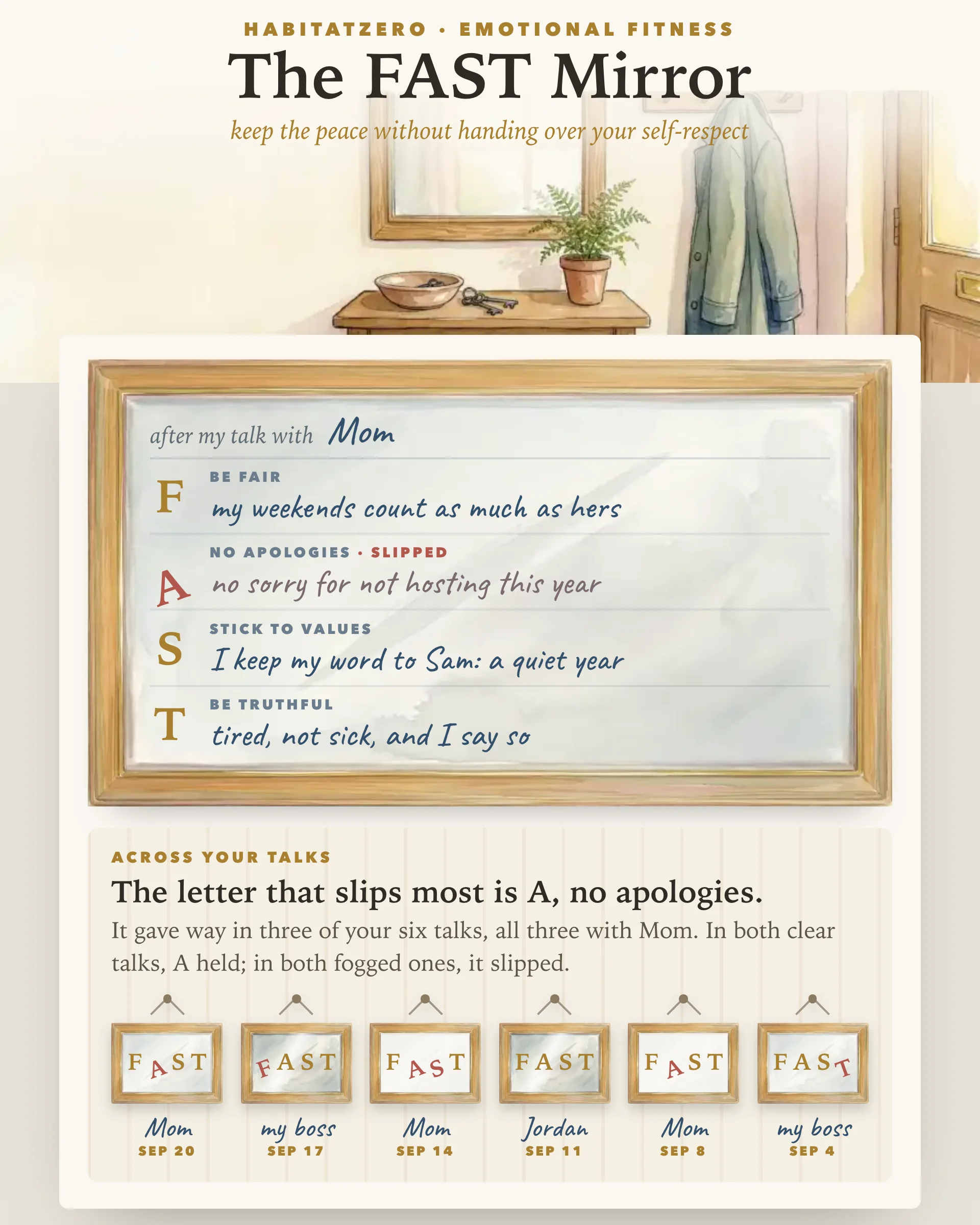
The page is a hall mirror, the one you pass on your way out to a hard conversation and again on your way back in. Write who the talk is with at the top of the glass, then one line under each letter about what it means in this particular talk. If a line won't come, the idea button offers one to reword; anything you type yourself is left alone.
After the talk, tap any letter that slipped. It drops and tilts on the glass, showing at a glance where you gave ground. Then answer the question underneath: walking away, can you meet your own eye? Clear, misted or fogged. Hang the talk and it joins a wall of small mirrors, twelve at most, each showing who it was with, which letters held and how the glass looked afterwards. Your four lines stay on the big mirror.
Once a couple of talks are up, the wall reads the pattern back: the letter that gives way most often, the person it tends to happen with, and whether the talks you left feeling clear kept a letter the foggy ones lost. If the same letter keeps sliding with your mom, write that line first next time, and say it early.
No study has tested FAST on its own, so nobody knows how much these four guidelines protect self-respect by themselves. The broader case for learning DBT skills outside a full program is encouraging but thin: a systematic review of seventeen trials that used DBT skills training without the rest of DBT found preliminary support across a range of problems, while warning that the studies' methods were too limited for firm conclusions.
The habit FAST pushes against has been studied more directly. Psychologists call it self-silencing, holding back your own needs and opinions to keep a relationship smooth. A 2021 meta-analysis pooled forty-two studies covering about ten thousand people and found a medium-sized link between self-silencing and depression. That is a correlation, not proof that one causes the other, and it says nothing about whether any worksheet changes either. It does suggest the small surrenders deserve attention.
Use the mirror before any talk where you can feel the pull to give yourself away: a parent who wants you to host again, a manager asking for one more weekend, a friend who needs you to lie for them. If you also have a request to make, write it with The DEAR MAN Script and bring your FAST lines along. When the same person keeps crossing the same line, the Boundaries Worksheet helps you name it and hold it. If you can't tell what your values say here, find your footing with Wise Mind first.
FAST assumes a relationship that is basically safe. Choosing better words will not make an abusive one safe, and your self-respect is not something you earn by getting the wording right. If someone hurts, threatens or controls you, The Hotline answers around the clock at 1-800-799-7233, or you can text START to 88788.
This page is skills practice, not treatment. If hard talks keep leaving the glass fogged, or you want to learn these skills properly, talk with a therapist, ideally one trained in DBT.
Be Fair, no Apologies, Stick to values and be Truthful. Marsha Linehan groups the four as guidelines for self-respect effectiveness: being fair to yourself as well as to the other person, dropping the extra sorries, not trading away what you believe for reasons that matter little, and no lies, excuses or put-on helplessness.
Say your mom wants you to host the holidays again, and you promised your partner a quiet year. Fair: your weekends count as much as hers. No apologies: one sorry for disappointing her, not five. Stick to values: the promise you made at home stands. Truthful: you tell her you are worn out rather than claiming a cold.
No. When you have actually done something wrong, owning it is part of being fair. The A is aimed at the extra apologies: sorry for asking, sorry for having a view, sorry for disagreeing, sorry for taking up room at all. Say one clean sorry for your share, then stop.
Reach for FAST when what you stand to lose is respect for yourself, not the argument or the friendship, such as the moment you notice you are about to agree just so the tension ends. DEAR MAN shapes the request itself and GIVE looks after the relationship, and most difficult talks borrow a little from all three.
The mirror above shows a filled example you can read through freely. Writing your own four lines, marking each talk and building the wall that shows your pattern all happen once you personalize the page in HabitatZero, which costs nothing.
By the team behind Fabulous, the science-based self-care app used by over 30 million people.