Leaves on a StreamEmotional Fitness · ~3 min
About this template · Updated September 2026
IMPROVE the moment is a crisis survival skill from dialectical behavior therapy, the treatment psychologist Marsha M. Linehan developed. It belongs to the distress tolerance module and appears as the "Improving the Moment" handout in her DBT Skills Training Handouts and Worksheets, and clinicians learn to teach it through Behavioral Tech, the training company she founded. HabitatZero made this umbrella independently. It has no affiliation with Dr. Linehan, Behavioral Tech or any DBT organization, and none of them has reviewed or endorsed it.
Distress tolerance is the part of DBT for moments you cannot fix yet, like news you cannot change tonight or an urge that insists it will never pass. The goal is modest and hard at once: get through without doing something that makes tomorrow worse. IMPROVE packs seven ways to do that into an acronym you can still find when clear thinking is the first thing to go.
In the 2015 second edition of the handouts, the letters stand for:
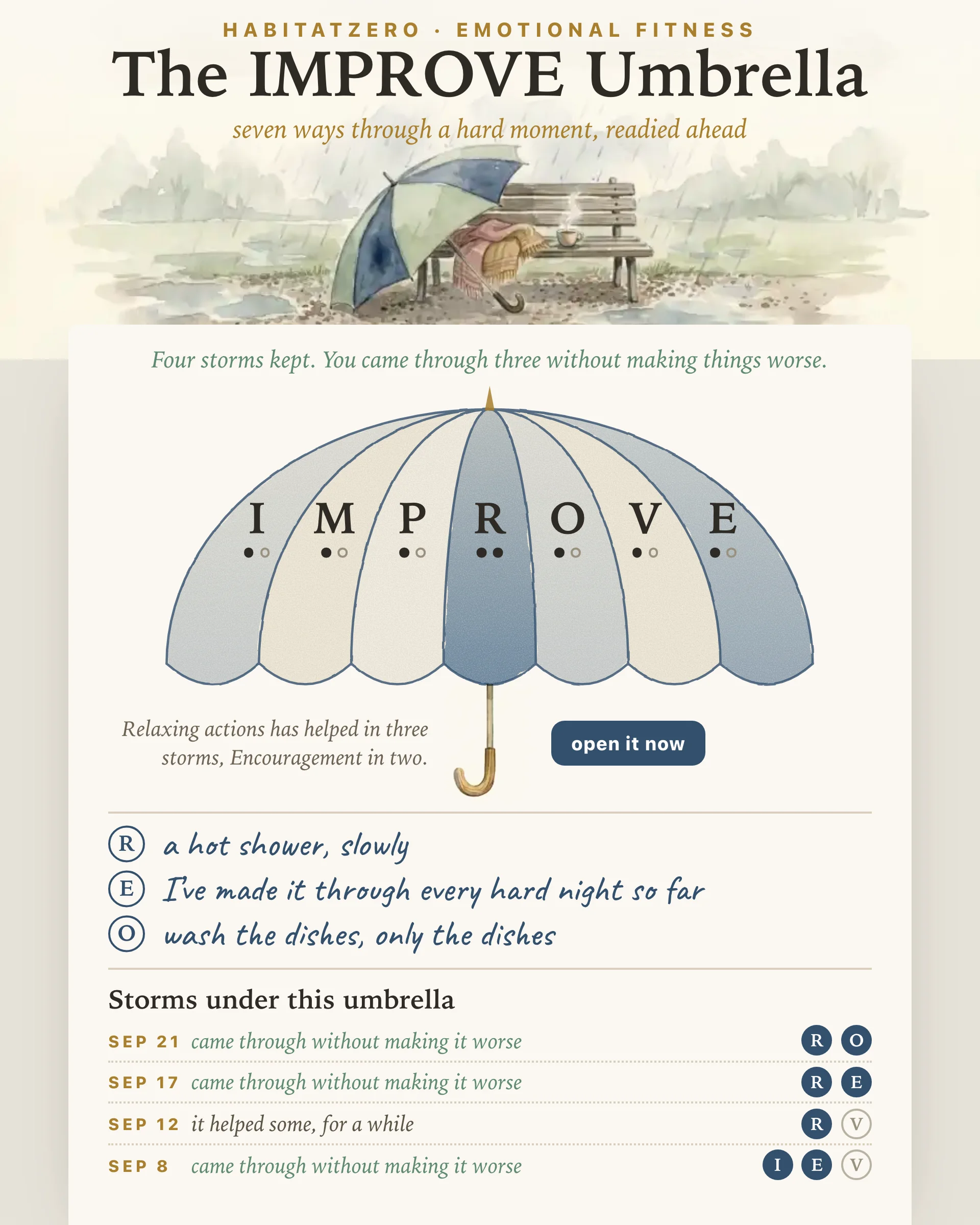
On a calm day, tap a panel, one for each letter, and give it one or two lines from the suggestions or in your own words. Two is the ceiling on purpose, because in a storm you need something you can take in at a glance.
When a hard moment arrives, press open it now. Your lines come back in one list, sorted by what has helped before, with a plain line about urgent help beside them. Give one line a few honest minutes, mark it helped or not this time, and try the next. When the worst has passed, say how you came through, using three steps borrowed from the five-point rating on Linehan's practice worksheets, and keep it in the log.
That log is what a printed handout cannot do. Every storm you keep deepens the blue on the panels that helped, so within a few weeks the umbrella shows which letters work for you, and a line beneath it names them. A panel that keeps failing gets flagged too, which usually means it needs new lines, not that you did something wrong.
The research does not isolate IMPROVE; it looks at DBT skills as a whole, learned over months with a therapist and a group. When Linehan's team followed 108 women with borderline personality disorder through a year in three of her randomized trials, those in DBT ended up using about three times as many skills as those in comparison treatments. In the statistical models, that growth in skills use fully accounted for their fall in suicide attempts and depression. That supports practicing skills, not any single letter.
In three lab experiments using upsetting pictures or unpredictable shocks, people facing the most intense material tended to choose distraction over rethinking, and leaned toward reappraisal when the upset was milder. A skill built for the peak of a crisis leans the same way, moving your attention and easing your body before it asks you to argue with your thoughts.
This page is practice, not treatment. DBT was designed to be learned with a person, and a DBT therapist can help you build your umbrella and test it. If you are in crisis or thinking about hurting yourself, call or text 988 (US) right now, or reach your local emergency number.
Ready the umbrella on an ordinary day, while choosing lines is easy. Open it when a moment cannot be solved right now and only has to be lived through: the hour after bad news, the night a craving comes back, the evening after an argument. Afterward, give the log thirty seconds; that is where the umbrella learns.
Not sure IMPROVE fits what you are facing? The Skills Compass routes across all four DBT modules. When the storm is mostly one urge building toward action, Urge Surfing lets you ride it out against a timer. And when the hard part has already happened and will not change, The Open Hand practices radical acceptance, the slower skill in the same module.
Imagery, Meaning, Prayer, Relaxing actions, One thing in the moment, Vacation and Encouragement. Together they make up IMPROVE the moment, a crisis survival skill in the distress tolerance module of dialectical behavior therapy, which Marsha Linehan developed.
Reach for it in a crisis you cannot solve right away, when the whole job is getting through the next hour without doing something that makes tomorrow worse. It is not a problem-solving tool. Once the peak has passed, other DBT skills can take on the problem itself.
No. Linehan's handout names God or a higher power, and it names your own wise mind just as readily. On this page the P panel can hold a prayer you know by heart, a plain request for strength, a minute of silence, or a question you put to yourself.
Both are crisis survival skills. ACCEPTS is distraction, pulling your attention off the pain for a while with activities, other people, other thoughts and strong sensations. IMPROVE tries to make the moment itself more bearable, through what you picture, what you make of the pain, how you talk to yourself and how your body feels.
The filled-in umbrella on this page is free to look through without an account. Readying panels of your own and keeping a storm log happens in HabitatZero, which costs nothing.
By the team behind Fabulous, the science-based self-care app used by over 30 million people.