Leaves on a StreamEmotional Fitness · ~3 min
About this template · Updated September 2026
Credit first: Wise Mind ACCEPTS was created by psychologist Marsha M. Linehan as part of dialectical behavior therapy (DBT). In the 2015 second edition of her DBT Skills Training Handouts and Worksheets it is Distress Tolerance Handout 7, titled "Distracting," one of six crisis survival skills. This radio is HabitatZero's own practice tool. It has no connection to Dr. Linehan, her publisher, or any DBT training organization, and none of them has reviewed or endorsed it.
When you cannot fix a painful situation right now, you can move your attention somewhere else until the worst of it passes. Each letter is a different place to move it.
Crisis survival skills have a narrow job. Linehan's handouts save them for moments when the pain is intense, the problem cannot be solved quickly, and acting on the urge would make things worse, and they say outright that these skills are not for everyday problems or for building a life worth living. Distraction gets you across the worst stretch without adding damage. Once the number comes down, the problem is still there, and that is when you turn back to it.
If the feeling is so hot you cannot think, TIP skills work on your body directly, and ACCEPTS may be easier to use once they have taken the edge off. The wise mind in its full name is the steady part of you that picks a distraction on purpose; Wise Mind is where to practice finding it. For all six crisis skills together, see DBT Crisis Survival Skills.
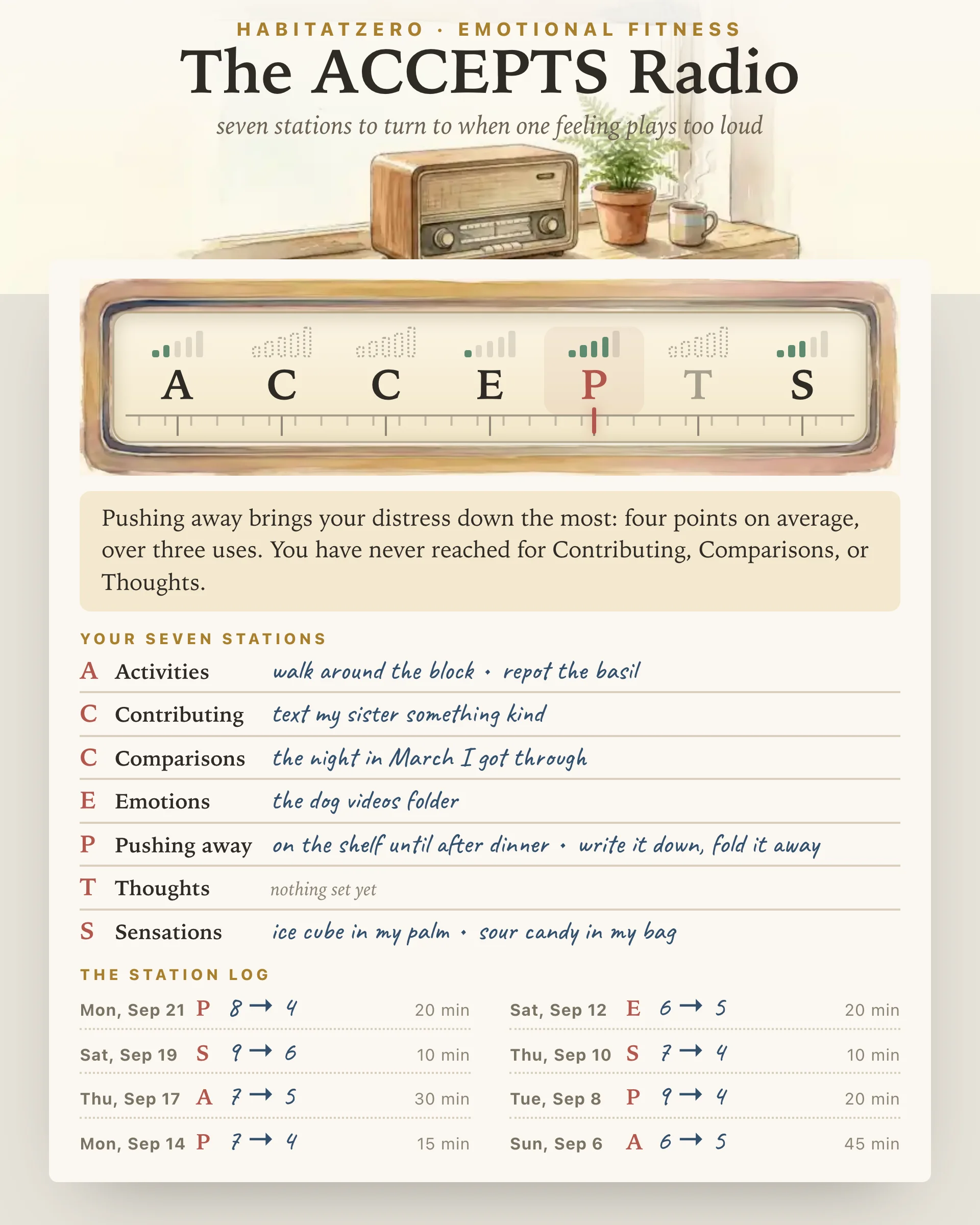
Each letter is a station on the dial. On a calm day, set one to three ideas on each station and mark where each one works: at home, at work, or out and about. When distress spikes, choose where you are. Stations with nothing ready for that place go dim, and seek jumps to the next one that has something.
Before you start, tap how strong the distress is, from zero to ten. When the worst has passed, tap the number after and how long you stayed tuned, then log it. The first number waits for you, so you can set it in the moment and finish later.
Each use adds signal to its station. The bars show how far that station brings your distress down on average, and the line under the dial names the strongest station and the letters you have never reached for. An unused letter is not a failure; it may just need a better idea.
DBT has a strong record in clinical trials, but they test the whole program: individual therapy, a skills group, phone coaching, and a team for the therapists. The closest look at the skills themselves came from a 2015 trial that took DBT apart. Among 99 women at high risk of suicide, the two versions that included skills training reduced self-injury and depression more than therapy without it, and only those two eased anxiety. That tested the whole skills curriculum, though. We found no study that tests ACCEPTS on its own.
Laboratory work on distraction leans the same careful way. A meta-analysis of 306 experimental comparisons found that distraction reliably changed how people felt, though the effect was small, while concentrating on the feeling did not help. Trying to suppress thoughts about the upsetting event did not help either, which is worth remembering for Pushing away. Let your own log decide: if a letter keeps leaving the number where it was, change its idea or lean on another one. A drop is not proof that a letter caused it, since intense feelings also ease with time. Getting through that time without making things worse is exactly the job.
Set your stations on an ordinary day. Reach for the radio when distress spikes and nothing can be fixed tonight: after a fight, during a craving, when a memory will not let go. If you are in DBT, bring your log to your skills group or therapist. This radio is practice for one skill, not therapy and not a safety plan. When you might act on thoughts of hurting yourself, no station is enough: put the radio down and call or text 988 in the US, or your local emergency number anywhere else.
Activities, Contributing, Comparisons, Emotions, Pushing away, Thoughts, and Sensations. Each letter is a separate road away from the crisis for a while: doing something absorbing, helping someone, setting tonight beside a harder time, calling up a different feeling, shelving the problem, handing your mind a task, and giving your body something strong to feel.
Reach for it when distress is running high, the problem cannot be solved tonight, and acting on the feeling would make things worse. Linehan's handouts say crisis survival skills are not meant for everyday problems or for building a life worth living. Distraction carries you over the peak; afterward, you turn back to what set it off.
Printable ACCEPTS handouts are everywhere, and this radio prints as well. Its print button puts your dial, the reading, all seven stations with their ideas, and the full log on paper, and the print window can save that as a PDF. What paper cannot do is add up which letters bring your distress down.
No. ACCEPTS comes from Marsha Linehan's DBT skills training materials, where it appears as Distress Tolerance Handout 7 in the 2015 second edition. This radio is an independent practice tool: Dr. Linehan, Guilford Press, and the DBT training organizations did not make it, review it, or endorse it.
You can explore the sample radio here without an account. Setting your own stations, tuning in by place, and keeping a log that shows what brings the number down all begin when you personalize it in HabitatZero, which is free.
By the team behind Fabulous, the science-based self-care app used by over 30 million people.