Leaves on a StreamEmotional Fitness · ~3 min
About this template · Updated September 2026
The idea that a few deep beliefs sit underneath your everyday thoughts comes from Aaron Beck's cognitive model, the ground cognitive behavioral therapy stands on. The Beck Institute's introduction to CBT sums the model up as the observation that how you read a situation shapes your reaction more than the situation does. The weekly log here follows Christine Padesky, co-author of Mind Over Mood, who described in detail how a new core belief can be built rather than only argued for. Neither the Beck Institute nor Dr. Padesky had any hand in this trellis, and neither has reviewed or endorsed it.
Automatic thoughts change with every situation, but underneath they lean on a few blunt conclusions, such as I'm not good enough, people always leave or nothing ever works out. Padesky sorts them the way this page does, into beliefs about yourself, about other people and about the world, and notes that they are usually stated as absolutes.
Padesky's advice on wording surprises people: keep the new belief as plain and absolute as the old one. A hedged version such as lovable to some people, sometimes is easy for the old belief to file away as a rare exception, while a plain one already leaves room for imperfection, since being lovable has never meant being loved by everyone.
Padesky compares a core belief to a prejudice: it survives by not noticing evidence against it, discounting what it does notice and calling the rest an exception. So one good day rarely moves it. In her 1994 paper on schema change the answer is a daily log of small observations that fit the new belief, plus a weekly rating from zero to a hundred on a scale that measures only the new belief.
Her typical numbers are slow on purpose: from zero to five or ten after one to two months of logging, twenty to forty a month or two later, and at least six months before the new belief feels settled. Naming kinds of evidence helps too. One client who logged only the times she helped others began finding evidence daily once she added looking after herself, facing hard tasks and saying what she thought.
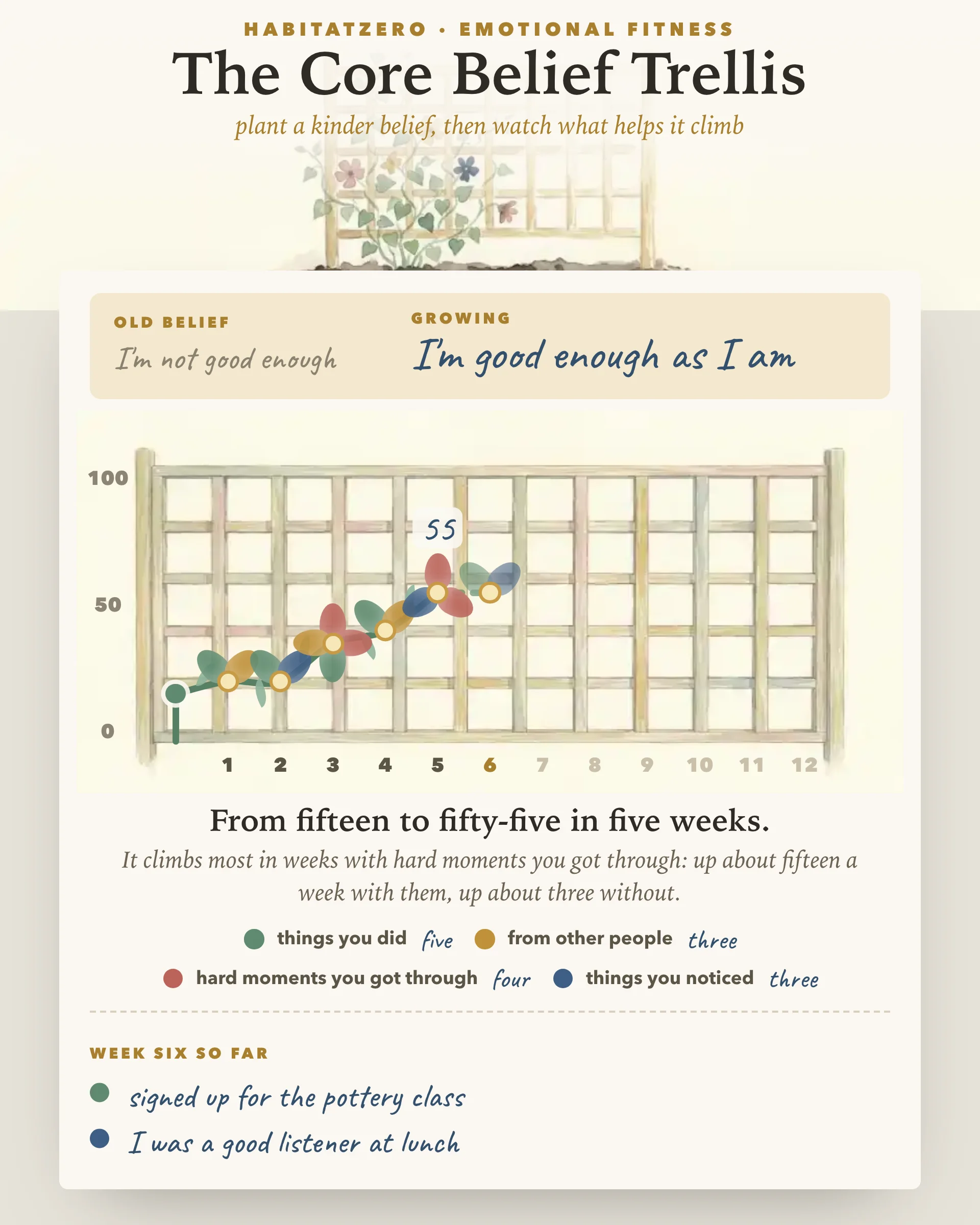
Tap an old belief or write your own, write the belief you want to grow, and rate how true it feels today; that rating plants the vine. During the week, add evidence as it happens, sorted into four kinds: something you did, something another person said or did, a hard moment you got through, and something you noticed in yourself. Each piece opens a petal on that week's flower, seven at most. At the end of the week you rate the belief again and tie the vine in at that height.
The part paper can't do starts once three weeks are tied in. The page compares the weeks that held each kind of evidence with the weeks that didn't and tells you which kind your climbs came with. It is a pattern in your own ratings, not proof of cause.
Structured CBT that targets a harsh, global belief about the self has decent support. A meta-analysis of programs built on Melanie Fennell's model of low self-esteem, which centers on that kind of bottom-line belief, found large improvements after weekly courses and much smaller ones after one-day workshops (Kolubinski and colleagues, 2018). The gains came from self-report questionnaires, and the authors could not say whether these programs differ from standard depression treatment. Because the studies tested whole courses of therapy, none of them shows what a log like this adds by itself.
So treat the trellis as a self-help exercise drawn from CBT, not as treatment. Beliefs that took shape early and have steered you for decades are what a CBT therapist can help with, and this log is a good thing to bring along. Writing down a belief like I'm worthless can also stir up more than you expected. If you are in crisis or thinking about hurting yourself, call or text 988 (US) right now, or reach your local emergency number.
Start when you notice the same verdict sitting under many different bad days. If you can't yet name the belief, catch the everyday thoughts first in the Thought Record Journal; after a few entries the belief tends to show itself. When a piece of evidence feels too small to count, the Thinking-Trap Spotter names the discounting habit that keeps shrinking it. And if the old belief talks to you in a harsh inner voice, the Self-Compassion Worksheet practices answering it more kindly.
They are the deepest and most absolute conclusions a person carries about themselves, about other people and about the world, such as the belief that you are unlovable or that people cannot be trusted. Cognitive therapy sees them as learned, often early in life, which is why they can feel like plain fact instead of opinion.
About yourself: I am not good enough, I am a failure, I am unlovable, I am helpless, I am worthless. About other people: people cannot be trusted, people always leave, others are better than me. About the world: the world is dangerous, nothing ever works out, effort does not pay off.
Christine Padesky puts most of the effort into strengthening a new belief instead of only disputing the old one. You write the belief you want in your own words, record small everyday evidence that fits it, and rate how much you believe it once a week. In her account that rating climbs slowly, over months rather than days.
Once you personalize this worksheet, its print button turns your trellis, weekly ratings and full evidence log into a printout, or into a PDF if you pick save as PDF in the print dialog. Day to day the interactive version does more, because it keeps the log and redraws the vine each week.
The trellis on this page is a locked preview with a filled-in example. Personalizing it in HabitatZero, which is free, gives you a trellis of your own that keeps every week you tie in.
By the team behind Fabulous, the science-based self-care app used by over 30 million people.