Leaves on a StreamEmotional Fitness · ~3 min
About this template · Updated September 2026
Check the facts is one of the emotion regulation skills that psychologist Marsha M. Linehan built into dialectical behavior therapy, or DBT. In the second edition of her DBT Skills Training Handouts and Worksheets it is Emotion Regulation Handout 8, practiced on Worksheet 5, and Handout 8a lists the facts that fit each emotion; the 2025 revised edition regroups the handouts skill by skill. The Fact Check is a practice page HabitatZero made on its own. Neither Linehan nor her publisher had a hand in building it, and neither has endorsed it.
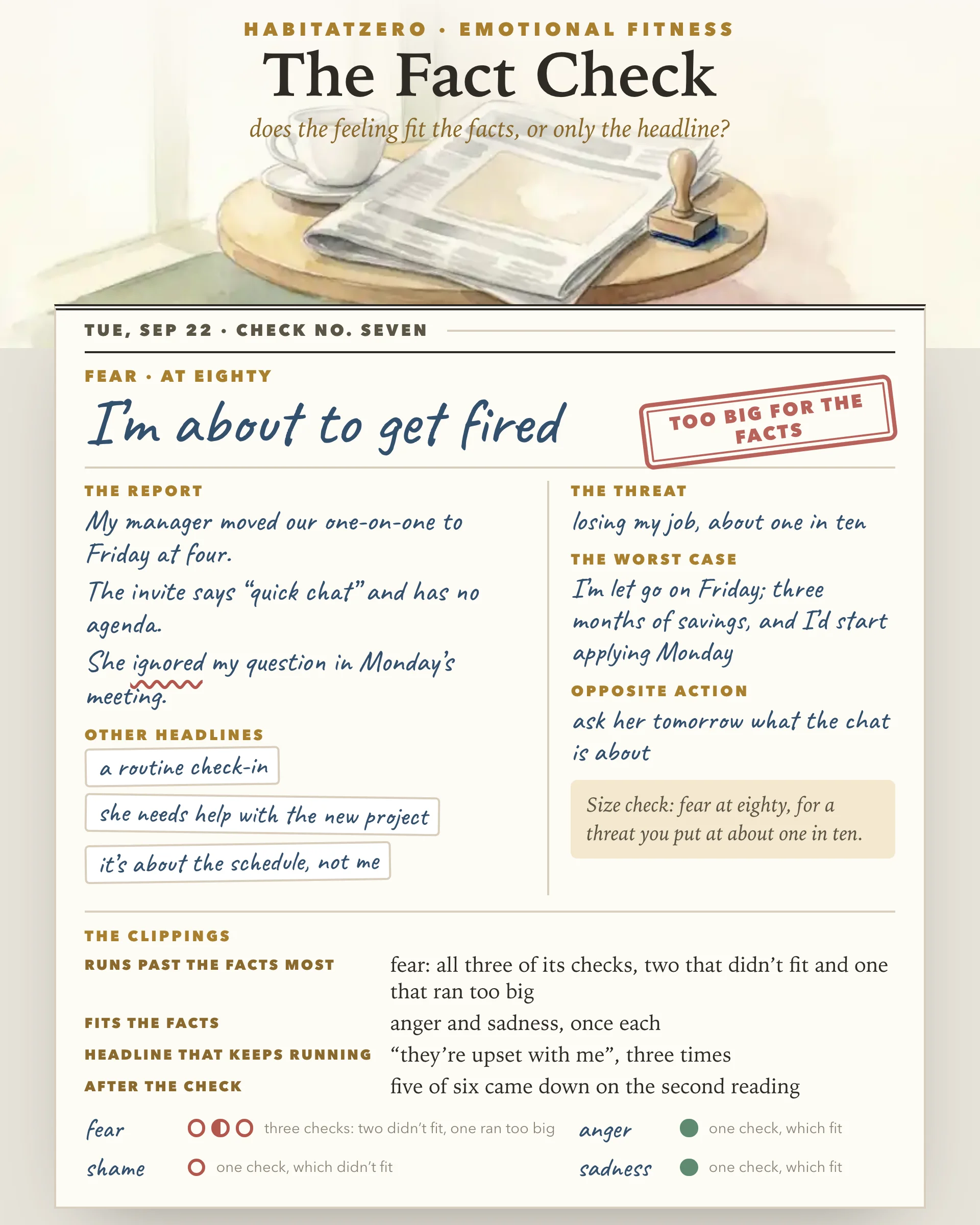
Your manager moves your one-on-one to Friday, and the invite says only "quick chat." Within a second your mind has written the headline, I'm about to get fired, and your body is reacting to that headline, not to the calendar. The handout says it plainly: many emotions are set off by how we interpret an event rather than by the event itself, and a strong emotion then colors how we read what comes next.
Checking the facts is not arguing yourself out of every feeling. Sometimes the check confirms it: a real loss calls for sadness, and a real threat calls for fear. The skill gives the feeling a fair hearing before you act.
The handout asks six questions, and this page keeps their order.
The page is laid out like a newspaper, which is roughly how a mind treats a hard moment. You pick the feeling and slide how loud it is, from small print to a banner. The report holds up to three plain lines, and the page underlines any word a reporter could not confirm, such as ignored, always or rude, and asks what you saw or heard.
The headline your mind wrote goes in next, set in type as large as the feeling is loud, with other headlines the same facts could carry below it. Two boxes weigh the threat, with honest odds, and the worst case, with how you would cope. A size check then sets the feeling's strength beside those odds, since Handout 8a ties intensity to how likely the outcome is and how much it would matter.
Then you stamp a verdict: fits, fits but too big, doesn't fit, or not sure yet. Each stamp points where Linehan's Handout 9 points. A feeling that fits sends you to problem solving, which Keys for a Stuck Door walks through. One that doesn't fit, or runs too big, sends you to opposite action, and The Flip Side takes that move all the way. Not sure yet means keep checking. Rate the feeling again and the headline shrinks to match.
Filed checks become clippings. From three on, the page reads them back: which feeling most often runs past the facts, which headline keeps running, and how often the second reading came in lower. A new feeling, a new strength or a changed report takes the stamp off, because the old verdict was about something else.
A CBT thought record asks whether a thought is accurate, and weighs the evidence for and against it. Step three overlaps with that work, but the final question differs: whether the emotion fits, in kind and in size. You can end with the same headline and still decide the fear was three sizes too big.
No trial has tested this skill on its own. The nearest evidence is on reappraisal, the wider family it belongs to. A meta-analysis of 306 experimental comparisons found that changing how people thought about a situation shifted their emotions by a small-to-medium amount, and that reappraising the situation itself worked better than reappraising the emotional response. Most were short experiments, not the heavy days you might bring here.
Within DBT, a study of 108 women treated for borderline personality disorder found that people in DBT used about three times as many skills by the end of treatment as people in comparison treatments, and that skills use fully accounted for their drop in depression and their gains in anger control. Practicing skills looks like part of how DBT helps; no single worksheet has shown that alone.
Reach for it once the first surge has passed and you can think in sentences: after a message that stung, or before a conversation you dread. If you cannot tell whether a feeling fits, Wise Mind is where Linehan's sixth step sends you.
This page is practice, not therapy, and DBT skills are best learned with a DBT therapist or in a skills group. If a check ever brings up thoughts of harming yourself or of not wanting to be alive, stop and talk with a person now: call or text 988 in the US, or reach your local emergency number anywhere else.
Check the facts is a dialectical behavior therapy skill for testing a feeling against what happened. You describe the event plainly, separate it from the story you told about it, weigh any threat and the worst case, and then decide whether the emotion and its strength fit the facts. That answer tells you whether to work on the situation or on the feeling.
Fear fits when your life, health or well-being is really under threat. Anger fits when something important is blocked or you are attacked or insulted. Sadness fits a real loss, guilt fits when you went against your own values, and shame fits when people you care about would reject you if something became known. Envy, jealousy, disgust and love each have their own fitting facts as well.
Keep the feeling and work on the situation that set it off, which DBT calls problem solving. The exception is when acting on the urge would only make things worse, and then opposite action still helps. When the emotion does not fit, or runs far bigger than the facts, opposite action is the tool to reach for.
No. Marsha Linehan's handouts are published by Guilford Press, and this interactive page was made separately, with credit to her method in the article. Neither Linehan, her publisher nor any DBT training group reviewed or endorsed it, so treat it as practice beside the published handouts and any DBT care you already have.
The page shows a locked sample so you can see a finished check. Personalizing it in HabitatZero is free, and it keeps your own checks along with the clippings file that shows which feelings run past the facts.
By the team behind Fabulous, the science-based self-care app used by over 30 million people.