
Leaves on a StreamEmotional Fitness · ~3 min
About this template · Updated September 2026
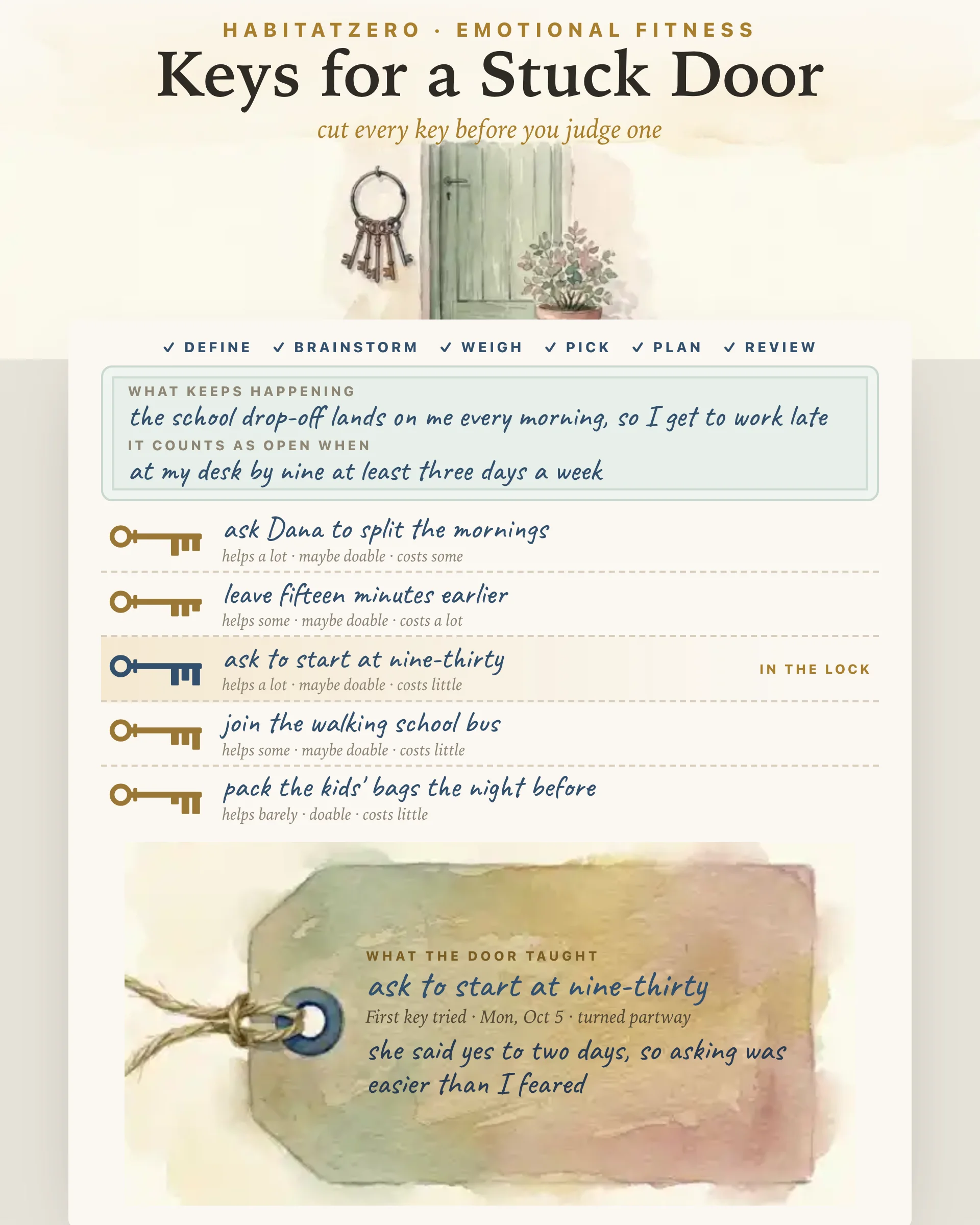
The steps on this page come from problem-solving therapy. Thomas D'Zurilla and Marvin Goldfried first described the approach in 1971, and D'Zurilla later developed it with Arthur Nezu and Christine Maguth Nezu; the three of them wrote the treatment manual that sets out the planful steps you will find here. This sheet is an independent practice tool, and none of those psychologists made it, reviewed it or endorse it.
Plenty of problems stay stuck for a reason that has little to do with a shortage of ideas. The chores that always fall to you, the conversation you keep putting off, the bill that grows while you avoid opening it: you could probably name two or three moves already. What stalls you is that every idea gets judged the moment it appears, found wanting and dropped, so you end up circling the problem instead of testing anything.
Your problem is a door, and every idea is a key. Name the door in a sentence and say what open would look like. Then cut keys: tap a suggestion or write your own. The page will not let you test anything until three keys hang on the ring, and it stops at eight so the ring stays easy to read.
Testing is where paper runs out. Each key goes on a small bench with three questions, and every answer cuts one of its teeth, deeper for a better answer. After a few minutes the ring shows at a glance which keys fit, and the page names the one your answers lean toward. The choice stays yours.
The key you choose goes in the lock. Write the first move, pick a day in the coming week, and the page names a backup key in case this one sticks. After the try, mark whether it opened, turned partway or stuck, and write what it taught. That line goes on a tag tied to the key. If the door is still shut, the next best key moves into the lock and the first try stays on record, which is the loop the therapy asks for.
Problem-solving therapy has a long research record. A meta-analysis of 31 studies with 2,895 participants found it beat no treatment, usual care and attention placebo, though it was not significantly better than other established therapies. Three things were linked to the size of the effect: whether homework was assigned between sessions, whether people were coached on their attitude toward problems as well as the steps, and whether one of its developers helped run the study. That last one is a reason to read the numbers with some care.
Most trials are about depression. An updated review of 30 trials found a sizable average effect, but results varied widely, and in the nine trials with the lowest risk of bias the effect was small, about the same as other talking therapies. For anxiety, a review of eleven primary care trials found a meaningful benefit for people with depression, anxiety or both.
Notice what those studies tested: guided therapy over several sessions, not a single worksheet. Treat this page as practice of one skill that can sit alongside care. It is not a treatment for anxiety or depression on its own.
Reach for it when one practical problem keeps circling and you catch yourself rehearsing it rather than trying anything. It works best on problems with at least one part you can influence. If a worry keeps looping and you are not sure there is anything to do, walk it through The Worry Tree first. If the same trouble returns after every fix, The Five Whys can help you find what keeps feeding it. And when the choice is big and its consequences run for years, The Long Forecast looks further ahead than any single try.
Some doors are not for keys. If the problem in front of you is about hurting yourself or ending your life, or someone is hurting you, set this page aside, call or text 988 in the US or your local emergency number, and let a person help you now.
Problem-solving therapy works through six: define the problem along with a goal you could check, brainstorm options without judging them, weigh each one, pick the best balance, plan the first move, then review what happened against the goal. When a try falls short, you return to your list and take the next option.
It is a structured talking therapy from the cognitive behavioral family, first described by Thomas D'Zurilla and Marvin Goldfried in 1971 and later developed with Arthur and Christine Nezu. It teaches a repeatable way to work through everyday problems, along with a steadier attitude toward having them at all.
A 2018 review of eleven primary care trials found a meaningful effect for patients with depression, anxiety or both, though most of the wider research is on depression. Those studies tested guided therapy, so use this worksheet as practice of the skill rather than as treatment for an anxiety disorder.
More than feels natural. The sheet asks for at least three before it lets you rate any, since the method holds off judgment until the list is long, and it stops at eight so the ring stays easy to read. Odd ideas belong on it too, because a strange option can point toward a workable one.
Not to look around: this page shows a worked example with every key already cut. To work on your own stuck door and keep the ring until review day, open it in HabitatZero, which costs nothing.
By the team behind Fabulous, the science-based self-care app used by over 30 million people.


