
The Overwhelm Recovery ProtocolWellness & Routines · ~5 min
About this template · Updated November 2026
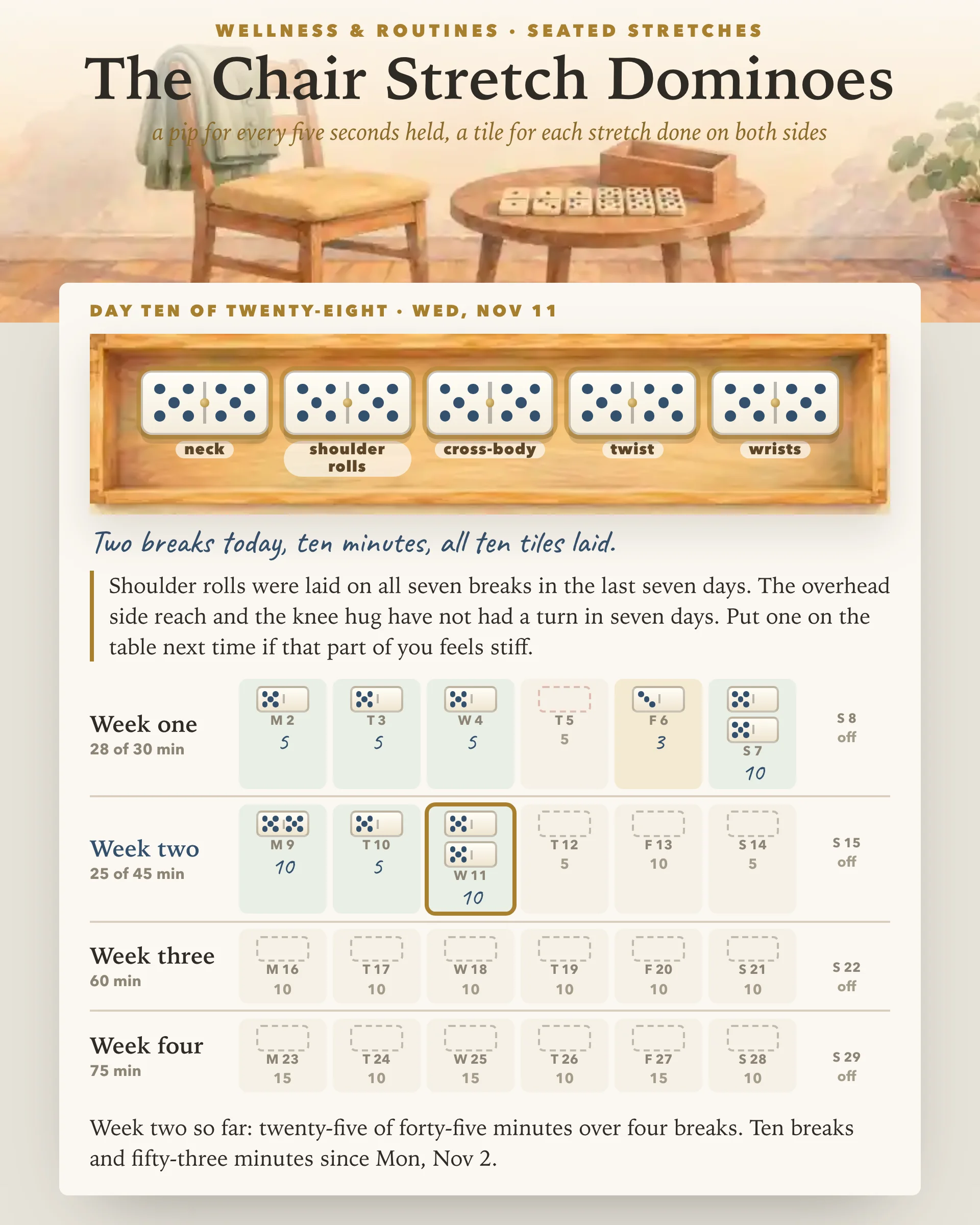
Chair stretches are the ones you can do without getting down on the floor or balancing on one leg. You sit on a sturdy chair, feet planted, and work from your neck down to your ankles and wrists. That suits anyone who sits most of the day, anyone easing back into movement, and plenty of people past sixty who would rather keep a seat under them. This page turns twelve of them into a short break you can time, five or ten minutes at a go, and keeps four weeks of those breaks in view.
Use a solid chair without wheels on a floor where it won't slide. Sit toward the front half of the seat with your feet under your knees. A stretch should feel like a mild, even pull; sharp pain, tingling or numbness means ease off at once. If you have had a joint replacement, a recent fall or surgery, osteoporosis, dizzy spells, or pain that hasn't settled, ask a doctor or physical therapist which of these moves suit you before you begin. After a hip replacement in particular, the figure four and the knee hug can bend the hip further than your surgeon wants, so check before trying them. With osteoporosis, keep the twist and the rounded half of cat-cow small.
Every stretch is a domino tile, and every tile takes one minute: five seconds to settle in, twenty-five seconds on the first side, five to switch, and twenty-five on the second. While you hold, a pip appears on that half of the tile every five seconds, counting up the way a real domino reads, one to five. Moves that use both sides together, like shoulder rolls or seated cat-cow, get two rounds in place of a left and a right.
A tile is laid only once both of its halves have run their full time. Hold the left side of the twist, stop before the right, and that tile stays unlaid. The log keeps whole minutes, so a break you end at three minutes and forty seconds counts as three. Pause freezes the clock, and skip jumps past a side or a whole stretch without counting the seconds it jumped.
Choose five minutes and five stretches go on the table; choose ten and there is room for ten. You start with a balanced set and can swap any tile for another from the library underneath, where every stretch comes with an easier way in.
The neck side stretch, shoulder rolls, the cross-body shoulder stretch, the overhead side reach and the chest opener look after the neck, upper back and shoulders. Seated cat-cow and the seated twist move the spine. The seated figure four, the knee hug and the hamstring stretch with a straight leg reach the hips and the backs of the thighs. Ankle circles and wrist stretches tend to the small joints that stiffen when you stay put. Whatever you pick, a break always runs from the top down.
The American College of Sports Medicine's position stand on exercise for adults recommends flexibility work for the major muscle groups on at least two days a week, adding up to about sixty seconds per stretch, and it encourages breaking up long spells of sitting with short bouts of movement. Hold length seems to matter as well. In a trial with retirement-community residents averaging about eighty-five, sixty-second hamstring stretches gained more range over six weeks than thirty- or fifteen-second ones. The twenty-five-second halves here are a gentle starting length, and a stretch you lay on two breaks in one day brings that side close to the full minute.
The limits deserve a plain word too. A systematic review of twenty-two studies in adults over sixty-five found signs that stretching programs can widen range of motion, but conflicting evidence on whether they make everyday tasks easier. Think of stretching as one part of staying supple, alongside walking and strength work, and not as a fix for any particular ache.
The plan starts small: one five-minute break a day in week one, with a day off each week. Week two adds a second break on every other day, week three settles at ten minutes a day, and week four reaches fifteen minutes on alternate days. Every break you log shows up in the four-week grid as a small tile with a pip for each minute, so a day with two breaks holds two tiles. A line under the grid notices which stretches had the most turns over the last seven days and which stayed in the box, a quiet nudge to rotate.
Open it when you notice you have been sitting a while, or tie it to something you already do: after breakfast, or while the kettle heats. If you'd like a set that follows how your body feels on a given day, The Stiffness Map builds one from the spots you tap. For a morning set and a desk set side by side, try The Daily Stretch Mat. And when you want some strength from the same chair, The Chair Circuit times seated moves for your legs, arms and core. When it is mostly your neck and shoulders asking for a break, The Neck and Shoulder Yoke goes deeper on them.
A balanced seated set reaches the neck and shoulders, the spine, the hips and the backs of the thighs, then the ankles and wrists. The neck side stretch, shoulder rolls, a seated twist, a straight-leg hamstring stretch and ankle circles make a sound five-minute start, and every move here comes with an easier version for stiff or sore days.
Guidance for adults suggests building to roughly a minute of stretching per muscle group, and one small trial in people in their eighties found sixty-second hamstring holds gained more range than shorter ones. This page starts gently at twenty-five seconds per side, so laying the same tile on two breaks in a day brings each side close to that minute.
For most people they are among the gentlest ways to move, because the chair carries your weight. Use a sturdy chair without wheels, go only as far as a mild pull, and stop if anything hurts or you feel dizzy. After a joint replacement, a fall or surgery, or with osteoporosis or lasting pain, ask a doctor or physical therapist which moves fit you.
Two or three days a week is a reasonable floor, and a short break on most days is easier to keep than one long session. The plan here opens with one five-minute break a day and works up to fifteen minutes on alternate days by week four, with a day off each week.
Regular stretching can increase how far a joint moves, and many people find a short seated break eases the stiff feeling that follows a long sit. Reviews in older adults show gains in range of motion but mixed effects on daily tasks, so pair stretching with walking and some strength work rather than relying on it alone.
By the team behind Fabulous, the science-based self-care app used by over 30 million people.


