
The Overwhelm Recovery ProtocolWellness & Routines · ~5 min
About this template · Updated November 2026
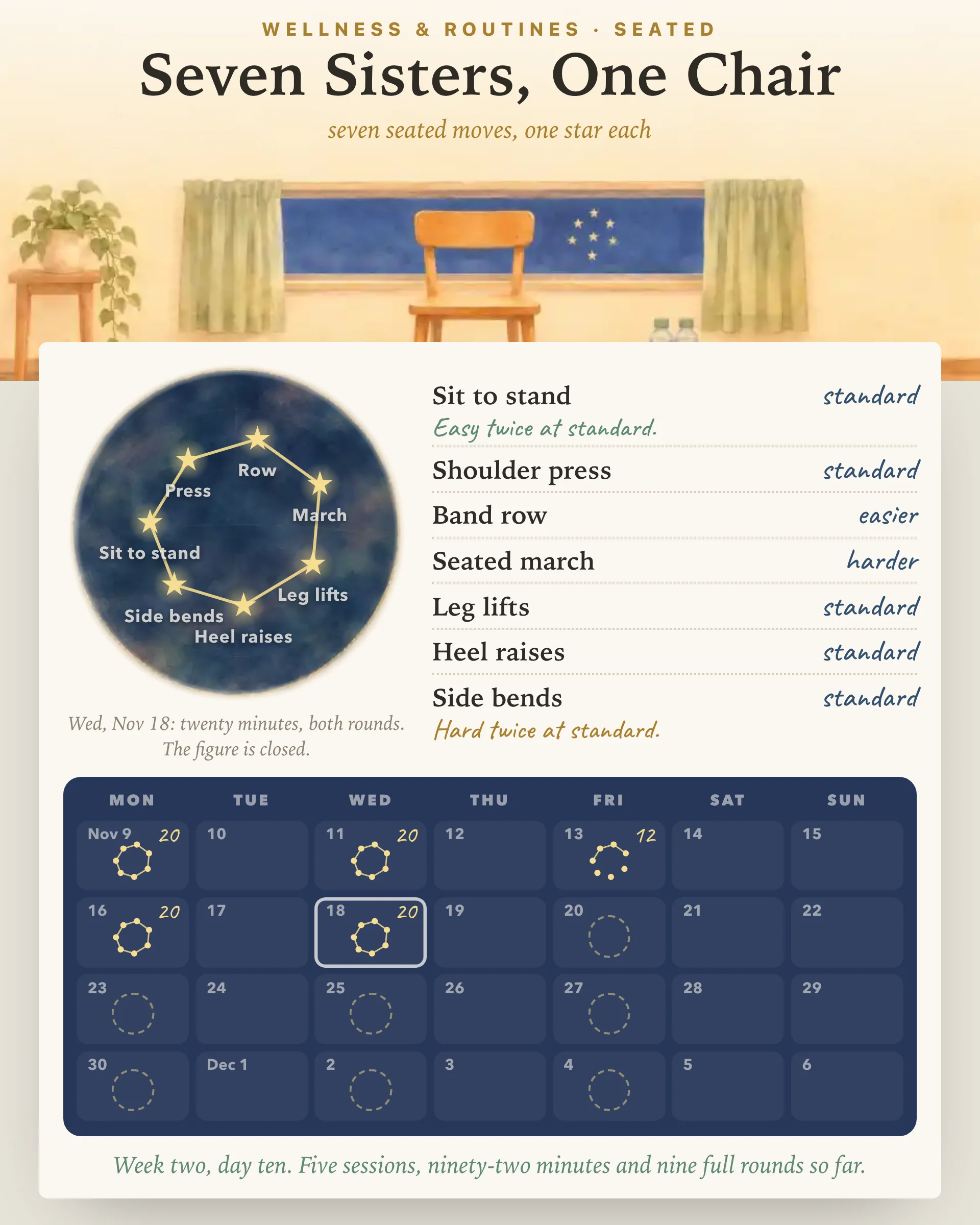
Chair exercises for women over 50 usually begin for a practical reason: getting down to a mat and back up has become a chore, your knees or back object to long standing moves, or you are coming back after years away. A sturdy chair takes balance out of the picture and leaves your legs, arms, back and breathing to do the work, at home.
This page lays each session out as a small chart of stars, the cluster also called the Seven Sisters, with one star for each of the seven moves. The first round lights every star as its move ends, and the second draws a line from each star to the next, so a whole session closes the figure. Four weeks of sessions fill a small dark sky below.
Before your first session, talk with a doctor or physical therapist if any of these apply to you: a heart condition or high blood pressure, a fall or spells of dizziness, a hip or knee replacement, an operation in recent months, a pregnancy or a baby born in the last few months, osteoporosis, or back or joint pain nobody has looked at yet. Push the chair back against a wall so it cannot slide, and stop any move that hurts.
Start each move one step lower than you guess. Week one is for learning the moves, not proving anything.
A session is a three-minute warm-up, two rounds of the seven moves and a three-minute cool-down. Every move owns one minute per round: working seconds first, then easy seconds of gentle marching. Week one is thirty seconds on and thirty easy, and by week four it is forty-five on and fifteen easy, so the session stays twenty minutes while the work inside it grows.
The clock keeps real time. If your phone locks, it catches up when you come back, and pause holds it as long as you need. End here stops early and keeps only what you finished: whole minutes, and a round only once all seven of its moves and their easy seconds have run. A stop inside the first minute keeps nothing.
After a session, tap easy, hard or hurt beside any move that was not about right. A move marked easy twice in a row at one level earns a suggestion to try the next version up, and hard twice suggests a step down for a while. A hurt mark brings a plain note to use the easier version or leave the move out, and to see a doctor or physical therapist if it hurts again.
Three sessions a week with a rest day between, counted from your first session: twelve planned days in all. A missed day simply stays dark, with nothing to make up.
A 2021 systematic review and meta-analysis of chair-based exercise pooled twenty-five studies with 1,388 adults aged 50 and older, in programs lasting two weeks or more. Chair exercisers improved their grip, the arm curls they managed in thirty seconds and the times they stood up from a chair in thirty seconds: a real, if modest, gain.
The World Health Organization's 2020 guidelines recommend regular muscle-strengthening activity at every age and 150 to 300 minutes of moderate activity a week for adults, with specific advice for pregnant and postpartum women. Sixty minutes of chair work a week serves the strength side, not the whole weekly target, so walks still belong in your week.
Bones need something the chair cannot give. A UK consensus statement on exercise for osteoporosis recommends resistance exercise together with impact exercise for bone strength, strength and balance work to lower the risk of falls, and avoiding postures that bend the spine far forward. Seated moves are not impact exercise, so add weight-bearing activity your doctor is comfortable with.
None of this promises anything about your weight, shape, bone density or heart, and many programs studied were short. Treat the page as a way to practice regularly and notice what changes.
For a shorter, gentler session built around the minutes you have, The Chair Circuit lets you pick a focus. When the band row feels easy at every level, The Resistance Band Rack gives the band more to do, and once standing feels steady, the standing strength plan for women in their forties and beyond is a natural next step. For a stretch break in the same chair, The Chair Stretch Dominoes times twelve seated stretches.
A balanced seated session works the legs, the pushing and pulling muscles of the arms and back, and the heart. This page uses seven moves that cover that ground: sit to stand, a shoulder press, a band row, a seated march, leg lifts, heel raises and side bends, each with an easier and a harder version.
Yes, as strength practice. A 2021 review of twenty-five chair-based programs in adults aged fifty and older found better grip strength, more arm curls in thirty seconds and more stands from a chair in thirty seconds. Seated moves do not replace walking or the weight-bearing activity bones respond to, so keep those in your week too if your doctor agrees.
Three sessions a week with a rest day between is a comfortable rhythm, and it is the rhythm this plan follows for four weeks. World Health Organization guidance asks for muscle-strengthening activity on a regular basis, and a short session three times a week is easier to keep up than a long one.
Talk to a doctor or physical therapist first if you have a heart or blood pressure condition, have had a fall or dizzy spells, have a joint replacement, had surgery recently, are pregnant or recently gave birth, or live with osteoporosis or back or joint pain. Stop any move that hurts.
Only a sturdy chair without wheels for the easier versions. The standard and harder levels add a resistance band for the row and two water bottles or light dumbbells for the press, and an ankle weight is optional for the hardest leg lifts.
By the team behind Fabulous, the science-based self-care app used by over 30 million people.


