
The Overwhelm Recovery ProtocolWellness & Routines · ~5 min
About this template · Updated November 2026
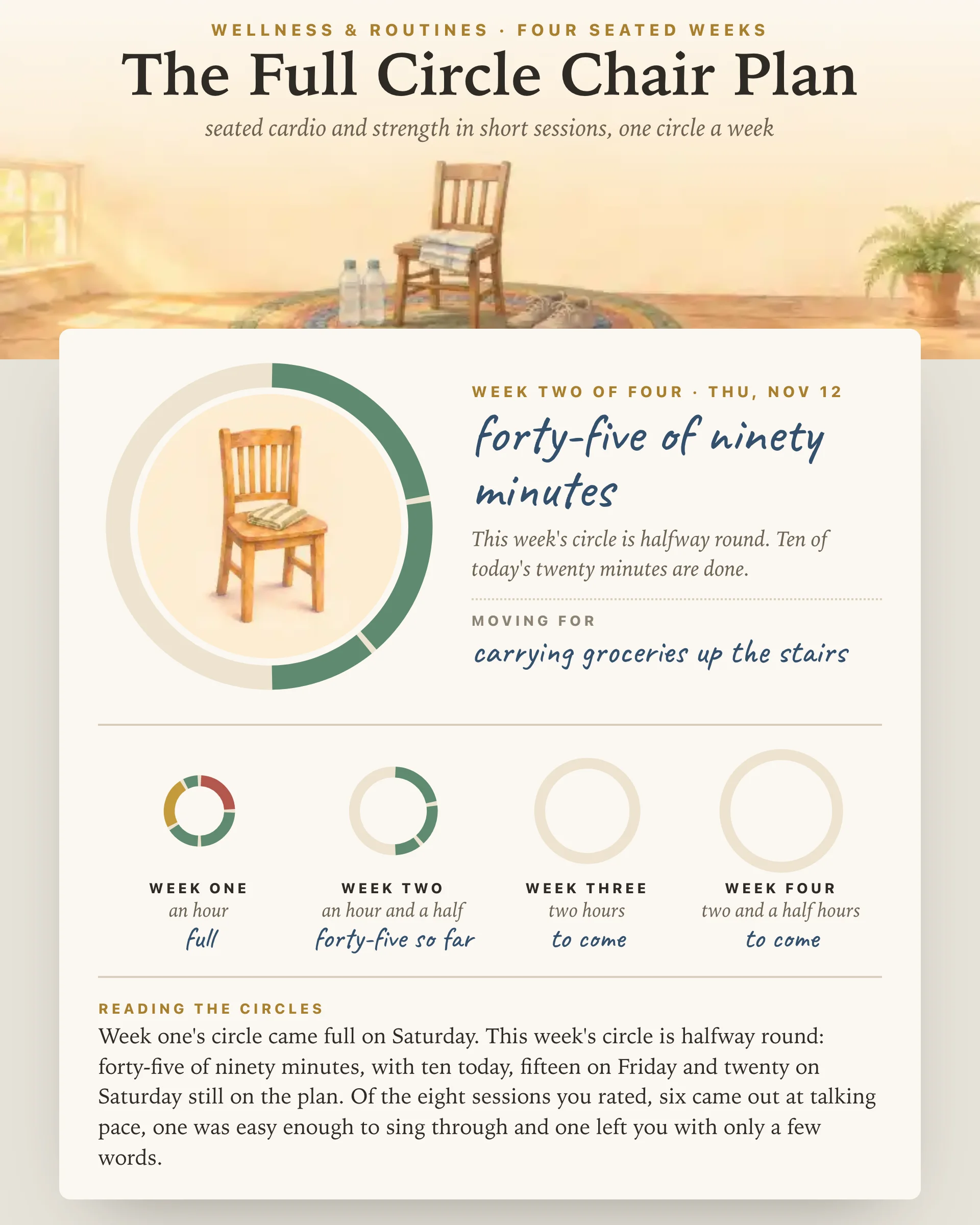
Chair exercises for weight loss suit people who want to move more but find standing workouts hard: sore knees, shaky balance, or a long gap since the last class. This page gives you four weeks of seated sessions, a timer that walks you through each one, and a circle for every week that fills as the minutes go in.
Start with the honest part. A Cochrane review of forty-three exercise trials in adults with overweight found that exercise alone produced small weight losses, and that exercise added to a change in diet did better than diet on its own. The same review found improvements in blood pressure, blood fats and fasting blood sugar even where little weight came off. The American College of Sports Medicine position stand reached a similar place: one hundred and fifty to two hundred and fifty minutes a week of moderate activity helps prevent weight gain but brings only modest loss by itself, and strength training does not speed up weight loss, though it may help you keep muscle while you lose fat.
So this plan makes no promise about the scale: movement works alongside what you eat, how well you sleep and time. What the plan can promise is a steady habit of moving most days, which matters for your heart, your strength and your mood whatever the number says.
Belly fat deserves its own sentence, because it is the most searched version of this question. You cannot choose where fat comes off. In a six-week trial of abdominal exercises, the exercise group's core muscles got stronger, but their belly fat measurements did not change. It was a small study in younger, sedentary adults, so read it as one piece of evidence. Seated core work is still worth doing; it just is not a spot remover.
The plan starts at one hour in week one, four days of fifteen minutes, and climbs to an hour and a half, then two hours, then two and a half hours in week four. That last figure matches the lower end of the World Health Organization's 2020 guidelines, which ask adults for at least a hundred and fifty minutes of moderate activity each week and add that some activity is better than none. From week three, a few days ask for thirty minutes, which you can split into a morning and an afternoon session. Two days a week are always rest.
Each session is ten, fifteen or twenty minutes long:
Every move has a gentler version, one tap away even in the middle of a session.
When a session ends, the page asks how talking felt while you moved. If you could talk in full sentences but could not have sung, you were at moderate effort, which is what the guidelines count. If you could have sung, move a little bigger next time: march faster, punch farther, lift the knees higher. If only a few words came, ease off and use the gentler versions. Each answer colors that session's arc, so you can see at a glance where most sessions landed.
Pick a length and press start. The timer keeps real time, so a phone that locks halfway through does not lose your place. When the time is up, the minutes go into this week's circle and the four-week grid marks the day. If you moved another way, such as a class at the community center, open the day and add it. Removing a session takes two taps, so nothing disappears by accident.
Below the plan sits a short list of reasons the scale cannot show, such as carrying groceries upstairs without stopping. Write up to three. On a week when the scale sits still, those are often the changes you notice first.
Speak with your doctor or a physical therapist before starting if you have had a fall, get dizzy, have had a joint replaced, live with a heart or blood pressure condition, or have pain that does not settle. Set the chair against a wall, choose one without wheels or arms that wobble, and keep a counter within reach when you stand up for sit to stand. Stop any move that hurts, and stop the session if you feel chest pain, faintness or a racing heart.
If you would rather build each session around legs, arms or core, The Chair Circuit times a seated circuit to the minutes you have. For slower stretching on rest days, The Chair by the Window is a gentle chair yoga routine. And if walking is comfortable for you, the Walking Plan for Weight Loss pairs well with this one. For one seated cardio session to music, The Chair Cardio Mixtape sets a steady beat to move to.
They help as one part of the picture. Reviews of exercise trials find that moving more on its own brings only small changes on the scale, and bigger ones when it goes along with changes in eating. What seated exercise does well is give people who find standing workouts hard a way to move most days, which supports heart health, strength and mood whatever the scale does.
No exercise takes fat from one chosen spot. In a small trial where adults did abdominal exercises five days a week for six weeks, their belly fat did not change, although their core muscles got stronger. Seated core and strength work is still worth doing; fat comes off the whole body slowly as eating, movement and sleep shift together.
World Health Organization guidance asks adults for at least a hundred and fifty minutes of moderate activity a week. This plan starts at one hour in week one and climbs to two and a half hours by week four, at an effort where you can still talk but could not sing.
Chair yoga is mostly stretching, posture and slow breathing. It is good for flexibility, calm and getting comfortable with movement, but it raises your heart rate far less than seated marching or punches. Use it as a cool-down or on rest days, and let the brisker seated rounds carry the weekly minutes.
For most older adults they are a sensible place to begin. Speak with your doctor or a physical therapist first if you have fallen, felt dizzy, had a joint replaced, live with a heart or blood pressure condition, or have pain. Use a chair without wheels set against a wall, pick the gentler versions on harder days, and stop if anything hurts.
By the team behind Fabulous, the science-based self-care app used by over 30 million people.


