Leaves on a StreamEmotional Fitness · ~3 min
About this template · Updated September 2026
Credit first. The three-column technique, which its author calls the triple-column technique, comes from the psychiatrist David D. Burns and his 1980 book Feeling Good: The New Mood Therapy; his own site is the place to read about his work. This page is an independent practice sheet built on his idea, and Dr. Burns had no part in it and has not endorsed it.
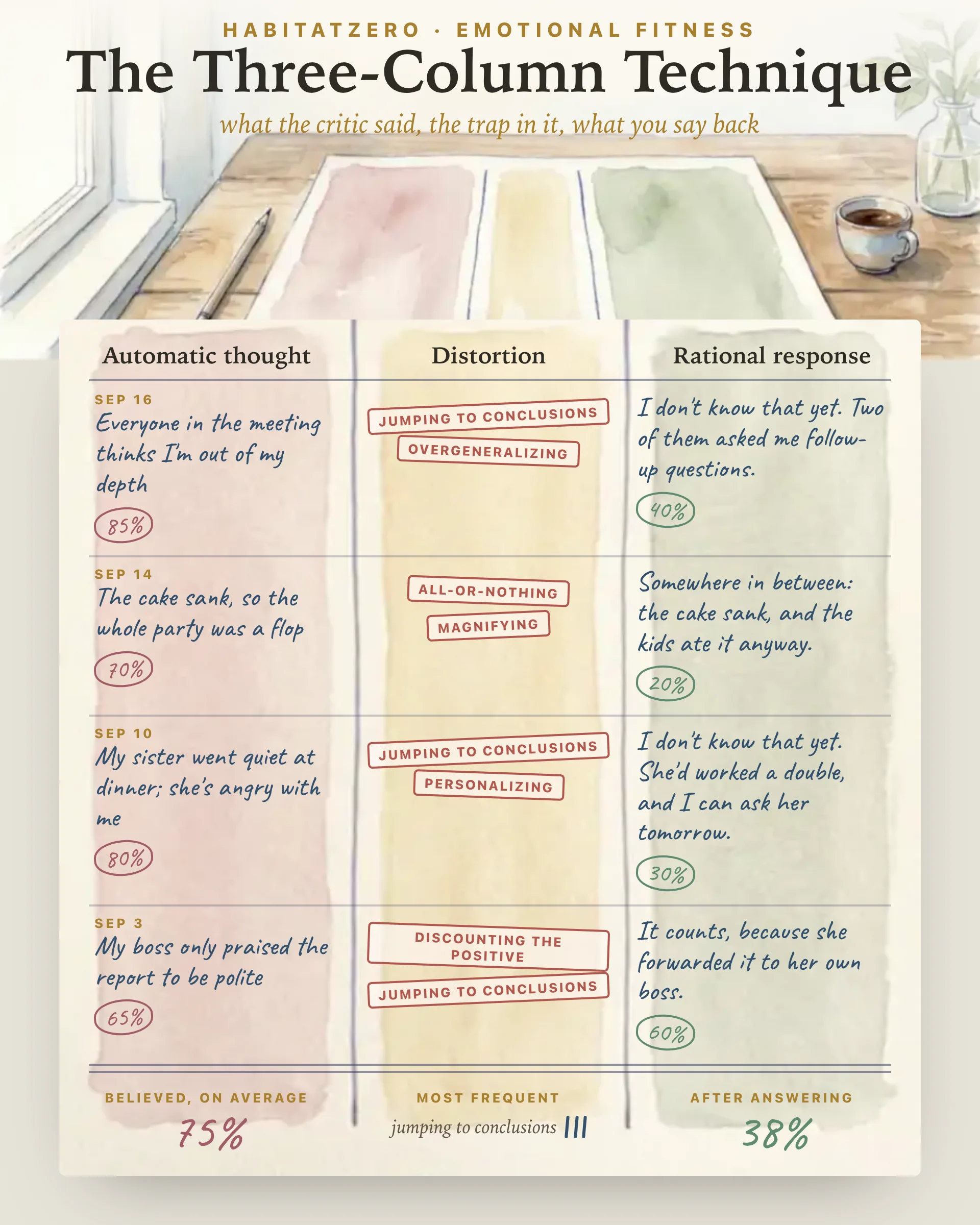
In the book, the technique sits under a blunt instruction: talk back to the internal critic. You draw two lines down a sheet of paper so it falls into thirds. The left column, headed Automatic Thoughts (Self-Criticism), catches the harsh sentence as your mind produced it. The middle column, Cognitive Distortion, names the thinking error inside it. The right column, Rational Response (Self-Defense), holds your answer. Burns's own example is someone running late for an important meeting whose mind announces that they never do anything right, which goes in the middle column as overgeneralization.
The first column is easy; most of us hear the critic perfectly well. The third is where people stall, because a thought argued with head-on tends to win. The middle column changes the terms. Once they all think I'm hopeless is labeled jumping to conclusions, you are no longer weighing whether you are hopeless. You are checking a sentence for a known flaw, a smaller job with an answer.
Burns works from a list of ten distortions: all-or-nothing thinking, overgeneralization, the mental filter, discounting the positive, jumping to conclusions, magnification or minimization, emotional reasoning, should statements, labeling, and personalization. If those names are new, a few rounds of the Thinking-Trap Spotter teach them on sample thoughts first.
The book is firm on this. Burns tells readers not to cheer themselves up with rationalizations they do not believe, and to write down what is actually true instead. So a good third column is both kinder and more accurate than the first. I'm a terrible parent does not become I'm a wonderful parent. It becomes something like I snapped once this morning, apologized, and still got everyone out the door, which is gentler and closer to the facts.
The worksheet is the sheet itself, painted: a rose column for the thought, a wheat column for the trap, a sage column for your answer. Write the thought on the left and slide to show how much you believe it right now. In the middle, ink up to three of the ten stamps, each with a plain definition; when your wording often points to a trap, as always or should do, that stamp gets a gold ring. The ring only hints, and the stamping stays yours. On the right, openers matched to your stamps help you start, and a second slider records how much you believe the old thought once you have answered it.
A note on the numbers. In the book, Burns suggests scoring how upset you feel before and after the exercise. This sheet scores how strongly you believe the thought instead, the measure his later Daily Mood Log uses for each negative thought, because it shows whether your answer reached the thought itself.
Each finished row lands on the page with its date, and a totals line does the arithmetic: average belief before answering, average after, and a tally of the traps you stamp most. From the third row on, the sheet names your most frequent trap and flags any row where belief barely moved. When no answer comes, Burns suggests leaving the thought for a few days and returning to it, and the same patience suits a stuck row.
The book itself has been tested. In a randomized trial with eighty adults with depression, people who read Feeling Good with minimal contact from the researchers improved more than a waiting-list group, held their gains three months later, and reported fewer automatic negative thoughts. A separate experiment in volunteers found that a single session with a thought record loosened belief in a target thought compared with a control condition, although testing the belief through a behavioral experiment shifted it a little sooner and more broadly.
Neither study isolates the three columns, the samples were small, and the book trial involved mild to moderate depression. A sheet on a screen is practice, not treatment. If low mood has lasted for weeks, or the same thoughts keep winning however you answer them, a CBT therapist can take this work further with you.
Use it the day a harsh sentence shows up, while you still remember its wording: after a meeting that went sideways, a message left on read, a mistake that grew in the retelling. Burns suggests about fifteen minutes a day for a month or two, and says it gets easier with practice. When a thought needs more room, the Thought Record Journal adds the situation, your feelings and the evidence on each side. If what keeps coming back is a worry about tomorrow rather than a verdict on yourself, the Worry Journal suits that loop better.
If the harsh voice turns to thoughts of suicide or of hurting yourself, that is not a thought to argue with on paper. Call or text 988 in the US, or your local emergency number, and talk with someone now.
It is a short written exercise from cognitive therapy. You split a page into three columns: the automatic thought on the left, the cognitive distortion hiding in it in the middle, and a rational response on the right. Putting all three in writing slows a harsh thought down enough to check it.
Psychiatrist David D. Burns set it out in his 1980 book Feeling Good: The New Mood Therapy, drawing on the cognitive therapy he learned as a student of Aaron Beck. Our painted three-column sheet is an independent take on the method, with no tie to Dr. Burns and no endorsement from him.
Burns lists all-or-nothing thinking, overgeneralization, the mental filter, discounting the positive, jumping to conclusions, magnification or minimization, emotional reasoning, should statements, labeling, and personalization. On this sheet each one is a stamp with a plain definition, and one thought can carry up to three of them.
The three-column version keeps only the thought, the distortion and the reply, so one row takes a few minutes. Longer thought records add the situation, your feelings and their strength, and the evidence for and against the thought, which helps when a sentence needs a closer look.
In a trial with eighty adults with depression, reading Feeling Good, which teaches this method among others, beat a waiting list, and one session with a thought record has been shown to loosen belief in a target thought. It is self-help rather than treatment, and a CBT therapist can help when the same thoughts keep winning.
By the team behind Fabulous, the science-based self-care app used by over 30 million people.