Leaves on a StreamEmotional Fitness · ~3 min
About this template · Updated September 2026
This technique has a paper trail. Paul Salkovskis sets out the responsibility pie chart in Understanding and treating obsessive-compulsive disorder, where he calls it one of the most helpful ways to loosen an inflated sense of responsibility, and Christine Padesky and Dennis Greenberger teach a responsibility pie for guilt and shame in their Mind Over Mood workbook. This page is an independent tool for practicing the published method; none of those authors built it, reviewed it or endorse it.
Guilt keeps a lopsided ledger. When something goes wrong and you could have done anything at all differently, the thought arrives fully formed: it was my fault. Salkovskis describes the rule underneath as all-or-nothing thinking, where being able to influence a bad outcome in any way means being responsible for it. Hindsight makes the rule stick, because once you know how things ended, the warning signs look obvious and the ordinary moment you looked away starts to look like a choice.
A pie chart argues with that rule in the one language it respects, which is proportion. There is a single circle, it adds up to a hundred, and every person and condition that played a part needs room in it. You cannot keep ninety for yourself without leaving ten for everything and everyone else.
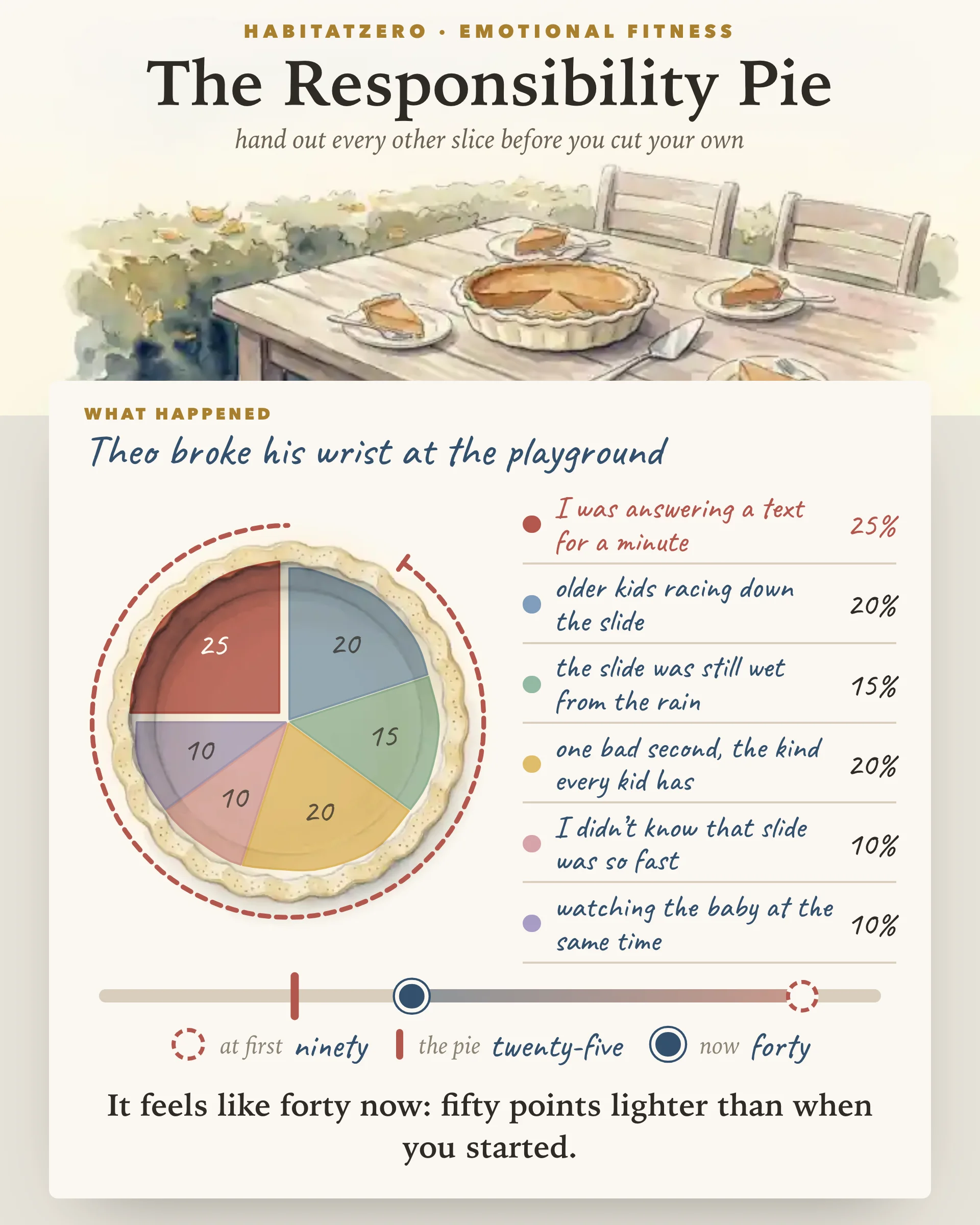
Start with what happened, in a few words, and slide to show how much of it feels like yours right now. Then write your own part: what you did, or didn't do. In Salkovskis's version your own contribution goes at the top of the list and gets sized last, and the page keeps that order.
Next you hand out slices. Five questions keep the list honest: who else was part of it, what the circumstances were, what was plain bad luck, what nobody could have known at the time, and what pressures were on you or on everyone. Tap a suggestion or write your own, then size each slice with the steppers or by dragging a cut around the rim of the dish. The dish takes up to eight other slices, and a dashed line along the rim keeps your first rating in view while you work.
When the list is done, cut your slice last. It is whatever is left on the dish, and it lifts out on its own. Then rate again. A line running from none of it to all of it marks three points: how it felt at first, what the pie leaves you, and how it feels now. Put the finished pie on the shelf. After two or three, the shelf tells you which kind of slice you most often leave out of your first count, which is the pattern worth watching.
The idea behind the pie has direct experimental support. In a study of thirty people with obsessive-compulsive disorder, lowering how responsible they felt was followed by clear drops in discomfort and in the urge to check, while raising it produced increases too small to be significant. That study tests responsibility itself, though, not the pie.
The treatments the pie belongs to have strong results. A review of thirty-seven trials of cognitive behavioral treatments for OCD found very large effects against waiting lists, and little difference between the exposure-based and the cognitive versions. Those trials test whole courses of therapy, so they cannot say how much one pie adds on its own.
Salkovskis attaches two cautions. The point is not to prove you carry no responsibility at all; it is to see that responsibility comes in shades rather than all or nothing. And going over an event in finer and finer detail tends to breed doubt instead of settling it. Cut one pie per event, read it, and stop.
Reach for it after a mistake at work, a fight you regret, an accident on your watch, or any outcome that has quietly become all yours. You can also cut a pie for something that hasn't happened, the harm you worry you might cause. If part of the pie really is yours, that slice points toward a repair or an apology, which Mind Over Mood treats as a step of its own.
This is self-help practice, not treatment. A CBT therapist can help, especially with guilt that won't let go, or with OCD, where the pie is one part of a treatment plan that also includes exposure. If blaming yourself ever turns into thoughts of hurting yourself, put the pie down and reach a person today: call or text 988 in the US, or your local emergency number anywhere else. If one stubborn thought keeps coming back after the pie, take it through the Thought Record Journal. If claiming blame is a habit, the Thinking-Trap Spotter names it personalization and helps you catch it early, and The Circle of Control sorts what is yours to act on next.
It is a cognitive therapy exercise for guilt and inflated responsibility. You list everyone and everything that fed into a bad outcome, give each a share of one circle, and size your own share last, so the chart shows how many hands were on it.
Rate how responsible you feel before you start. List your own part, then every other person, condition and piece of luck involved. Size all of those slices before yours, so your share is simply what remains, and finish by rating your responsibility again.
Yes. In CBT for obsessive-compulsive disorder it is a common way to loosen an inflated sense of responsibility for harm, used alongside exposure work. With OCD it belongs inside treatment with a therapist, and one pie per worry is enough, since going over an event again and again tends to feed doubt.
Guilt is one of its main uses. It separates the part that was yours from the parts that were not, and Greenberger and Padesky list it among their strategies for guilt and shame in Mind Over Mood. If a real slice is yours, the next step is a repair or an apology rather than more self-blame.
The filled example on this page is open to anyone. Cutting your own pies and keeping them on a shelf happens in HabitatZero, which costs nothing to use.
By the team behind Fabulous, the science-based self-care app used by over 30 million people.