
The Overwhelm Recovery ProtocolWellness & Routines · ~5 min
About this template · Updated November 2026
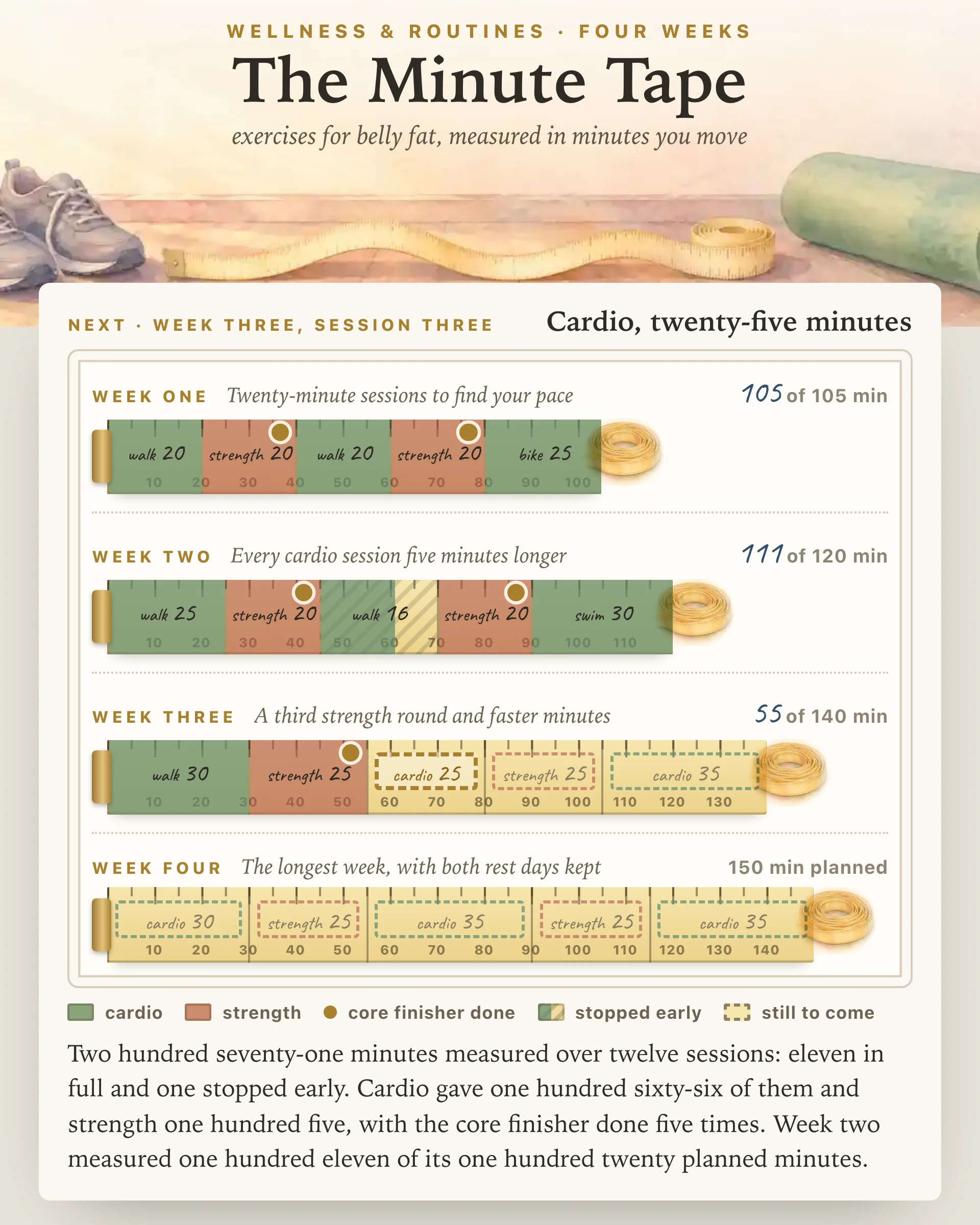
Search for exercises for belly fat and you will mostly find short lists of moves that promise to trim your middle. The plain answer first: no exercise burns fat from your belly in particular. Fat leaves the whole body, in an order you do not get to choose. What exercise can do is add up, session after session, and that running total is what studies link to less fat deep in the belly. This page gives you four weeks of sessions built to add up, a timer that runs each one, and a tape that measures the minutes you actually did.
Spot reduction has been tested. In one six-week trial, twenty-four sedentary adults were split into a group doing seven abdominal exercises five days a week and a group doing nothing new. By the end the exercisers managed more curl-ups, yet their belly fat, overall body fat and waist measurement had not moved. It was a small study of people aged eighteen to forty, and it says nothing against a strong core. It simply shows that working a muscle does not melt the fat lying over it.
Exercise for the whole body is another story. A review of fifteen studies covering 852 people found that exercise with no diet attached still reduced visceral fat, the deep fat packed around the organs, and that aerobic training at moderate or high intensity showed the most promise. An eight-month trial then compared kinds of training side by side: aerobic training reduced fat mass more than resistance training, and adding resistance work to aerobic work did not trim more fat, though only the groups doing resistance work gained lean muscle. So cardio carries the fat side of this plan, and the strength days look after your muscle.
What you eat, how you sleep and plain time shape a waistline as well, and no page of exercise can honestly promise a number of inches or pounds. It can make the moving part steady.
Each week holds five sessions and two rest days. Cardio sessions start at twenty minutes and grow to thirty-five: three easy minutes, a brisk middle where you can talk in short sentences but could not sing, and two easy minutes to finish. Brisk walking is the default; cycling, swimming, dancing, stairs or marching at home count the same.
Strength comes twice a week: a chair squat, a counter push-up, a backpack row, a glute bridge and a supported lunge, forty-five seconds each, two rounds at first and three from week three. A five-minute core finisher follows, made of dead bugs, bird dogs, forearm planks, side planks and slow climbers. Every move on the card has an easier version, and each floor move has a standing one.
The timer talks you through every block and keeps true time even if your phone locks in a pocket. When a session ends in full, its whole stretch of tape fills in. Stop early and only the whole minutes you finished go on, hatched, and a strength set abandoned halfway counts for nothing, so the tape never claims more than you did. Swam without your phone? Set the minutes you really managed and put them on by hand.
From week three, some cardio sessions slip in one faster minute out of every five. A meta-analysis of thirty-nine studies found that high-intensity interval training reduced total, abdominal and visceral fat, although the routines varied widely and the authors call for larger trials before naming a best one. Treat those minutes as extra effort without extra time, never as a shortcut, and stay brisk if one leaves you dizzy or unusually breathless.
A tape around your middle is the obvious way to keep score, and the page allows it quietly. Measure once at the start and again after weeks two and four, standing tall, with the tape level just above your hip bones after an easy breath out, at the same time of day each time. Waist readings move slowly and drift with meals and water, so four weeks may show no change while the habit does its work. Every reading is set only against your own first one, and the page never names a target.
If you have had a fall or dizzy spells, a joint replacement, a heart or blood pressure condition, pain that keeps returning, or a baby within the past year, check with your doctor or a physical therapist before the first session. Stop any move that hurts. Keep a sturdy chair or the kitchen counter within reach whenever you step back into a lunge or balance on one leg, and use the standing versions if getting down to the floor and up again is hard.
If your larger goal is weight loss and you want a planner that tracks showing up instead of the scale, the Training Consistency Planner sits well beside these four weeks. For cardio days outdoors, a walking session cut to the time you have gives each walk some shape. And if counter push-ups feel like too much at first, the wall push-up ladder builds you up to them one step back from the wall at a time. If you are over fifty and want brisk walks at the center, The Three-Track Peg Board lays out four weeks of walks, two strength days and a short core finisher.
No exercise pulls fat from the belly in particular. What helps a waist over time is movement you can repeat: cardio such as brisk walking or cycling on most days, plus strength training two or three days a week. Steady aerobic work has the clearest link to less deep belly fat in studies, strength work protects your muscle, and sleep and eating count alongside both.
They build the muscles under the fat, not a smaller layer on top. In a six-week trial, adults doing abdominal exercises five days a week gained endurance in those muscles while their belly fat and waist size stayed put. That is why core work here is a short finisher after strength days rather than the whole plan.
For the fat itself, aerobic exercise has the stronger evidence. In an eight-month trial, aerobic training cut more fat than resistance training alone, while the resistance groups gained more muscle. Doing both gets you both, which is why this plan alternates them.
The way you lose any belly fat: from the whole body, slowly. Where fat settles and which part shrinks first depends largely on things you do not pick, such as genes, age and hormones, and no lower ab move changes that order. Regular activity, strength work, sleep and eating move the whole picture.
Usually longer than workout videos suggest, and it varies a great deal between people. The trials that measured deep belly fat mostly ran for three months or more, while gains in fitness and stamina usually show up well before any change on a tape. Four weeks is a beginning, which is why this page counts minutes instead of inches.
By the team behind Fabulous, the science-based self-care app used by over 30 million people.


