
The Overwhelm Recovery ProtocolWellness & Routines · ~5 min
About this template · Updated November 2026
Barre as a workout started with Lotte Berk, a German-born dancer in London who, in 1959, built a method of exercise from ballet positions and music for people who had never danced. Today's barre classes descend from it. This page is our own take on that tradition: no studio, teacher or estate tied to her name has had a hand in it or given it their blessing.
Doing barre at home asks for very little: something steady at hip height to rest a hand on, a mat or a soft rug, and a pair of light weights. A kitchen counter is the classic stand-in for the rail. The back of a heavy dining chair works too, if it has no wheels, does not fold and stays put when you lean on it. Two cans of soup will do for weights at first.
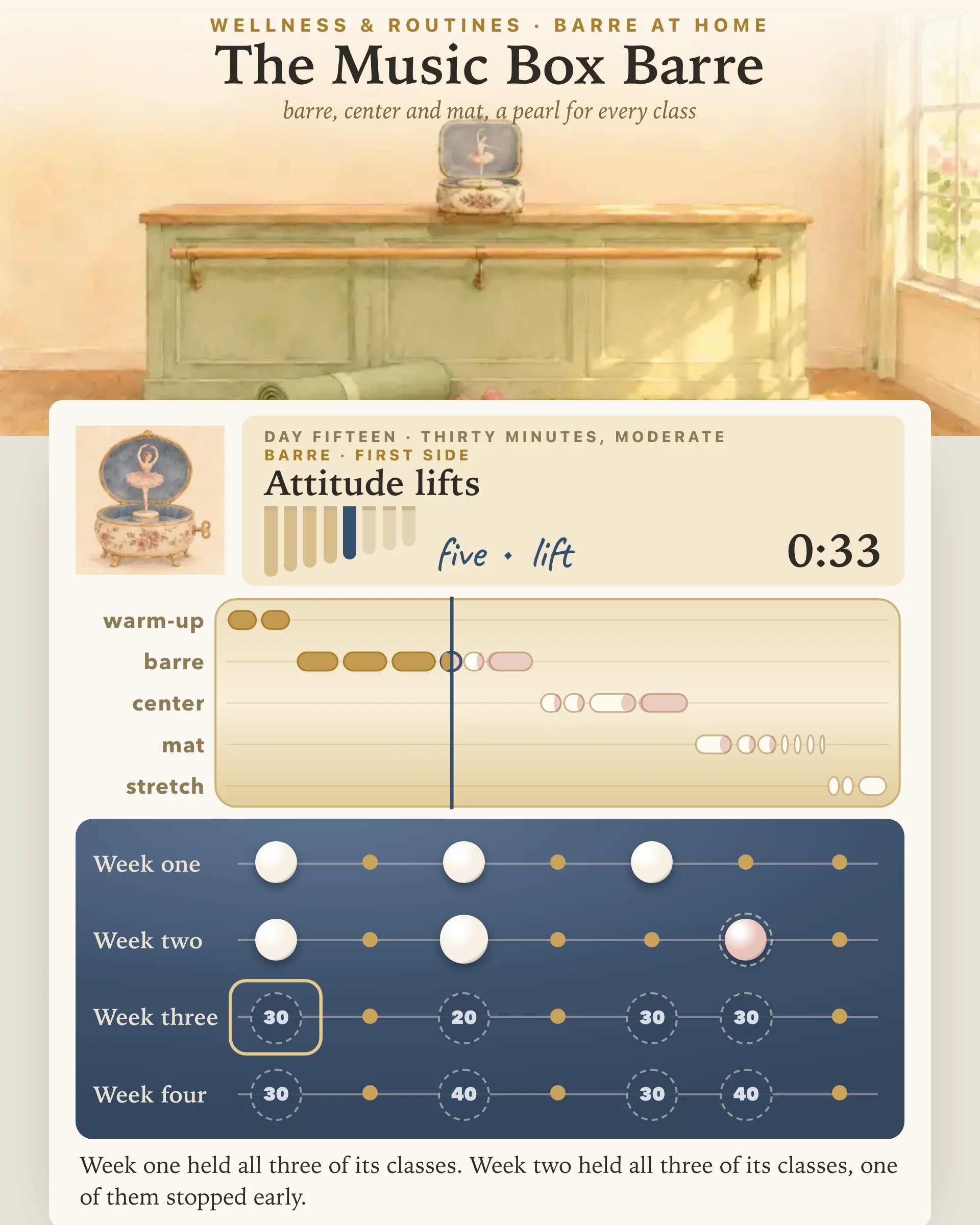
You choose twenty, thirty or forty minutes, and the class runs in five parts:
The barre always gets the biggest share. A thirty-minute class gives three minutes to the warm-up, eleven to the barre, seven to the center, six to the mat and three to the stretch.
Each move opens with a few seconds to get set. Then a comb of eight teeth lights up one count at a time, with the word for that count beside it: down, up, lift, lower. One-sided moves switch sides halfway through, and the plank counts each hold down in seconds, with ten seconds of rest between.
The page makes no sound, so play any music you like. The clock works from real time: if your screen locks on the mat, the class is still in the right place when you look back. Pause stops it, skip moves past a move that does not suit you today, and stop ends early while keeping the minutes you did.
Gentle keeps the counts slow, mostly four down and four up, with smaller ranges and very light weights or none. Moderate counts two and two and finishes most moves with pulses, the inch-down, inch-up movement barre is known for. Strong is quicker still, with longer pulses and a thirty-five-second plank instead of fifteen. The small print under each move changes too: at gentle, second-position pliés keep both hands on your barre.
The plan holds fourteen classes:
When a class ends, you thread its pearl on that day of the strand. Longer classes make bigger pearls, the color shows the level, and a class stopped early gets a dashed ring. Tap where you felt the work most, and the reading tallies those places, compares your minutes with the plan, and suggests the next level after three whole classes in a row. The strands carry no dates, so a missed Tuesday simply waits.
Barre itself has hardly been studied. The closest match to this page is a 2025 trial of walking and barre in women aged sixty-five and over: twenty-seven women, nine each in a barre group, a walking group and a group that did not exercise, for twelve weeks of fifty-minute sessions three times a week. Scores on a depression questionnaire fell in both exercise groups and rose in the inactive one. Nine people per group is far too few to say barre beats walking, or to promise anything about mood.
The broader evidence concerns strength work. The Physical Activity Guidelines for Americans advise muscle-strengthening activity on two or more days a week for adults, and for older adults a mix that includes balance training. A meta-analysis of resistance exercise in adults aged fifty and over, pooling forty-seven studies, found strength improved across the board, with larger gains from harder training. Barre uses light loads and many repetitions, the gentle end of that range: a pleasant way to build a strength habit, not a substitute for heavier lifting if that is your goal.
Talk to a doctor or physical therapist first if you have had a fall, dizzy spells, a joint replacement, back trouble, a recent pregnancy, a heart or blood pressure condition, or ongoing pain. Keep a hand on the counter for every standing move on one leg, and stop any move that hurts.
If getting down to the floor is hard, The Kitchen Chair Barre keeps the whole class standing at the back of a chair. For heavier weights, try Strength Training for Women Over 40, and The Beginner's Pilates Mat goes deeper into the floor work. When you want the mat work as a full class, The Mat Pilates Class Deck deals one in the traditional order.
Yes. A kitchen counter at hip height, or the back of a heavy chair that cannot slide or fold, does the same job. Rest a hand on it for balance rather than leaning your weight into it, and keep a mat beside it for the floor part of the class.
It borrows the positions of a ballet class, such as pliés and relevés, and mixes them with small strength moves for the legs, seat, arms and middle. The ranges are small and the counts run long, so the muscles tire through repetition instead of heavy loads.
This plan holds fourteen classes over four weeks: three a week at first, then four, with a rest day after most of them. Classes grow from twenty minutes to forty, and a shorter class on a busy day still earns its pearl.
It counts as muscle-strengthening work, which US guidelines advise on two or more days a week. Barre keeps the weights light, though, and research in older adults ties harder resistance training to bigger strength gains, so many people pair it with a plain strength plan.
No. Barre classes trace back to Lotte Berk, a dancer who began teaching her method in London in 1959, and countless teachers have changed it since. This page was made independently, and nobody connected with her name has seen it or approved it.
By the team behind Fabulous, the science-based self-care app used by over 30 million people.


