
The Overwhelm Recovery ProtocolWellness & Routines · ~5 min
About this template · Updated November 2026
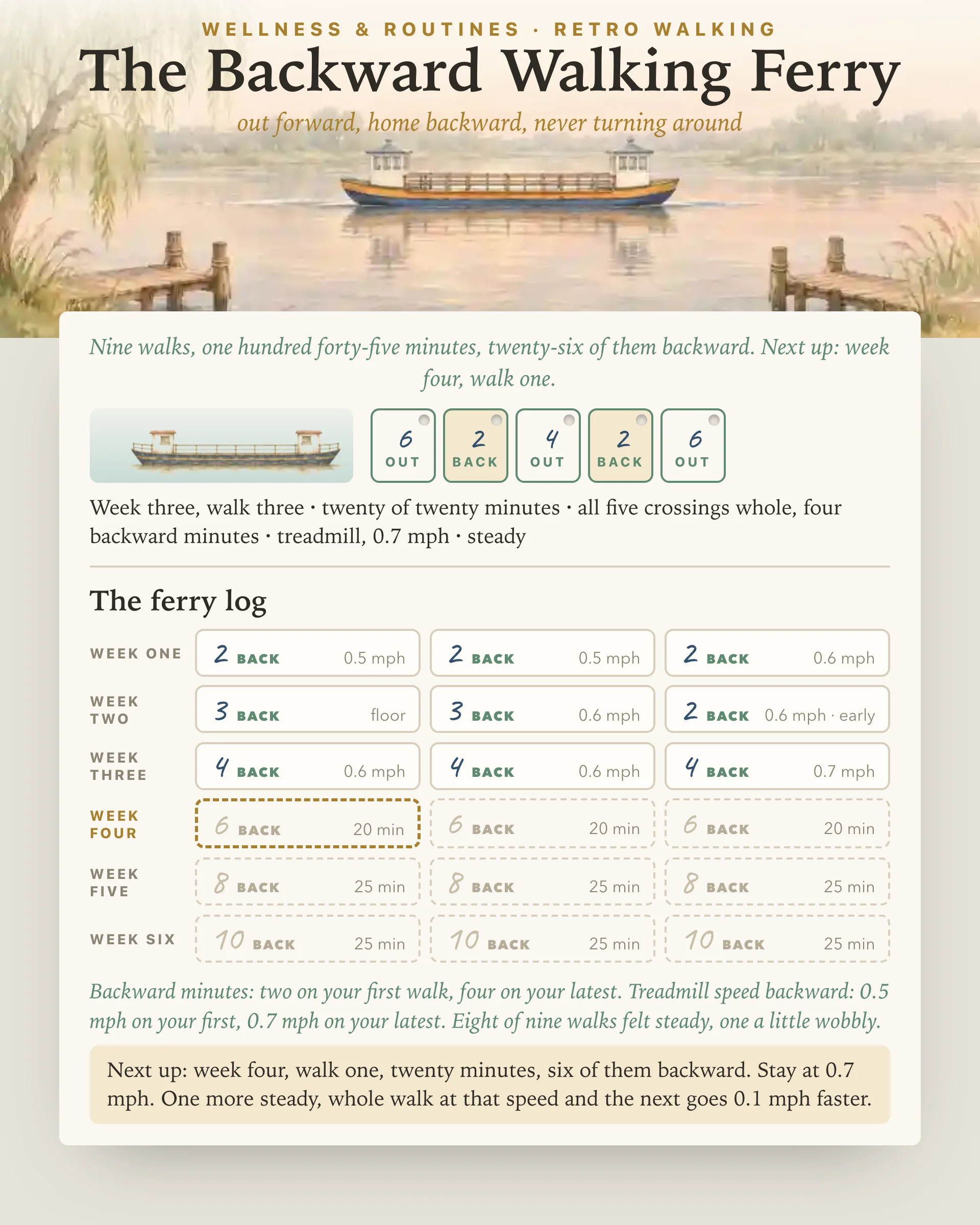
Walking backwards on a treadmill looks strange and feels stranger for the first half minute. Your foot searches for the belt behind you, your hand finds the rail, and each step lands toe first instead of heel first. Backward walking, also called retro walking, works the legs in a pattern most of us never practice, and it rewards a slow, attentive pace.
This page is a six-week plan for three days a week. Each walk is an ordinary walk with backward minutes folded in, two in the first week and ten by the sixth, always in short crossings with forward walking on either side.
Some river ferries have a wheelhouse at each end, so they cross out and come home without turning around. Every walk here has that shape. Each crossing is a paper ticket: out means forward, back means backward, and the number is its length in minutes. In week one the strip reads five minutes forward to warm up, one backward, three forward, one backward and five forward to cool down, fifteen minutes in all.
Tap cast off and a silent timer walks you through it, punching a ticket only when its whole time runs. At every change of direction the clock waits, so on a treadmill you can stop the belt, hold both rails and turn before any time counts. It keeps true time even if your phone locks. Dock early and only whole minutes go in the log. A dizzy or unsteady stop takes one tap, keeps what you did and marks the walk unsteady.
The belt follows a start-low rule. Your first backward speed is 0.5 mph, and the page suggests a tenth of a mile an hour more only after two treadmill walks in a row at one speed that ran whole and felt steady. It never lets you set a speed above its suggestion, and an unsteady walk steps the next one down. The ferry log sets each walk only against your own earlier ones.
Stop if you feel dizzy or if anything hurts. Before your first walk, check with a doctor or physical therapist if you have fallen in the past year, use a cane or walker, get dizzy, have a heart or blood pressure condition, or have had a hip or knee replaced.
The clearest evidence comes from knee osteoarthritis. In a randomized trial from a rehabilitation research group in Saudi Arabia, 68 adults aged 45 to 66 with mild to moderate knee osteoarthritis added ten minutes of supervised backward walking to usual physiotherapy, three days a week for six weeks. They had less pain and better function at the end than a group who had physiotherapy alone. They did not do clearly better than a third group who walked forward instead, the groups were small, and nobody was followed up afterward. Ten backward minutes three days a week is roughly where this plan ends.
A 2025 review by physical therapy researchers in Taiwan pooled thirteen randomized trials and found moderate to large drops in pain and disability when backward walking was combined with usual rehabilitation. Its authors say the effect on its own, how long it lasts and how sure the evidence is still need study. An earlier review from South African physiotherapists of 21 studies and 635 people agreed for knee osteoarthritis, rated the studies middling in quality, and found too little evidence for other walking problems.
Backward walking also costs more effort. When exercise scientists at a US university had seventeen young adults walk at 3.5 mph, heart rate, oxygen use and how hard it felt were all higher backward than forward. That study included no older people, but it is one reason the belt starts slow here. None of these studies shows that backward walking prevents falls, helps with weight loss or eases back pain, and the knee trial above was supervised in a clinic, not done alone at home.
This page only adds backward minutes. To walk in place around a room, try The Living Room Mile. To shape an everyday forward walk with an easy start, a push and a slow finish, the walking ribbon cuts it for you, and for a steep incline at a steady pace there is the incline treadmill tracker. If backward steps feel shaky even beside a wall, spend a few weeks on The Balance Ladder at a counter first.
Start once you can walk forward for fifteen minutes with ease, on days you would walk anyway. If walks keep feeling unsteady even on the floor, ask a physical therapist to watch you try it.
In small trials of people with knee osteoarthritis, adding backward walking to usual exercise care eased pain and helped daily function over two to six weeks. Those trials were short, and in one trial of 68 adults backward walking did not clearly beat ordinary forward walking. Claims beyond that, such as weight loss or fewer falls, have not been shown.
Slower than you expect. This plan starts at 0.5 mph with a hand on the rail, because the same speed feels harder backward than forward. It suggests a tenth of a mile an hour more only after two steady, whole walks in a row at one speed. If your belt cannot go that slow, practice on the floor beside a wall.
Retro walking is another name for backward walking: stepping back on purpose, the toes reaching behind you first and the heel rolling down after. Physical therapists sometimes add a few minutes of it to knee rehabilitation, alongside the usual strengthening exercises.
Two minutes is plenty at first, split into one-minute crossings inside a fifteen-minute walk. Over six weeks this plan grows that to ten backward minutes a walk, three days a week, which is about what one knee trial used.
Anyone who has fallen in the past year, uses a cane or walker, gets dizzy, has a heart or blood pressure condition, or has had a hip or knee replaced. A doctor or physical therapist can say whether the belt, the floor beside a wall or neither suits you.
By the team behind Fabulous, the science-based self-care app used by over 30 million people.


