
The Overwhelm Recovery ProtocolWellness & Routines · ~5 min
About this template · Updated November 2026
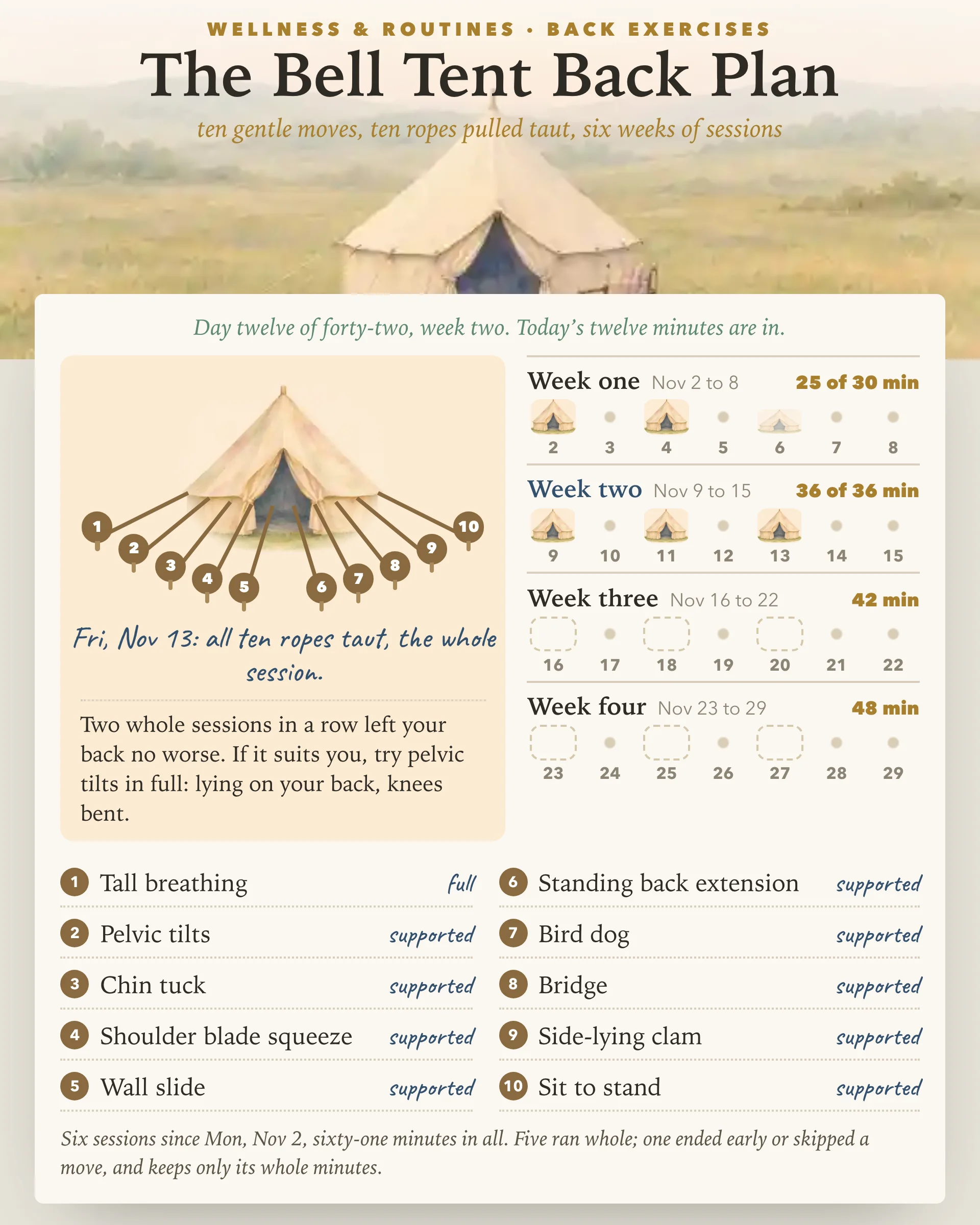
A bell tent stands because its ropes pull evenly from every side and its pegs hold fast in the ground. The muscles along your back and around your hips do a similar job for your spine. This page gives you ten gentle back exercises for seniors, a timer that keeps honest count, and six weeks to find out how your back takes them. It cannot cure back pain or promise you a back that never hurts.
See a doctor before any exercise if your pain is severe, began after a fall, or comes with numbness, a fever or weight loss you can't explain. Go the same day for new weakness in a leg or any change in bladder or bowel control: MedlinePlus lists these among the back pain signs to report to a provider right away.
With osteoporosis or a past spine fracture, leave out any forward bend that carries a load, such as a toe touch, a sit-up or lifting a basket with a rounded back. A UK consensus statement on exercise for osteoporosis advises avoiding postures with a high degree of spinal flexion and recommends exercise that extends the spine, which is why none of the ten moves curls you forward. Check with a doctor or physical therapist first, too, if you have had a fall, dizziness, a joint replacement, or a heart or blood pressure condition. Never move into sharp pain.
In session order:
Every move has a supported version, seated or holding a chair or counter, and a full one. The full bird dog, bridge and clam go on a firm bed or the floor, so pick them only if getting down and back up is easy for you.
Press begin and the timer takes you through all ten moves: a short get-set with the instructions on screen, then holds counted down or slow reps paced beat by beat. A hold counts only when its seconds run out. A set you stop partway keeps only the reps you finished, marked as cut short. Stop early and you keep only whole minutes, and skipped time never counts as done.
Each move has a rope on the painted tent that pulls taut once all its holds or sets have run in full. The six weeks sit below as rows of small tents: a whole session pitches that day's tent, and one cut short pitches it halfway. The plan is three sessions a week, growing from ten minutes to twenty.
After each session, or better the next morning, mark how your back took it: better, about the same, stiffer or sorer, or sharp pain, numbness or weakness. Two whole sessions in a row that leave your back no worse are the sign to try one move in full. One that leaves it stiffer or sorer, even a session you cut short, sends you back to the supported versions, and if your back is still worse after the next one, talk to a doctor or physical therapist. Sharp pain, numbness or weakness means stop and see a doctor.
The WHO guideline on chronic low back pain, published in 2023, covers adults including older people whose pain has lasted more than three months without a disease behind it. It lists structured exercise programs among the care that may be offered, and it rates the evidence behind that as low certainty.
Studies of older adults alone are thinner. A 2019 review of 18 randomized trials in people aged 60 and over with non-specific back pain found that exercise, like the other treatments it looked at, did not bring a clinically important drop in pain or disability compared with sham treatment, usual care or minimal care. The authors rated that evidence very low to moderate in quality and expected new trials to change it. A 2023 review of 31 trials with 2,120 older people found low-quality evidence that mixed exercise programs eased pain soon after the programs compared with no treatment, a waiting list or sham, and noted that most trials were small and weakly designed.
So the studies do not show that any one move is best, that benefits last beyond a few months, or that a sheet like this one matches a supervised program. They also cover only pain with no serious cause behind it, which is what the warning signs above are for. Treat these six weeks as a careful test of what your back tolerates.
The Plumb Line Posture Plan is a daily posture habit of five moves with a weekly wall check, and The Stiffness Map builds stretches around wherever you feel tight today. This plan strengthens the back and hips three days a week and listens to how your back answers. If thin bones are your main worry, The Osteoporosis Exercise Pagoda adds strength and balance days built for them, and The Espalier Pear adds yoga at a wall.
Gentle ones that work the muscles along your spine and around your hips and that you can do without getting down to the floor: pelvic tilts, chin tucks, shoulder blade squeezes, wall slides, a small backward lean at a counter, bird dog, bridges, clams and sit to stand. Studies in older adults have not crowned one best move, so a varied set you repeat each week is a sensible start.
For most older adults with everyday back pain, gentle exercise is a reasonable choice, and WHO guidance on long-lasting low back pain includes older people among those who may be offered it. See a doctor first if the pain is severe, followed a fall, or comes with numbness, leg weakness, fever, weight loss, or bladder or bowel changes, and stop any move that brings sharp pain.
Usually, with care and your doctor's agreement. Favor small backward leans and strength work, and leave out forward bends that carry a load, such as toe touches, sit-ups or lifting a laundry basket with a rounded back. After a spine fracture, a physical therapist can tell you which versions suit you.
This plan uses three sessions a week with a rest day between them, starting at ten minutes and reaching twenty by week six. Mild muscle soreness in the first week or two is common when a move is new, but back pain that is worse the next day is a signal to ease off.
The trials in older adults ran for weeks or months, and the average benefit they found was small and was mostly measured soon after the programs ended. Six weeks is long enough to learn the ten moves, settle on the right versions and see how your back responds. Nobody can promise a back free of pain.
By the team behind Fabulous, the science-based self-care app used by over 30 million people.


